Showing posts with label President Rutherford B. Hayes. Show all posts

Thursday, October 23, 2025

Oakwood Cemetery, Sandusky County, Fremont, Ohio


Oakwood Cemetery, Fremont, Ohio

Courtesy Find a Grave


Oakwood Cemetery was established in 1858 when James Vallette from Ballville Township sold twenty-six acres of beautiful oak woods to the newly formed cemetery association.  The location met the needs of the growing city of Fremont, Ohio and its surrounding area. Oakwood Cemetery was located two miles from the center of Fremont on the road to Tiffin along the Sandusky River.  The first recorded burial at the cemetery was Benjamin Munson on October 6, 1860.  Since that date more than 25,000 burials have been recorded. The cemetery has expanded as needed over the years.  Records can be viewed at the Hayes Presidential Library and Museums.

Oakwood Cemetery,  GAR Circle

Courtesy of Find a Grave


The Hayes Circle is located at the main entrance of the cemetery where sons and one daughter of President Rutherford B. Hayes and Lucy Webb Hayes are buried.  Webb Cook, and his wife,  Mary Miller Hayes are buried at Spiegel Grove near the burial site of the President and First Lady who were reinterred in 1915 by second son Webb Cook Hayes.


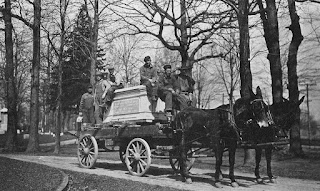
Oakwood Cemetery,  1915

For the complete story of the removal of the bodies of President Rutherford Hayes and Lucy Webb Hayes, please read the earlier Ohio's Yesterdays blog post (January 1918) by Meghan Wonderly-Kolbe, Annual Giving and Membership Coordinator at the Rutherford B. Hayes Presidential Library and Museums. 


Sunday, April 25, 2021

Grim: The Hayes Family's Favorite


From George Washington to Joe Biden, America’s presidents and their families have displayed great affection for their dogs. Perhaps none enjoyed this special bond more than the Hayes family. Their collection of canines included every size and shape. But the hands-down favorite was a beautiful brindle, mouse-colored greyhound named Grim, a gift from the DuPont family of Delaware. According to President Hayes, when the “good natured greyhound” arrived at Spiegel Grove, he “took all our hearts at once.”

 It was Grim’s special personality – his peculiarities – that endeared him to the family.  One day Lucy Hayes sang the Star Spangled Banner and “Grim lifted up his head and howled in a most pitiful manner.” And ever after when his mistress sang the national anthem, Grim began to howl. But if Hayes and the children were exceedingly fond of their “large, handsome” greyhound, it was Lucy whom Grim loved the best.  Hayes recalled, “How happy old Grim always was when she returned after an absence.” He was “lonely without her and unhappy.”

President Hayes and Lucy with Grim at Spiegel Grove
May 1887 

Lucy Keeler Photograph Collection

Had it not been for its many trees, Spiegel Grove would have suited Grim’s natural love for running to perfection. The sleek greyhound reached such speeds that “if a tree chanced to be in his way,” he would run headlong into it. Later, two pups fathered by Grim, Jove and Juno joined in these antics that so delighted the Hayes family. The three greyhounds raced around the grounds and if a door were open, they continued the chase inside. The family’s shepherd and little terrier were forever relegated to bringing up the rear.


                    Enlargement of Photo Showing Grim Beside Lucy

The president, believed that because of his size and appearance, Grim commanded respect from everyone who knew him. Wagons and carriages turned aside for him wherever he went. But Grim’s privileged status may have been his undoing. One spring day, while running on Lake Shore Railroad tracks, Grim encountered an oncoming train.  Instead of moving aside, he “stopped still.”  The engineer blew his whistle repeatedly, but Grim “did not stir.” Death was instantaneous. The president could only conclude that Grim fully expected “the train to turn out for him.”

 Hayes and Lucy were deeply affected by the loss of this much-loved pet. As soon as the frost was out of the ground. Hayes carried the remains of dear Grim to “cemetery point.”  He buried him there by his war horse Whitey.  Grim lies there still – only a few feet from the final resting place of the master and mistress to whom he had given so much joy.

Note: Taken in May 1887 by Lucy Keeler at Spiegel Grove with President Hayes and Lucy this photograph is the only known image of Grim. In the second picture, Photographic Curator Gil Gonzalez enlarged that portion  featuring Lucy with Grim by her side. 


Saturday, November 9, 2019

Plenty Coups Meets the "Great Father"


During the 19th century, tribal delegations traveled to Washington, D. C. to visit the president at the White House. The purpose of these visits was to negotiate new treaties and to impress tribes with the progress of America’s civilization. One of those who visited was respected warrior Plenty Coups, a representative of the Crow nation living in what is today Montana.  Because Plenty Coups could speak English, the tribe knew he could help them understand the negotiations. Later, Plenty Coups told about his visit in 1880 with President Hayes.

Plenty Coups wrote, “The President said that he had sent for us to talk concerning the future of our people. He said the he wanted us to send our children to school and that they would build a house and barn for each of us. He wanted us to learn to farm. He said they were going to build a railroad through the Yellowstone Valley, but that they wanted us to make peace with the other tribes in our part of the country.”

President Hayes asked Plenty Coups and his people to leave Montana and move to land in North Dakota.
                                                           

Plenty Coups

“I refused because we did not wish to leave our country.  When the President asked my reasons, I said that in North Dakota the mountains are low and that I wanted to live where the mountains are high and where there are many springs of fresh water … I said that he had asked us to do many things, but that before we could give him our answer, we would like time to talk it over among ourselves.”

The Crow leaders felt they were being held hostage until they agreed to a “yes-treaty.”  While delayed, they visited Mount Vernon, George Washington’s home.

“I was one among many visitors at Mount Vernon that day, and yet there was no talking, no noise, because we were thinking of the great past and the unknown future. When people think deeply they are helped, and in the silence there I sent my thoughts to the Great White Chief in that other life. I spoke to him, and I believe he heard me. I said: “Great Chief, when you came into power the streams of your country’s affairs were muddy. Your heart was strong, and you led them through the war to the peace you loved … As you helped your people, help me now, an Absarokee chief, to lead my people to peace. I too, have a little country to save for my children.”

After two months, Plenty Coups went home. The Crow compromised and sold some land to the U. S. government, but refused to let the railroad or telegraph lines come through their hunting grounds. Plenty Coups visited Washington many times. Through his diplomacy and strong leadership, Plenty Coups preserved the Crow nation’s land.

                                                                 
This image (dated February 29, 2016) is courtesy of Arlington National Cemetery. Plenty Coups' headdress is being prepared for display at the Arlington National Cemetery's Memorial Amphitheater Display Room by Curator Roderick Gainer (left), and, Brent Orton (right), Chief Plenty Coups removed this war bonnet from his head and placed it on the Tomb of the Unknown Soldier on November, 11, 1921, in tribute to the Unknown.
Chief Plenty Coups was selected as the sole representative of Native Americans for the dedication of the Tomb of the Unknown Soldier. He gave a short speech in his native tongue in honor of the soldier and the occasion. He placed his war-bonnet and coup stick upon the tomb. They are on display in a case there to this day.

Monday, June 3, 2019

President Rutherford B. Hayes' 1878 Journey to Minnesota and Dakota Territory


President Rutherford B. Hayes and First Lady Lucy Hayes and their presidential entourage in Dakota Territory, 1878

Guest Post by
Vince Godon  
Several years ago, I came across a story about President Rutherford B. Hayes visiting the Oliver Dalrymple bonanza farm near Casselton, Dakota Territory (now North Dakota) in 1878. At the time, I was writing a book (Reshaping the Tornado Belt: The June 16, 1887, Grand Forks/East Grand Forks Tornado) about a tornado that struck the city where I live and work. A president visiting a small territory back in 1878 was a big thing, so I thought there may be some photographs taken of the trip. Needless to say, when I found that the Rutherford B. Hayes Presidential Library and Museums had a photograph of the occasion, I was thrilled. I received permission from the Hayes Presidential Libary and Museums to use the photograph in my book, which included a generic section on bonanza farms. Since I was not looking into why President Hayes was visiting Dakota Territory, it ended my research into that topic.

I love history, architecture, historical brickmaking, and live in the Upper Midwest. For those reasons, I also maintain a website called Minnesota Bricks (www.mnbricks.com). On this website, I have compiled information on Minnesota brickyards, brick manufacturers, and historical buildings. When conducting research into these topics, I constantly come across other interesting information. For those of you who love history, you know how easy it is to get off track. Rather than discard these other interesting stories, I decided to combine my love of history with my expertise in making videos. I have made nearly a dozen historical YouTube videos to date, mainly about Minnesota history.

Recently, I came across a story that mentioned President Rutherford B. Hayes had visited the Minnesota State Fair. Again, I knew that a state fair getting a presidential visit would have been a big thing. Then I noticed that the year of the visit was 1878. I remembered my earlier story about Hayes visiting the bonanza farm in 1878, and was hooked. Coming across the same story twice makes you feel like you were meant to research a topic. The result was learning many interesting things about 1878, President Hayes, Minneapolis and St. Paul, and the Minnesota State Fair. Rather than trying to explain them all here, check out my historical video at:


Friday, January 19, 2018

Moving the Bodies of President Rutherford B. Hayes and First Lady Lucy Webb Hayes to Spiegel Grove

by
Meghan Wonderly
Annual Giving and Membership Coordinator
Rutherford B. Hayes Presidential Library and Museums

While his father’s Memorial was breaking new ground as the first presidential library, Webb Hayes, second son of President Rutherford B. Hayes was occupied with transporting his parents’ bodies to Spiegel Grove. This was far from a sudden decision on Webb’s part.  His earliest plans for the memorial included preparations for Lucy and Rutherford’s removal from Fremont, Ohio's Oakwood and re-internment at Spiegel Grove. Webb desired that his creation follow the model set by America’s first presidents—to have the president buried at his estate much like Jefferson at Monticello or Washington at Mount Vernon. By relocating his parents’ bodies to Spiegel Grove, Webb was bringing his Memorial full circle.  Visitors would not only be able to pay homage to Rutherford and Lucy’s lives through their belongings and life’s work, they would also be able to visit their final resting place.   Spiegel Grove was to be a site of pilgrimage for those devoted to and interested in Rutherford B. Hayes.  Webb sought to “conceal and make more private the Monument and Base in which the bodies” were to be placed, so that visitors to the tomb would be able to visit the grave site in relative solitude to pay their respects.[1] 
Before moving forward with the task, Webb secured his siblings’ approval. While much of his family was in agreement with him, Webb did face displeasure from some family members.  Rutherford Platt Hayes voiced strong dissent to the reburial in 1911. He argued that it went against his father’s wishes, writing, “Father selected the place and arranged everything himself and I know that it was his thought and wish that he and mother should remain there permanently.”[2] Presuming that the other Hayes siblings felt as he did, he sent his attorney to Fremont to prevent Webb from moving the bodies of their parents until all of the children were in agreement.[3] We have few details; however, it must have taken the siblings four years to resolve their issues regarding the reburial, because discussions of the removal did not resume until 1915.
Before moving forward with the task Webb secured further family approval. Some felt the same as Rutherford. His cousin Laura Platt Mitchell, who was Rutherford’s favorite niece, strongly opposed the plan.  Close friend and cousin, Mrs. L.C. Austin, had approved of the plan since 1911. Webb reached out to her once more for possible financial assistance. The relocation of the bodies, including the beautification of the knoll and the new monument, was estimated to cost $1,500. 

While updates on the progress of the memorial project were occasionally shared in newspapers across Ohio, this particular aspect of the project appealed to the public. Like modern times, the macabre and the dramatic attracted the media more than anything else. When the bodies of the former president and first lady were moved from their original burial site to Spiegel Grove, the nation paid attention. The notion of a son digging up his deceased parents and moving their bodies as he saw fit struck a chord of intrigue within the nation. The fact that the bodies were a first lady and president added to the sensational coverage. In January 1915, the Norwalk Reflector Herald of Norwalk, Ohio, shared that “there was talk today of disinterring the bodies of the late President Rutherford B. Hayes and his wife and their removal to a crypt in the memorial.” It took several months to finalize plans for the removal of the bodies, but when the event took place, newspapers across the country covered this story, including the Boston Evening Globe, the Waunakee Index of Wisconsin, the Hamburg Reporter of Iowa, and the Waco Morning News. 
Webb had planned to move his parents in late spring of 1915, but discovered on March 31st that he would be unable to disinter the remains between April 1st and October 1st to prevent further decomposition. With this knowledge, Webb sprang to action.  On that very day the former president and first lady were disinterred and placed in a vault of the Hayes Memorial building until the completion of their granite mausoleum.  Lucy Keeler recorded Webb’s retelling of the event in her diary:
Webb & the workmen had been early to Oakwood; the caskets stood side by side in the crypt of the Memorial Building—covered with flags.  However Webb soon decided to move them to the adjoining vault; that was done—the flag draped with 2 handsome wreaths.  Then the vaults doors were closed; we went to the house for dinner.  Present; Webb; his wife; Birchard; his wife; Dr. and Mrs. Wright; myself; Miss Crocker the housekeeper, and the workman.  All done quietly, quickly and in Webb's masterly manner [sic].  He came to tell me—at the first opportunity—that he found the original casket almost intact in excellent condition (though he had prepared two new lead caskets in case of need.)  The old coffin (Mrs. Hayes--1889) sagged open at one end and out rolled—in his hands—his mother’s wedding ring!  He showed it to me—engraved with her name from RBH.  It seemed to me like a last message from Aunt Lucy to this devoted son of hers!  After dinner, I went over to the Memorial Bldg again.  Soon Birchard came running, asking me to bring my Kodak and go up Hayes Avenue and take a picture of the great stone Webb has brought from Barre Vt. Quarries (weighs 25 tons) 15 x 12 feet to cover the new grave on the knoll of Spiegel and serve as base to the monument now at Spiegel.  I took several views of it the people.[4]

Whether or not the former first lady’s wedding ring actually fell out of the coffin and into her son’s hand is debatable. He did not rebury the wedding ring with his mother.  Instead, Webb kept his mother’s wedding ring and it is currently on display in the museum


Moving the bodies when they did meant that their reburial had to wait until the monument portion of the tomb was finalized.  In a beautiful and impressive ceremony the bodies were removed from the Memorial building and re-interred at the knoll on April 3rd, where they remain to this day.  The new resting place was approved by the Hayes family, even those who had once opposed the project.  In September 1915 Lucy Keeler commented on Laura Platt Mitchell’s change of opinion on the matter, stating, “Laura is so pleased with the Knoll and Monument, though she had all along opposed Webb’s plan of moving his parent’s remains.”[5]  Rutherford also underwent a small change of heart. His wife Lucy Platt Hayes wrote to Mary Miller Hayes: “We are all glad to have the final move accomplished so simply and quietly.”[6]


While this decision to move the bodies of his parents may seem unusual or grotesque, it was not altogether uncommon at the time.   Webb had prior experiences with disinterring and moving bodies, on his own and with his father.  Upon Lucy’s death in 1889 Rutherford moved the body of their youngest child, so that he would be buried with Lucy. Manning Force Hayes had passed away in 1874.  In 1906 Webb worked in cooperation with the Western Reserve Historical Society, in which he was a Trustee, to secure Colonel George Croghan’s body.  Croghan was a local war hero, having defended Fort Stephenson during the War of 1812 in Fremont, Ohio.  Webb gained permission from Croghan’s family to move his body from Kentucky to Fremont. Once Croghan’s move was finished acquaintances offered congratulatory words to Webb on his accomplishment. One man said, “Accept my congratulations on your successful search for the “bones” of Col. Croghan.”[7]  Another stated that he received confirmation that Webb had “found and swiped George” with his congratulations. 
With the bodies of the former president and first lady safely resting at the knoll in Spiegel Grove, attentions turned back to the memorial.


[1] WCH to L.C. Austin, 1914, WCH Papers, Rutherford B. Hayes Presidential Library & Museums.
[2] Rutherford Platt Hayes [RPH] to L.C. Austin, 22 July 1911, RPH Papers, Rutherford B. Hayes Presidential Library & Museums.
[3] RPH to L.C. Austin, 5 July 1911, RPH Papers, Rutherford B. Hayes Presidential Library & Museums.
[4] LEK Diary, 31 March 1915, LEK Papers, Rutherford B. Hayes Presidential Library & Museums.
[5] LEK Diary, 9 September 1915, LEK Papers, Rutherford B. Hayes Presidential Library & Museums.
[6] Lucy Platt Hayes to MMH, 30 April 1915, RPH Papers, Rutherford B. Hayes Presidential Library & Museums.
[7] R.M. Kelley to WCH, 8 June 1906, WCH Papers, Rutherford B. Hayes Presidential Library & Museums.

Monday, October 16, 2017

Ken and Vicki Juul Donate General Manning Force's Carriage Clock and Music Box

Vicki and Retired Naval Commander Ken Juul

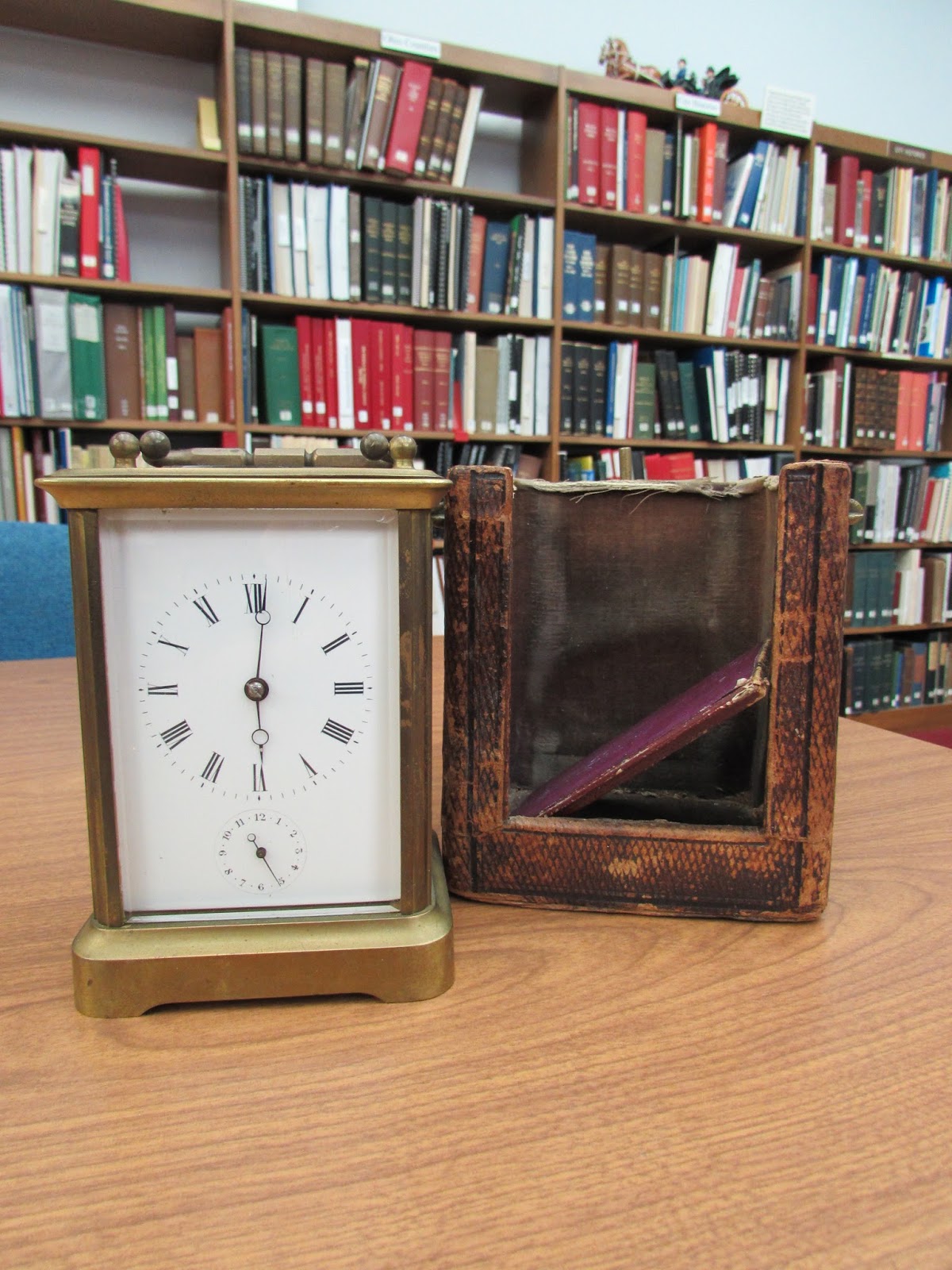
In early October, retired Naval Commander Ken Juul and his wife Vicki visited the Hayes Library and Museums to make a special donation of items that had been carried by Ken's great grandfather General Manning Force during the Civil War.  Below are images of the French carriage clock with its leather case and the small music box. Both belonged to General Force.  We are deeply grateful to Ken and Vicki for their thoughtfulness and generosity.

In 2012, Ken and Vicki donated General Force's Civil War escutcheon. Because of the lifelong friendship that existed between General Force and President Rutherford B. Hayes, Juul felt that the Hayes Presidential Library and Museums was an appropriate repository for the escutcheon, the carriage clock, and music box. President Hayes and Lucy named their eighth child  and the only one born at Spiegel Grove for General Manning Force. 

French Carriage Clock and its Leather Case
Music Box owned by General Manning Force
General Manning Ferguson Force


Manning Force was born Dec. 17, 1824 in Washington, D.C. to Peter and Hannah Force, the fourth of ten children. He attended Harvard University and Harvard Law School. Upon graduation in 1848, he moved to Cincinnati, Ohio, and entered the practice of law. Force joined the Literary Club of Cincinnati where he met fellow lawyer Rutherford B. Hayes with whom he would form a lifelong friendship


Prior to the Civil War, Manning Force served as a member of the Burnett Rifles.
On August 26, 1861, he was appointed major of the 20th Ohio Volunteer Infantry. The following month, he was promoted to lieutenant colonel. The first battle for the 20th O.V.I. was at Fort Donelson in February 1862. Shortly after the battle of Shiloh, Force was promoted to colonel and placed in command of the regiment. During the 1863 siege of Vicksburg, he served as acting commander of the 2nd Brigade of Mortimer Leggett’s Division,17th Corps, and was then promoted to brigadier general. 

In the summer of 1864, Leggett’s Division joined William T. Sherman’s drive on Atlanta. While leading his brigade in the defense of Bald Hill, Force was struck by a Minie ball. The ball struck him on the left side of his face and exited the upper right side of his skull. Believing the wound fatal, Force was sent home to die. Instead, he recovered and rejoined Sherman’s Army, taking part in the March to the Sea. For his actions at Atlanta, Force was promoted to major general and, in 1892, awarded the Congressional Medal of Honor. Following the Civil War, he was appointed military commander of the District of Mississippi, a position he held until January 1866 when he was mustered out.

Manning Force returned to his law practice in Cincinnati, Ohio. From 1866 to 1875 he served as judge of the Hamilton County Common Pleas Court. He married Frances Dabney Horton of Pomeroy, Ohio, on May 13, 1874. They had one son, Horton Caumont Force

In 1876, Manning Force was defeated in his bid for the U.S. House of Representatives. He later joined the faculty of the Cincinnati Law School and was also elected judge of the Superior Court of Cincinnati. Suffering from overwork, Force resigned his seat on the bench. He spent time with his good friend Rutherford B. Hayes at Spiegel Grove in Fremont, Ohio. After his stay in Fremont and a month long vacation in Europe, Force returned to Cincinnati. In 1888, he was appointed Commandant of the Ohio Soldiers’ and Sailors’ Home in Sandusky, Ohio, a position he held until his death May 8, 1899.


Friday, January 6, 2017

Students at Carlisle Indian Industrial School, Carlisle Barracks, Pennsylvania, 1879

Carlisle Indian Industrial School Students, Carlisle Barracks, Pennsylvania, 1879
The above names appear on the reverse of this cabinet card.

1. Anna Laura, Daughter of Shooting Cat, Rosebud Agency
2. Alice Wynn, Daughter of Lone Bear, Pine Ridge Agency
3. Hattie, Daughter of Lone Wolf, Pine Ridge Agency
4. Mabel, Kiowa, from Fort Sill Indian Territory
5. Rebecca, Daughter of Big Star, Rosebud Agency
6. Stella Berht, Daughter of Chasing Hawk, Rosebud Agency
7. Grace, Daughter of Cook ?, Rosebud Agency
8. Ruth, Daughter of Big Head, Rosebud Agency

Miss Mary R. Hyde, Matron (center)


President Rutherford B. Hayes threw the support of his administration behind Captain Richard H. Pratt's efforts to establish the Carlisle Indian Industrial School at Carlisle, Pennsylvania. Pratt believed that through a curriculum of English, training in the trades and the white culture, Christianity, citizenship, and patriotism, Indian boys and girls would soon learn the "white man's way" and take their place in mainstream American society. During its existence (1879-1918), this first off-reservation school served as a model for other boarding, day, and off-reservation schools funded by the federal government.


Army Captain Richard H. Pratt, Superintendent of the Carlisle Indian Industrial School sent stereoview, cabinet card, boudoir images of the students to President Rutherford B. Hayes and First Lady Lucy Webb Hayes in 1879. These were produced by commercial photographer John N. Choate. This image, along with others, are believed to feature the first group of students who entered Carlisle in the fall of 1879.  

Choate photographed the students in their traditional dress upon their arrival at Carlisle. Later, Choate photographed the same students in white man's clothing. For Pratt, the "before" and "after" images served as visual evidence of the program's success in assimilating Indian students. Pratt sent photographs to Christian reformers, Hayes administration officials, congressmen, and others who believed that Indians could be "Americanized" through education. Pratt did not send President Hayes images of students in their traditional dress.

Students were not allowed to speak their native language or wear their traditional dress, however they did gain a skill and learned to read, write, and speak English. The experiment created patterns of dislocation and separation and emotional and cultural disruptions in the lives of the students, their families, and their communities. As adults, most Carlisle students were caught between their own society and the white man's world. However, many discovered their own resilience, resourcefulness and ways of resistance. 

You can learn more about the school and these and other students through school records, publications, documents, and more photographs at  The Carlisle Indian School Resource Center . which represents an effort to aid the research process by bringing together, in digital format, a variety of resources that are physically preserved in various locations around the country." The center seeks "to increase knowledge and understanding of the school and its complex legacy, while also facilitating efforts to tell the stories of the many thousands of students who were sent there."