Showing posts with label First Lady Lucy Webb Hayes. Show all posts

Tuesday, August 17, 2021

Lucy’s Compassion Touched the Lives of Many


First Lady Lucy Webb Hayes

Hayes Presidential Library and Museums


Lucy Webb Hayes’ compassion and kindness extended well beyond her family, friends, and the communities in which she lived. Becoming first lady broadened her horizons even further. Now her concerns were for veterans, the impoverished, and the chronically ill around Washington, D. C. She also became well aware of the challenges Indians confined to reservations faced. Her concerns drew her to Hampton Normal and Industrial School located at Hampton, Virginia. Created in 1868, by the Freedmen’s Bureau, it was managed by General Samuel Armstrong, a son of missionaries and commander of African American regiments during the Civil War. Hampton was devoted to the education of the children of freed slaves.

 General Samuel Armstrong

Courtesy of Library of Congress


But Armstrong was given a new challenge when President Hayes released the Plains warriors from Fort Marion in St. Augustine, Florida. Under the care of Colonel Richard Pratt, the Native Americans could choose to return to the plains or remain in the east for education at the old cavalry barracks in Carlisle, Pennsylvania. But until it was repaired, Pratt asked Armstrong to house the Native Americans at Hampton. Armstrong immediately agreed and made plans to build a structure at Hampton to house his new students.


                                        Hunkpaka Girls on Arrival at Hampton

Courtesy of Library of Congress

Like most Americans, the president, first lady, and his administration believed that through education in the English language, the trades, patriotism, Christianity and citizenship, the native peoples would soon find their place in mainstream American society. Today, this attitude is clearly seen as paternalistic and destructive of their culture, but in 1878, it was an extraordinarily enlightened Indian policy. 


Booker T. Washington 

Their teacher at the newly built Wigwam (which still exists today on campus) was none other than Booker T. Washington. He was Hampton’s most successful graduate who returned to take a teaching position before creating the Tuskegee Institute.


Wigwam at Hampton

Courtesy of National Historic Places

The arrival of the Native Americans from Fort Marion created publicity across the nation. President Hayes became the first prominent individual to support Hampton’s efforts. During Lucy’s frequent visits to Hampton, Armstrong showed her photographs, ledger art, and pottery designed by the Native American students. It was his way of demonstrating to Lucy that these dispossessed children could succeed in American society. Lucy’s influence attracted wealthy individuals and reformers. A new wave of funding from Christian reformers helped shore up the school’s finances. President Garfield, Grant, and Secretary of War Robert Lincoln visited and advocated Indian education so strongly that the federal government paid $16,000 for 100 students to attend Hampton the next year. While the Native American program never matched that for African American students, the federal funding attracted nearly double the number of private contributions.


Pottery Compote by Bears Heart

Hayes Presidential Library and Museums

Many of the Fort Marion Indians joined Pratt when the Carlisle Barracks was completed, but some remained at Hampton. Among them was Bears Heart, a Cheyenne warrior who Lucy knew well.


Bears Heart at Ft. Marion

Courtesy of National Archives

 Nearby is one of the pottery pieces created by him and given to Lucy. Bears Heart traveled with Armstrong to reservations and encouraged children to gain skills and education at the school. Eventually, between the years 1877 to 1923, nearly 1400 students came to Hampton from 62 different tribal groups.


Wednesday, May 5, 2021

A Mother’s Love: Hayes Children Eagerly Await Lucy’s Return


Curator of Manuscripts Julie Mayle shared this touching letter written by Scott Hayes (7 years old) and his sister Fanny (11 years old ) to their mother First Lady Lucy Webb Hayes. President Hayes and Lucy's  two youngest children lived with them in the White House from  1877 to  1881. 

Scott wrote this heartfelt letter in March of 1878, telling his mother how lonely he and sister Fanny were without her. Lucy had gone to Chillicothe, Ohio to visit Cook family members. Lucy's kindness, compassion and caring ways not only endeared her to her own children, but to those of friends and relatives. 

Scott wrote this letter in pencil on White House stationery.  Julie has prepared a transcription of the letter below that also includes a short note from Fanny. The letter is part of the Rutherford B. Hayes Papers located at the Rutherford B. Hayes Museum and Libraries.


Executive Mansion, Washington

March 21

My dear mama

I was so glad to get Aunt Phoebe’s letter telling all about you.  We want to see you so much for it is so lonely without you.  We want you to come home very soon.  Fan has got hurt on her poor knee and can’t walk without her leg getting stiff.  We are all in a great hurry for you to come home.  Are you not ready to start?  I’m going to see Joe Potter to-day.  Fan and I went last Saturday and had a good time.  I hope you will send me an answer very soon.  Love to all.

Your loving Scott


Dear Mama

I hope that you will answer my letter as soon as possible, now as this is Scott’s letter I will stop.

Love to all, I am your loving Fanny

p.s.

Rud will be at home on Friday

               Fanny

               March 28th 1878


This picture of Lucy in the White House conservatory was taken by artist Theodore Davis. Fanny stands behind Lucy while Scott is seated to her right. Next to Scott is  Theodore Davis' daughter, Carrie. This photograph was taken in 1879.


Sunday, April 25, 2021

Grim: The Hayes Family's Favorite


From George Washington to Joe Biden, America’s presidents and their families have displayed great affection for their dogs. Perhaps none enjoyed this special bond more than the Hayes family. Their collection of canines included every size and shape. But the hands-down favorite was a beautiful brindle, mouse-colored greyhound named Grim, a gift from the DuPont family of Delaware. According to President Hayes, when the “good natured greyhound” arrived at Spiegel Grove, he “took all our hearts at once.”

 It was Grim’s special personality – his peculiarities – that endeared him to the family.  One day Lucy Hayes sang the Star Spangled Banner and “Grim lifted up his head and howled in a most pitiful manner.” And ever after when his mistress sang the national anthem, Grim began to howl. But if Hayes and the children were exceedingly fond of their “large, handsome” greyhound, it was Lucy whom Grim loved the best.  Hayes recalled, “How happy old Grim always was when she returned after an absence.” He was “lonely without her and unhappy.”

President Hayes and Lucy with Grim at Spiegel Grove
May 1887 

Lucy Keeler Photograph Collection

Had it not been for its many trees, Spiegel Grove would have suited Grim’s natural love for running to perfection. The sleek greyhound reached such speeds that “if a tree chanced to be in his way,” he would run headlong into it. Later, two pups fathered by Grim, Jove and Juno joined in these antics that so delighted the Hayes family. The three greyhounds raced around the grounds and if a door were open, they continued the chase inside. The family’s shepherd and little terrier were forever relegated to bringing up the rear.


                    Enlargement of Photo Showing Grim Beside Lucy

The president, believed that because of his size and appearance, Grim commanded respect from everyone who knew him. Wagons and carriages turned aside for him wherever he went. But Grim’s privileged status may have been his undoing. One spring day, while running on Lake Shore Railroad tracks, Grim encountered an oncoming train.  Instead of moving aside, he “stopped still.”  The engineer blew his whistle repeatedly, but Grim “did not stir.” Death was instantaneous. The president could only conclude that Grim fully expected “the train to turn out for him.”

 Hayes and Lucy were deeply affected by the loss of this much-loved pet. As soon as the frost was out of the ground. Hayes carried the remains of dear Grim to “cemetery point.”  He buried him there by his war horse Whitey.  Grim lies there still – only a few feet from the final resting place of the master and mistress to whom he had given so much joy.

Note: Taken in May 1887 by Lucy Keeler at Spiegel Grove with President Hayes and Lucy this photograph is the only known image of Grim. In the second picture, Photographic Curator Gil Gonzalez enlarged that portion  featuring Lucy with Grim by her side. 


Thursday, January 28, 2021

Emma Foote's Days at the Hayes White House


Emma Foote Glenn
Rutherford B. Hayes Presidential Library and Museums


During the Hayes Administration, it was not customary to hire a staff to assist the First Lady.  Without grown daughters, Lucy Hayes invited nieces, cousins, and daughters of friends to stay at the White House to help with social events and secretarial duties. One of these was Miss Emma Foote of Cincinnati, Ohio.  Lucy had known Emma since her husband's years as Ohio's governor.  

Emma was the daughter of Jane Foote who had come from New York to Champaign County and then to Cincinnati.  A widow, Jane and her daughter Emma lived in the Carlisle House owned by her brother-in-law George Carlisle, a wealthy Cincinnati banker. Hayes had also rented rooms for the family at the Carlisle in 1872.

When Hayes became president, Lucy immediately asked Emma to join them in Washington.  Of course, Emma was thrilled. Her letters to the Carlisles give a glimpse of life at the Hayes White House.  She not only assisted Lucy for more than a year, but also traveled with the Hayes family, attended social events and state dinners, including that given for the Grand Dukes Alexis and Constantine of Russia.  
(Emma's letter to her cousin about this event has been transcribed below.}

She and Winnie Monroe attended the theater accompanied by General William T. Sherman. She enjoyed elegant luncheons given but Kate Chase Sprague. Emma shopped in New York for Lucy, delivered flowers to disabled veterans, wrote letters, and accompanied the First Lady to charity events.  Emma traveled with the Hayes family to New York and throughout New England. She was pleased when Lucy gave her a "special room" at the Soldiers' Home where the Hayes family stayed during the hot summer months.  

Although not wealthy, Emma received an excellent education. She was deeply interested in politics and appreciative of the opportunity to know some of the nation's most prominent men and women.  Her nearly year-long stay led many to believe she was part of the Hayes family.

But, indeed, Emma was not a relative. In the spring of 1878, Webb, President Hayes' second son and secretary to his father, proposed to Emma. However, Emma was not interested.  It was then that she knew it was time to leave. 

She joined her cousin Florence Murdoch in New Jersey.  Later, she met Colonel George Glenn.  In the winter of 1880, Lucy and the President attended her wedding at the Carlisle House. From then on, Emma led a vastly different life. As an officer's wife, it was a harsh existence at forts on the western frontier and in Arizona.  Always cheerful and blessed with a buoyant personality,  Emma viewed her experience as a great adventure. When Colonel Glenn died of malaria contracted in Cuba during the Spanish American War, Emma returned to Cincinnati where she lived out the final days of a full and exciting life.


Emma Foote Glenn
Rutherford B. Hayes Presidential Library and Museums

Executive Mansion,   Washington                                                                  
                        Saturday April 21, 1877

My dear Florence,

I will send this letter to Orange [New Jersey] first so I will not have to write the same thing twice.  Thursday was the grand dinner. It was raining dreadfully, but everyone attended. Promptly at quarter of seven we all went down stairs to see the handsome table, then to the blue room. In a few moments members of the Cabinet and wives arrived.  Lady and Sir Edward Thornton, then the Grand Duke and party. he was dressed in a plain evening dress.  It was a little stiff before we went out to dinner.  Soon dinner was announced.  Right off the grand Marine band commenced to play the Russian March.  Stringed instruments, fifty of them, played all through the dinner.  They were so far off the music was not deafening.  Mrs. Hayes looked like a Queen as she sat between the Grand Duke and Constantine.  I went out with Gen. Schurz, Sec. of the Interior.  Sec. of War on my right.  The grandest sight I ever expect to see as I looked up and down the table.  It was not till after dinner that we were presented to his Royal Highness.  I had quite a long talk with him. I was not at all nervous or excited at dinner.

Nothing can ever compare with my feelings like the first dinner I took in the White House.  Then I was a bundle of nerves, could not eat much less speak, the other eve.  I send you a paper.  I can't believe I had shaken hands with his Royal Highness.  He is very sensible, not at all airy to use such an expression.  We were all sorry to have them say good night.    /signed/ Emma [Foote]


Colonel George Evan Glenn

Rutherford B. Hayes Presidential Library and Museums


Friday, January 19, 2018

Moving the Bodies of President Rutherford B. Hayes and First Lady Lucy Webb Hayes to Spiegel Grove

by
Meghan Wonderly
Annual Giving and Membership Coordinator
Rutherford B. Hayes Presidential Library and Museums

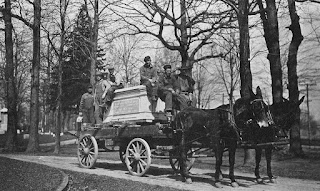
While his father’s Memorial was breaking new ground as the first presidential library, Webb Hayes, second son of President Rutherford B. Hayes was occupied with transporting his parents’ bodies to Spiegel Grove. This was far from a sudden decision on Webb’s part.  His earliest plans for the memorial included preparations for Lucy and Rutherford’s removal from Fremont, Ohio's Oakwood and re-internment at Spiegel Grove. Webb desired that his creation follow the model set by America’s first presidents—to have the president buried at his estate much like Jefferson at Monticello or Washington at Mount Vernon. By relocating his parents’ bodies to Spiegel Grove, Webb was bringing his Memorial full circle.  Visitors would not only be able to pay homage to Rutherford and Lucy’s lives through their belongings and life’s work, they would also be able to visit their final resting place.   Spiegel Grove was to be a site of pilgrimage for those devoted to and interested in Rutherford B. Hayes.  Webb sought to “conceal and make more private the Monument and Base in which the bodies” were to be placed, so that visitors to the tomb would be able to visit the grave site in relative solitude to pay their respects.[1] 
Before moving forward with the task, Webb secured his siblings’ approval. While much of his family was in agreement with him, Webb did face displeasure from some family members.  Rutherford Platt Hayes voiced strong dissent to the reburial in 1911. He argued that it went against his father’s wishes, writing, “Father selected the place and arranged everything himself and I know that it was his thought and wish that he and mother should remain there permanently.”[2] Presuming that the other Hayes siblings felt as he did, he sent his attorney to Fremont to prevent Webb from moving the bodies of their parents until all of the children were in agreement.[3] We have few details; however, it must have taken the siblings four years to resolve their issues regarding the reburial, because discussions of the removal did not resume until 1915.
Before moving forward with the task Webb secured further family approval. Some felt the same as Rutherford. His cousin Laura Platt Mitchell, who was Rutherford’s favorite niece, strongly opposed the plan.  Close friend and cousin, Mrs. L.C. Austin, had approved of the plan since 1911. Webb reached out to her once more for possible financial assistance. The relocation of the bodies, including the beautification of the knoll and the new monument, was estimated to cost $1,500. 

While updates on the progress of the memorial project were occasionally shared in newspapers across Ohio, this particular aspect of the project appealed to the public. Like modern times, the macabre and the dramatic attracted the media more than anything else. When the bodies of the former president and first lady were moved from their original burial site to Spiegel Grove, the nation paid attention. The notion of a son digging up his deceased parents and moving their bodies as he saw fit struck a chord of intrigue within the nation. The fact that the bodies were a first lady and president added to the sensational coverage. In January 1915, the Norwalk Reflector Herald of Norwalk, Ohio, shared that “there was talk today of disinterring the bodies of the late President Rutherford B. Hayes and his wife and their removal to a crypt in the memorial.” It took several months to finalize plans for the removal of the bodies, but when the event took place, newspapers across the country covered this story, including the Boston Evening Globe, the Waunakee Index of Wisconsin, the Hamburg Reporter of Iowa, and the Waco Morning News. 
Webb had planned to move his parents in late spring of 1915, but discovered on March 31st that he would be unable to disinter the remains between April 1st and October 1st to prevent further decomposition. With this knowledge, Webb sprang to action.  On that very day the former president and first lady were disinterred and placed in a vault of the Hayes Memorial building until the completion of their granite mausoleum.  Lucy Keeler recorded Webb’s retelling of the event in her diary:
Webb & the workmen had been early to Oakwood; the caskets stood side by side in the crypt of the Memorial Building—covered with flags.  However Webb soon decided to move them to the adjoining vault; that was done—the flag draped with 2 handsome wreaths.  Then the vaults doors were closed; we went to the house for dinner.  Present; Webb; his wife; Birchard; his wife; Dr. and Mrs. Wright; myself; Miss Crocker the housekeeper, and the workman.  All done quietly, quickly and in Webb's masterly manner [sic].  He came to tell me—at the first opportunity—that he found the original casket almost intact in excellent condition (though he had prepared two new lead caskets in case of need.)  The old coffin (Mrs. Hayes--1889) sagged open at one end and out rolled—in his hands—his mother’s wedding ring!  He showed it to me—engraved with her name from RBH.  It seemed to me like a last message from Aunt Lucy to this devoted son of hers!  After dinner, I went over to the Memorial Bldg again.  Soon Birchard came running, asking me to bring my Kodak and go up Hayes Avenue and take a picture of the great stone Webb has brought from Barre Vt. Quarries (weighs 25 tons) 15 x 12 feet to cover the new grave on the knoll of Spiegel and serve as base to the monument now at Spiegel.  I took several views of it the people.[4]

Whether or not the former first lady’s wedding ring actually fell out of the coffin and into her son’s hand is debatable. He did not rebury the wedding ring with his mother.  Instead, Webb kept his mother’s wedding ring and it is currently on display in the museum


Moving the bodies when they did meant that their reburial had to wait until the monument portion of the tomb was finalized.  In a beautiful and impressive ceremony the bodies were removed from the Memorial building and re-interred at the knoll on April 3rd, where they remain to this day.  The new resting place was approved by the Hayes family, even those who had once opposed the project.  In September 1915 Lucy Keeler commented on Laura Platt Mitchell’s change of opinion on the matter, stating, “Laura is so pleased with the Knoll and Monument, though she had all along opposed Webb’s plan of moving his parent’s remains.”[5]  Rutherford also underwent a small change of heart. His wife Lucy Platt Hayes wrote to Mary Miller Hayes: “We are all glad to have the final move accomplished so simply and quietly.”[6]


While this decision to move the bodies of his parents may seem unusual or grotesque, it was not altogether uncommon at the time.   Webb had prior experiences with disinterring and moving bodies, on his own and with his father.  Upon Lucy’s death in 1889 Rutherford moved the body of their youngest child, so that he would be buried with Lucy. Manning Force Hayes had passed away in 1874.  In 1906 Webb worked in cooperation with the Western Reserve Historical Society, in which he was a Trustee, to secure Colonel George Croghan’s body.  Croghan was a local war hero, having defended Fort Stephenson during the War of 1812 in Fremont, Ohio.  Webb gained permission from Croghan’s family to move his body from Kentucky to Fremont. Once Croghan’s move was finished acquaintances offered congratulatory words to Webb on his accomplishment. One man said, “Accept my congratulations on your successful search for the “bones” of Col. Croghan.”[7]  Another stated that he received confirmation that Webb had “found and swiped George” with his congratulations. 
With the bodies of the former president and first lady safely resting at the knoll in Spiegel Grove, attentions turned back to the memorial.


[1] WCH to L.C. Austin, 1914, WCH Papers, Rutherford B. Hayes Presidential Library & Museums.
[2] Rutherford Platt Hayes [RPH] to L.C. Austin, 22 July 1911, RPH Papers, Rutherford B. Hayes Presidential Library & Museums.
[3] RPH to L.C. Austin, 5 July 1911, RPH Papers, Rutherford B. Hayes Presidential Library & Museums.
[4] LEK Diary, 31 March 1915, LEK Papers, Rutherford B. Hayes Presidential Library & Museums.
[5] LEK Diary, 9 September 1915, LEK Papers, Rutherford B. Hayes Presidential Library & Museums.
[6] Lucy Platt Hayes to MMH, 30 April 1915, RPH Papers, Rutherford B. Hayes Presidential Library & Museums.
[7] R.M. Kelley to WCH, 8 June 1906, WCH Papers, Rutherford B. Hayes Presidential Library & Museums.

Sunday, February 7, 2010

Lucy Webb Hayes and Her Four-Footed and Feathered Friends

The nearby photo of Lucy Webb Hayes, wearing the President’s hat while feeding pigeons on a cold, snowy morning, is one of the last ever taken of the former first lady. It has always been one of my favorites. This candid image would be considered common place in today’s casual world, but in the 19th century, such unassuming poses of women, particularly former first ladies, were much less common. Perhaps its appeal is that it represents a true reflection of who Lucy Webb Hayes was and how she lived her life.

Compassionate, cheerful, gracious, and possessed of a quiet confidence, Lucy showered kindness on family, friends, children, the sick, and the helpless. The same was true for animals - be they domestic or wild. It was always her way.

Upon Lucy’s arrival in Washington, society columnists commented on what changes she surely would make in her hair style, her dress, and her demeanor. But the First Lady remained unchanged - outwardly and inwardly. It wasn’t long before such questions were forgotten. Rather, Lucy’s warmth and kindness to all around her became the recurring topic in DC newspaper columns.

Gifts for Lucy poured in – a mockingbird, a Siamese cat, a turkey, a cow, and other feathered and four-footed creatures. They all found their place in the White House family. When Lucy learned that an owl had become trapped inside the unfinished Washington Monument, she asked that construction stop until it could be freed.

When the Hayeses returned to Ohio, their White House pets came with them. Their homecoming at Spiegel Grove brought more gifts of dogs, chickens, turkeys, and cats. Lucy welcomed and loved them all.

In his letters and diary, President Hayes often mentioned how children, servants, and animals responded to Lucy. He wrote, “All seemed to know her, and loved to be near her. The dogs would climb on her, the Jerseys would rush to her, the pigeons came at her call….How happy she was to see their glad welcome of her. I must preserve the pictures that show these things.”


Lucy's Jersey Cows at Spiegel Grove

Everyone was aware of Lucy’s love for animals and the affection they returned. Some weeks after her death, a Fremont teamster came up to President Hayes after Sunday services. He said, “There was a notable thing at [Lucy’s] funeral. I noticed it and many others [did]. The jerseys – her Jerseys – all came up as near to the funeral procession as they could get and stood in a row looking at it – standing still like soldiers in ranks until the funeral had all passed.”

Ohio Soldiers' and Sailors' Orphans Home, Xenia, Ohio

The stereoscopic view at left is of children playing on the lawn before one of the cottages at the Ohio Soldiers' and Sailors' Orphans' Home in Xenia, Ohio. The image, one of a series, was given to Lucy Webb Hayes, who was instrumental in rasing funds to establish and support the orphanage.

The Grand Army of the Republic, a veterans' organization of Union soldiers who fought in the American Civil War, established the Ohio Soldiers' and Sailors' Orphans' Home in Xenia, Ohio in 1869. GAR officials rented a two-story building, where some 50 children were housed.

Initially, children whose fathers had died in the Civil War or as a result of service-related wounds or disabilities were accepted. The need was so great that the city of Xenia donated more than 100 acres outside the city to establish a larger orphanage. A committee petitioned Ohio's General Assembly to assume control of the orphanage. In April 1870, the orphanage officially became an institution of the state of Ohio. That summer, the orphanage was moved to the land outside Xenia.

The first board members (1870 - 1874) were General Ralph P. Buckland, of Fremont; General James Barnett; General J. Warren Keifer; Barnabas Burns; General Manning F. Force; head of the Soldiers' and Sailors' Home at Sandusky; General John S. Jones; and A. Trader.


Originally, the Ohio Soldiers' and Sailors' Orphans' Home provided Ohio children who had lost their father in the American Civil War with a place to live. Eventually, the State of Ohio opened the institution to orphans of all military conflicts and the children of all veterans, including ones who had not died on the battlefield. In some cases, the children of a living veteran and/or his spouse, who were suffering financial difficulties could leave their children at the home. In 1901, more than 900 children resided at the institution. It was the largest institution of its kind in the world.


Children lived in cottages like the one featured in the image above. They received a traditional education and manual training. In 1978, the Ohio Soldiers' and Sailors' Orphans' Home became known as the Ohio Veterans' Children's Home. In 1997, the Ohio Veterans' Children's Home ceased operation. More than 13,500 children had been cared for and educated. The Greene County Library maintains an online database of "Applications for Admission" to the home from 1877 - 1919.

As early as 1881, the Association of Ex-Pupils was formed. Members consist of former pupils of the Ohio Soldiers' and Sailors' Orphans' Home or of the Ohio Veterans' Children's Home. You can read a 1901 article from the institution's newspaper, the "Home Weekly", reporting on some of the former pupils. For pictures of the home from 1901, follow this link to those displayed on Ohio Memory.

Each year, the association holds a three-day reunion on the former site of the home. They also operate a museum and have worked to improve the care of the Collier Chapel Cemetery. In 1963, a history, titled Pride of Ohio: The History of the Ohio Soldiers' and Sailors' Orphans' Home at Xenia, Ohio, 1868-1963, was published. The association is now in the process of publishing a second history due out this year.

Thursday, April 9, 2009

Childhood Dream Comes True for Helen Herron Taft

Venus Williams, Miley Cyrus, Oprah Winfrey, Condoleezza Rice, and Katie Couric are just a few of the notable figures who serve as role models for today’s young women. But in the 19th century, it was an altogether different matter! Barred from voting and severely limited in establishing an independent career, women rarely rose to national prominence. But Helen Herron, a Cincinnati teen found her role model – First Lady Lucy Webb Hayes.

At the age of seventeen, “Nellie,” as her friends called her, visited the White House. She and her entire family were guests of President Rutherford B. and First Lady Lucy Webb Hayes. From that day forward, Helen knew that she wanted to become First Lady more than anything in the world. Years later, she recalled that her visit to the Hayes White House was “the only unusual incident of her girlhood!”

A short time after the Herron family visit, “Nellie” met “the adorable Will Taft.” They later married. William Howard Taft became solicitor general of the United States and then a federal circuit court judge. In 1900, Taft was appointed head of the civil government of the Philippines. Helen, the mother of three children, was more than willing to travel half way around the world to live in a foreign land if it helped her husband’s career. Four years later, the Tafts were back in Washington. President Teddy Roosevelt had chosen Taft as his Secretary of War. Helen was delighted at her husband’s rising political career.


In 1908, her lifelong dream came true! William Howard Taft was elected President of the United States! It was an exciting day when Helen Taft stepped into the role of First Lady. But only two months later, she suffered a severe stroke. Although ill for more than a year, Helen Taft was determined to resume her social obligations. By late 1910, the First Lady, with the help of her daughter, delighted the nation when she hosted the White House events during the Christmas holidays.

Helen Taft became famous for her elegant receptions for prominent dignitaries and foreign heads of state. In her memoir, Recollections of Full Years, the First Lady considered the celebration of the Tafts’ 25th wedding anniversary the “greatest event” of her White House years. Several thousand guests celebrated with them at an evening garden party.

Social obligations were not the First Lady’s only concern; she wanted to make the nation’s capitol a beautiful place for visitors. At her request, Japanese cherry trees were planted. The two original trees she helped plant at a ceremony still stand several hundred yards west of the John Paul Jones Memorial. When the cherry trees bloom each spring, they serve as a reminder of a young Ohio teenager with a big dream and an indomitable will – First Lady Helen Herron Taft.

Saturday, February 16, 2008

White House Easter Egg Roll


White House Easter Egg Roll
[Courtesy of the Library of Congress]
Slowly, silently, the White House gates opened. In dashed a group of small boys. Each carried a basket of brightly-colored Easter eggs. As they rushed across the freshly clipped grass of the South Lawn, their numbers multiplied. Out of nowhere, hordes of laughing, giggling children - some in dainty pinafores, others in tattered rags - flooded the White House lawn. Moments later, the grounds were alive with streams of color as thousands of Easter eggs rolled and bounced down the slopes. Behind them came hundreds of children, running, tumbling, screaming, and laughing all the way to the bottom. From inside the White House, President Rutherford B. Hayes and the First Lady watched with delight.

Washington's children always had claimed the grounds around the halls of government as their own on Easter Monday. Even before the Civil War, thousands of little ones gathered on the lawns of the U.S. Capitol to roll, race, toss, chase, and eat gaily-painted eggs. At noon government workers, nannies, and nurses came with picnic lunches to watch the fun. The afternoon was spent playing tag, croquet, skipping rope, racing, and floating eggshells. Only when the sun set did the celebration end.

But on Easter Monday in 1877, Congressmen were horrified to find the Capitol rotunda filled with screaming children, broken eggshells, and discarded sandwiches. Determined to return dignity to the hallowed halls, they signed a bill into law forbidding any such future events on the Capitol grounds. But even an act of Congress could not prevent the children of Washington from enjoying their East Egg Roll.

The following year, just before Easter, a boy bravely approached President Hayes and asked, "Are you going to let us roll eggs in your yard?" Unfamiliar with the event, Hayes answered, "I don't know, I'll have to see about that." When the White House staff explained the tradition, the President good-naturedly ordered the gates left unlocked on Easter Monday. Hidden from view, the Hayeses and their staff watched with amusement as children slipped through the gates to roll eggs on the South Lawn. The next year, the Easter Egg Roll became an official White House celebration and has remained so ever since.

Today the staff prepares 10,000 eggs for this unique event hosted by the First Lady, with each adding her personal touch to the 125-year-old tradition. Mrs. Nixon brought the Easter Bunny. Betty Ford introduced eggs decorated in the Ukrainian style. Rosalyn Carter presented souvenir eggs. Nancy Reagan autographed wooden eggs, and Hillary Clinton's featured the paw print of Socks the cat. More importantly, the White House Easter Egg Roll remains a fun-filled day especially for children - just as it did in President Hayes' time.