
Richard Stotz with Roscoe, the Regimental Mascot
In Richard Stotz's last years, he gave a scrapbook of photographs to his nephew. They were taken during Stotz's time as combat photographer with the 28th Marine Corps during World War II. The photographs were taken by him and his fellow comrades during training at Camp Pendleton, in Hawaii, at the Battle of Iwo Jima, and during the occupation of Tokyo.
You can see a gallery of some of his photos on the Hayes Presidential Center website
We "pinned" some of Richard Stotz's photographs on Historypin, where you can see a slideshow .
In October, the Stotz Photographs were highlighted as the featured collection of the week on the Historypin blog.
Richard “Dick” H. Stotz was born on 18 March 1922 in Fremont, Ohio to Edward and Neva (Heinman) Stotz. Upon graduating from Fremont Ross High School in 1940, he owned and operated Abdoo Photography with his brother, Donald Stotz. On 14 December 1942 Dick enlisted in the United States Marine Corps and reported to boot camp at Camp Pendleton in San Diego, California.
After graduating from boot camp he was assigned to the base photograph section as a photographer, completing numerous aerial and reconnaissance training missions. In 1944 Dick was reassigned to the 5th Marine Division, 28th Regiment intelligence platoon as a motion and still photographer. Each division had 12 to 30 still photographers and cinematographers. Stotz and the other combat photographers were sent to 20th Century Fox Studios in Hollywood, California for additional training on still photography. After completing this training he rejoined his platoon, along with fellow photographer L.R. Burmeister and combat correspondents William Vessey and W. Keyes Beech.

Marines Carrying Their Wounded Comrade
Stotz’s primary duty was to capture the battle in photographs as it was taking place. The job of a combat photographer was made more dangerous because they were never heavily armed, usually carrying only a single weapon and their camera equipment. Photographs taken during a combat assault, like Iwo Jima, were rarely developed in the field. The photographers film was sent out by plane or naval ship to an alternate location to be developed. Most likely, photographers never saw the actual photographs. These photographs were be used for training purposes and to identify any mistakes that may have occurred.

Medic Treating Wounded Marine
Once on shore the Marines were immediately met with a heavy assault from the Japanese that included artillery and machine gunfire. Both the United States and Japan experienced heavy casualties during the initial invasion. Intelligence correspondent, Sgt. Bill Vessey, was killed on 20 February 1945, the second day of the battle. Sgt. L.R. Burmeister was wounded several days later. On 22 February 1945 the Marines gained control of Mount Suribachi and proceeded to take possession of both airfields on the island. Stotz was acquainted with fellow photographer, Joe Rosenthal, who took the iconic photograph of the flag raising atop Mt. Suribachi. The assault lasted 36 days, with the United States taking control of the island on 26 March 1945. The seizure of Iwo Jima allowed for sea and air blockades, andthe ability to conduct intensive air bombardment to destroy Japan’s air and naval capabilities. Although Iwo Jima was a key victory for the United States, the battle resulted in over 26,000 American casualties. Twenty-seven Medals of Honor were awarded to Marines and sailors, more than were awarded for any other single operation during the war.
To read more about the Marines on Iwo Jima, follow this link to Iwo Jima: A Retrospective
To read more about the Marines on Iwo Jima, follow this link to Iwo Jima: A Retrospective
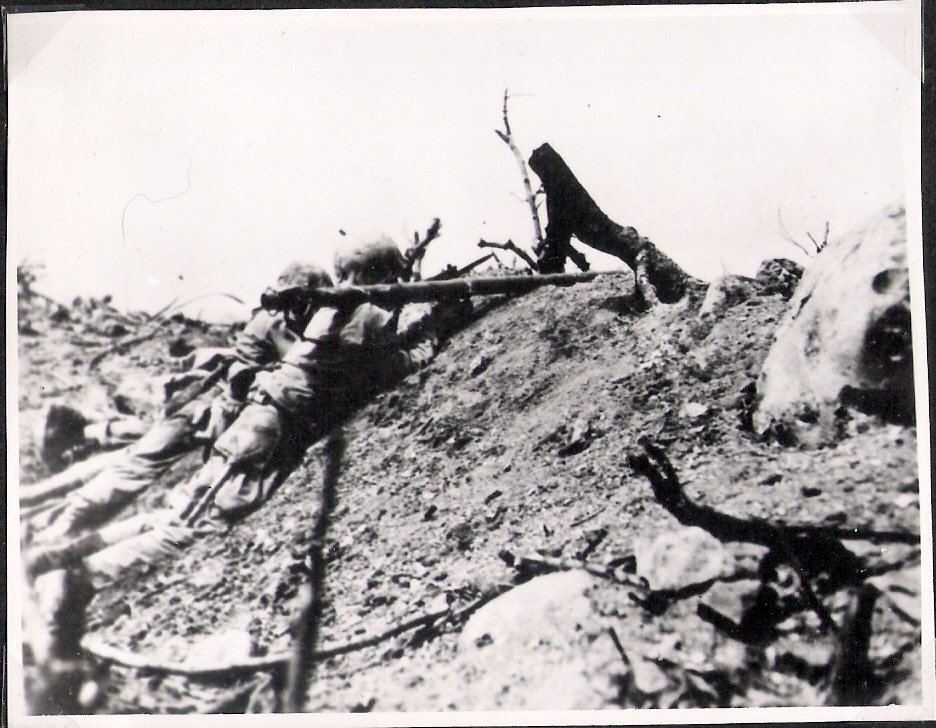
Marines Dug In


