Showing posts with label World War II. Show all posts

Monday, May 6, 2024

Nazi Stolen Treasures at the Merkers Salt Mine

 Merrill Rudes was a prominent Ottawa County, Ohio, probate and juvenile courts judge. Born in Genoa, Ohio in 1920, he served as a captain in General George Patton’s Third Army during World War II. Captain Rudes was with the Third Army as it crossed the Rhine, plunging deep into German territory. While on patrol near Thuringa, Captain Rudes met two women who had worked as forced labor at the nearby Merkers mine. They told him of “treasure in the Salt Mines.”  According to a March 2019 wtol.com (Toledo, Ohio) article, Rudes included their information in his notes and sent it up to headquarters.

On April 8th, 1945, U.S. Army officials followed up on Rudes’ notes. There, in the mine, they discovered more than 500 masterpieces by artists such as Rubens, Vermeer, Rembrandt, Manet, Titian, and others. The vault inside Merkers contained the Nazis’ stolen gold, silver, platinum, sculptures, drawings, and also valuables confiscated from Holocaust victims.


Generals Eisenhower, Bradley, and Patton examining valuables stolen by the SS from Jews in concentration camps 
Courtesy of National Archives


Immediately, Patton informed Generals Dwight D. Eisenhower and Omar Bradley. On the 12th, the three generals descended more than 2,100 feet into the mine to personally inspect its treasures. General Eisenhower was visibly moved when he saw those items taken by the SS from Jews at the concentration camps.

That night while discussing the protection and movement of the treasures, the three generals learned of President Franklin Roosevelt’s death. According to the earlier Yalta Conference agreement, this area would become part of the Russian sector once the war ended. The generals planned to remove the treasures as quickly as possible via a heavily-guarded convoy that included air cover. The artwork, many pieces wrapped in sheepskin overcoats, abandoned by the Nazis, was transferred within days to Wiesbaden and then Frankfurt. 


Young Woman with the Pearl Necklace by Vermeer, 1664
Courtesy of Wikimedia Commons
,

In late 1946, amid strong opposition, 202 of the most important works were brought to the U.S. President Truman, personally, gave his assurance the paintings were not confiscated, but only temporarily moved for better protection at the National Gallery of Art in Washington, D.C. 

Two years later, when conditions improved, General Lucius Clay ordered the artwork returned. But many Americans wanted to see the paintings before they left for Europe. The Army agreed to a traveling exhibit that would take the paintings on a 12,000-mile journey to 14 of the nation’s leading museums. An estimated 7 million Americans saw the European masterpieces. An requested admission fee of 30 cents raised more than $190,000 which the U.S. Army used for the support of orphans in the American sector of Germany.


Generals Eisenhower, Bradley, and Patton Looking at Stolen Artwork


"Paintings from the Berlin Museums" Exhibition, 1948
                         Courtesy of  National Gallery of Art


The National Gallery of Art in Washington, D. C. was the first to display the paintings beginning March 17th to April 25th, 1948. In 40 days 964,970 visitors attended the exhibit. The original frames had  been removed for storage. Because they were lost in a fire, the gallery used simple wood moldings to display the paintings.  Fifty of the most fragile paintings (mostly on panels) were returned immediately. After the Boston exhibit another fifty paintings  were returned.

In March 1949, over a 10-day period, more than 100,000 visitors saw the exhibit at the Toledo Museum of Art. The exhibit was in part made possible by the museum’s director Otto Wittman, one of the Monuments Men (now made famous by George Clooney’s movie). Area businesses raised funds so that 42,000 schoolchildren could attend. As Toledo was the tour’s final stop they would be among the last Americans to see the masterpieces all in one place in the U.S.


Note: For a detailed account of events at Merkers mine, see  Greg Bradsher's article in the National Archives publication "Prologue," Volume 31, No.1, Spring 1999.


Thursday, August 7, 2014

The Charles and Jessie Biehler Family's Sacrifice in WWII


Robert Biehler
Armored Reconnaissance Division,
 Entered the U.S. Army November 11,1942

Earl Biehler
North Africa, Christmas 1942
Inducted into the U. S. Army January 8, 1942

Donald Biehler
Enlisted in the U.S. Navy October 2, 1944
Discharged September 14, 1945

Louis Biehler
Served with the 164th Infantry in the Negras, in the Philippines
Killed May 7, 1945 Philippines

Fred "Fritz" Biehler
Entered the U.S. Army January 9, 1942
Military Police

Lester Biehler
Served with the U. S. Army Communications Headquarters Division,
330th Infantry
since October 29, 1942
Participated inn the landing at Omaha Beach 
Killed July 5, 1944
Carentan, Normandy, France


Several weeks ago, I had the privilege of meeting Mildred Biehler Lipstraw of Oak Harbor, Ohio, at the Hayes Presidential Center. She had seen our news release regarding the Northwest Ohio Veterans Oral History Project.
 She wanted to tell me of the extraordinary sacrifice of her family during World War II.

Mildred is one of twelve children of Charles and Jessie Caris Biehler, who originally lived not far from Rocky Ridge in Ottawa County, Ohio.  According to Mildred, the family moved to Sandusky County around 1927, where her father managed the Sandusky County Farm Bureau Co-op. Three of her brothers were employees of the Co-op

It was humbling experience to learn of the Biehler family's sacrifice. Six of Charles and Jessie's sons served during World War II. Two did not survive the war. Lester and Louis were killed in action. Lester was killed in Carenton France just after the D-Day invasion. Louis was killed in the Philippines May 7, 1945.


Mildred remembers that in November 1948, a Military Honor Guard accompanied the bodies of her brothers Lester and Louis home to Fremont. The Honor Guard remained on duty through the days prior to the memorial service held for these young heroes . They rest in the Veterans Circle at Fremont's Oakwood Cemetery.

It is with much thanks to Mrs. Lipstraw for providing the Hayes Presidential Center with copies of her brothers' war time photographs and other documents about their service. They will be added to the Center's Biographical File, but we wanted to share the Biehler family's sacrifice for our country's freedom during World War II.


Monday, December 24, 2012

Richard "Dick" Stotz: Marine Corps Combat Photographer at Iwo Jima


Richard Stotz with Roscoe, the Regimental Mascot


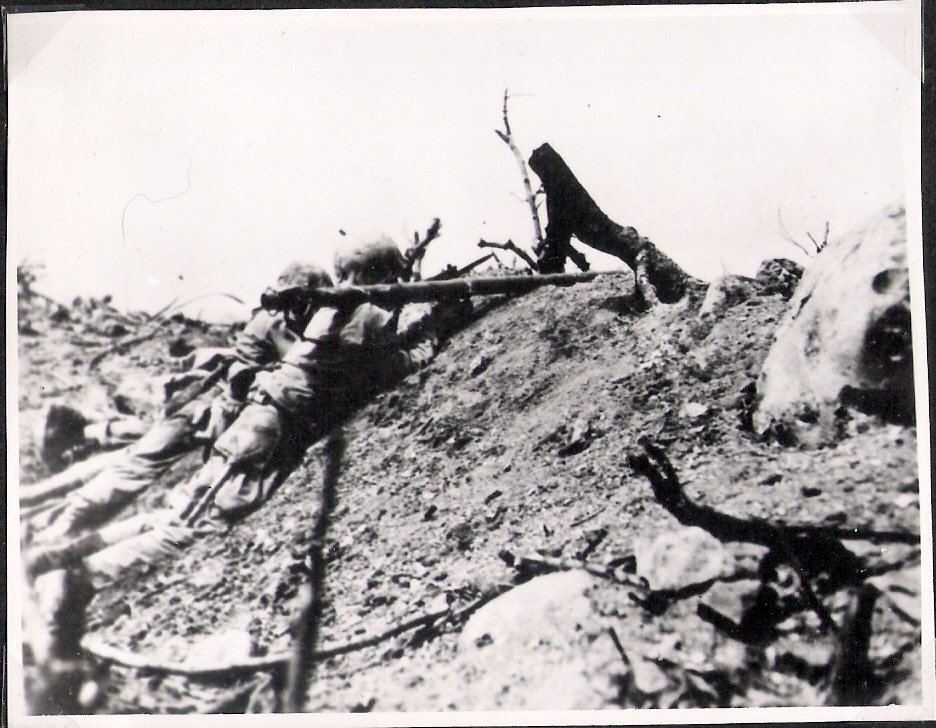
In Richard Stotz's last years, he gave a scrapbook of photographs to his nephew. They were taken during Stotz's time as combat photographer with the 28th Marine Corps during World War II. The photographs were taken by him and his fellow comrades during training at Camp Pendleton, in Hawaii, at the Battle of Iwo Jima, and during the occupation of Tokyo.

You can see a gallery of some of his photos on the Hayes Presidential Center website

We "pinned" some of Richard Stotz's photographs on Historypin, where you can see a slideshow .

In October, the Stotz Photographs were highlighted as the featured collection of the week on the Historypin blog.

Richard “Dick” H. Stotz was born on 18 March 1922 in Fremont, Ohio to Edward and Neva (Heinman) Stotz. Upon graduating from Fremont Ross High School in 1940, he owned and operated Abdoo Photography with his brother, Donald Stotz. On 14 December 1942 Dick enlisted in the United States Marine Corps and reported to boot camp at Camp Pendleton in San Diego, California.

After graduating from boot camp he was assigned to the base photograph section as a photographer, completing numerous aerial and reconnaissance training missions. In 1944 Dick was reassigned to the 5th Marine Division, 28th Regiment intelligence platoon as a motion and still photographer. Each division had 12 to 30 still photographers and cinematographers. Stotz and the other combat photographers were sent to 20th Century Fox Studios in Hollywood, California for additional training on still photography. After completing this training he rejoined his platoon, along with fellow photographer L.R. Burmeister and combat correspondents William Vessey and W. Keyes Beech.


Marines Carrying Their Wounded Comrade

In September 1944, the 28th Regiment left Camp Pendleton and sailed to the Hawaiian Islands for Camp Tarawa to join the 26th and 27th Regiments. Intense training, field maneuvers and mock landings took place until January 1945. While aboard the USS Dickens the regiments received a top secret operation called “Workman Island”, later to be known as Iwo Jima. On 19 February 1945the 28th Regiment arrived at the island of Iwo Jima and was part of the second assault wave to advance ashore, followed by three additional waves of troops.

Stotz’s primary duty was to capture the battle in photographs as it was taking place. The job of a combat photographer was made more dangerous because they were never heavily armed, usually carrying only a single weapon and their camera equipment. Photographs taken during a combat assault, like Iwo Jima, were rarely developed in the field. The photographers film was sent out by plane or naval ship to an alternate location to be developed. Most likely, photographers never saw the actual photographs. These photographs were be used for training purposes and to identify any mistakes that may have occurred.


Medic Treating Wounded Marine

Once on shore the Marines were immediately met with a heavy assault from the Japanese that included artillery and machine gunfire. Both the United States and Japan experienced heavy casualties during the initial invasion. Intelligence correspondent, Sgt. Bill Vessey, was killed on 20 February 1945, the second day of the battle. Sgt. L.R. Burmeister was wounded several days later. On 22 February 1945 the Marines gained control of Mount Suribachi and proceeded to take possession of both airfields on the island. Stotz was acquainted with fellow photographer, Joe Rosenthal, who took the iconic photograph of the flag raising atop Mt. Suribachi. The assault lasted 36 days, with the United States taking control of the island on 26 March 1945. The seizure of Iwo Jima allowed for sea and air blockades, andthe ability to conduct intensive air bombardment to destroy Japan’s air and naval capabilities. Although Iwo Jima was a key victory for the United States, the battle resulted in over 26,000 American casualties. Twenty-seven Medals of Honor were awarded to Marines and sailors, more than were awarded for any other single operation during the war.

To read more about the Marines on Iwo Jima, follow this link to Iwo  Jima: A Retrospective


Marines Dug In