Showing posts with label Sandusky Ohio. Show all posts

Wednesday, July 8, 2026

Davis' Boat Works, Sandusky, Ohio


 Adelbert Davis was born in 1857, the son of Sandusky, Ohio businessman Ira T. Davis. At the age of six, he became deaf after one term in public school. He attended and graduated from the Ohio School for the Deaf in Columbus, Ohio.  Following graduation, he worked as a printer, clerk, quarryman and other occupations until he discovered his skills as a draftsman and carpenter.  He married Lucy Cook, who also attended the Ohio School for the Deaf, graduating in 1878.  The couple had two children; both employed at the Boat Works. He opened the Davis Boat Works around 1890, located in Sandusky at the foot of Sycamore St.  

. 
 
Davis Boat Works

Charles E. Frohman Collection


In an issue of the "Silent Worker," Mr. Davis stated that experience and brains were built into his boats.  He claimed that skilled labor, good materials, and ample shop facilities made the boat works a success. His business grew so much that orders came in from as far away as Texas, California, Maine, and Wisconsin.  

Davis agents took orders for the company for dingeys, motor boats, launches, yachts, and pleasure boats; one from St. Petersburg, Russia and another from Alexandria, Egypt.  Among his most famous yachts were the "Companion," a 55-foot power cruiser and the "L. E. R. Jr., a 65-foot power boat built entirely of mahogany.

Weldon B. Cooke

Charles E.Frohman Collection

When California aviator, Weldon B. Cooke, settled in Sandusky to create his aeroplanes, he became interested in developing hydroplanes.  It was the Davis Boat Works who converted his hulls. The "flying boats" were constructed in sections so they could be disassembled, shipped by rail, and reassembled. While Cooke's "Irene" flying boat became a local sensation, she never achieved flight.

Irene, Hydroplane

Courtesy Sandusky History Blog

Davis' Boat Works continued in business until about 1920, providing many of the boats that sailed and raced on Lake Erie. Adelbert  Davis died of pneumonia in 1937 at the age of 80 in Columbus, Ohio


Tuesday, July 29, 2025

Mass Baptism at Cedar Point, Sandusky, Ohio


 Mass Baptism at Cedar Point, Sandusky, Ohio, 1922

Ernst Niebergall Photograph Collection

This photograph of the mass baptism in Lake Erie is part of the Ernst Niebergall Collection preserved by the late Charles E. Frohman  at the Rutherford B Hayes Library and Museums.  It is dated 1919, but according to the Watch Tower History of the Jehovah's Witness International Bible School Association, it was one of the photographs taken during the nine-day convention held at Cedar Point, Sandusky, Ohio, from September 5th through the 13th in 1922.

The baptism in Lake Erie of some 200 delegates took place on September 6th at sunrise during an open-air, praise and prayer service. The baptism was conducted by the vice president of the association Pastor C. A. Wise of Indianapolis. Participants waded into Lake Erie where volunteers assisted with their immersion. More than 6,000 onlookers attended the baptism. 

More than 10,000 delegates from the U.S., Canada, and Europe gathered to hear talks given simultaneously in 11 different languages.  The Breakers Hotel was packed to "overflowing." Cedar Point management housed attendees in other buildings on the grounds.


Brother Joseph F. Rutherford speaking in the Coliseum
 
According to the history, the high point of the convention took place on the 8th when some 8,000 people gathered in the Coliseum to hear Brother Rutherford's famous speech "The Kingdom" which urged delegates to "advertise the King and the Kingdom." The audience was "electrified" when a banner above the stage was unfurled and proclaimed those very words.

At this convention a resolution was passed to oppose war, revolution, anarchy, and violence in any form. Members opposed WWI and would do so again during WWII.  It was not until 1946 and 1953 Supreme Court cases exempted members from military service

The convention was filmed, but it has never been located.


Sunday, August 18, 2024

Sandusky Tractor

    Sb

Sandusky Tractor

Charles E. Frohman Collection


The Sandusky Tractor was produced by the Dauch Manufacturing Company of Sandusky, Ohio.  A manufacturer of farm tractors, Dauch titled the 10-20 J the "little fellow with the big pull." The Sandusky Tractor became one of its most popular models and was sold on the  international market. The 10-20 was powered by kerosene and equipped with a four-cylinder, four-cycle engine, and a three-speed transmission.  

According to the company's trade catalog of which one is held by the Smithsonian, the Sandusky Tractor could pull several plows. It also handled easily in small fields. 

To learn more about the company and its founder J.J. Dauch, see the Sandusky, Ohio Library's blog Sandusky History. 


Sunday, May 3, 2020

The Lorain-Sandusky Tornado of 1924: Ohio's Deadliest

Sandusky Standpipe Crushed by Tornado
Courtesy of Sandusky Library


On a warm Saturday afternoon in late June 1924, a light rain began falling. Blue-black clouds gathered over Lake Erie's Sandusky Bay. The winds, coming from the southeast, suddenly swung to the northwest and increased rapidly to gale force. Sandusky's 23,000 residents had no idea that within minutes they would be engulfed by Ohio's deadliest tornado.  

Sandusky Yacht Club. ca. 1910
Following the tornado, no part of the yacht club was ever found
Rutherford B . Hayes Library and Museums


Located on the eastern edge of what has come to be known as "tornado alley," Ohio experiences an average 16 tornadoes each year. While tornadoes can occur in any month and at any time of the day or night, the peak season runs from April through July, with the bulk of twisters hitting between 2 P.M. and 10 P.M.


Tornado Alley
Tornadochaser.com

By this definition, the tornado that touched down at the northern edge of Sandusky on the afternoon of June 28, 1924 fit the classic mold. While it was neither the largest nor the strongest tornado to hit Ohio, it was the deadliest. What set this one apart from the others? It was the twister's destructive path through populated areas.
                                                             
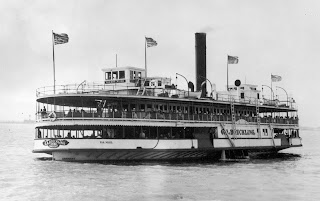
Boeckling
Lake Erie's Yesterdays
At the Cedar Point dock, 1,200 passengers aboard the "Boeckling" looked on in horror as the twister tore apart the waterfront.
                                                

                                                Cedar Point
            Lake Erie's Yesterdays 

 Nine city blocks bounded by Adams Street, Market Streets, and Washington Park were damaged. By the time the tornado headed out into Lake Erie, it had killed eight Sanduskians and destroyed more than 100 homes and 25 businesses in the city. 


Tornado's Path
Courtesy of Cleveland Memory
                                               
The deadly funnel then came down at Cedar Point. Shortly after 5 P.M., it roared ashore at Lorain's Lakeview Park ripping a three-mile path of death and destruction through the city's downtown.  The grim tally in Lorain was 72 people killed, 500 homes destroyed, and another 1,000 damaged. Fifteen bodies were found among the wreckage of the State Theater and another eight were discovered in the collapsed Bath House.  Cars were blown into Lake Erie and nearly every downtown business sustained damage.  The freighter "Henry Ford II," under construction at the American Shipbuilding yards, broke its moorings and rammed a bridge on the Black River pushing it four feet off its foundation. 

The National Guard, Salvation Army, Red Cross, and search and rescue teams made up of ordinary citizens worked through the night to locate the missing and injured. Doctors and nurses came from Clevcland, Ohio to treat the injured. But it would be weeks and weeks before life in the two cities returned to anything that resembled a normal existence. 

No one knows the exact number of human lives lost that deadly day in 1924, but 85 has become the accepted figure. The so-called "Lorain-Sandusky Tornado" ranks 22nd on the nation's list of the 25 deadliest tornadoes. It remains the only Ohio tornado to make that infamous list.  

Less than a year later, the Midwest would experience the nation's deadliest twister.  The "Tri-State Tornado" took the lives of 695 people along a 220-mile track through Missouri, Indiana, and Illinois.  Since then education, better forecasting, communication and construction techniques all have helped lessen the deadly impact of a tornado. However, tornadoes continue to be nature's deadliest phenomenon.

____________________________________________

Note: See the excellent  "Sandusky History" blog for more details and photos.


Tuesday, April 21, 2020

The Sinking of the Lusitania

RMS. Lusitania

On May 7, 1915, the RMS Lusitania, the British ocean liner, the largest in the world, was returning to Liverpool, England on her 101st voyage across the Atlantic. A German U-boat torpedoed and sank her in 18 minutes. Nearly 1200 of some two thousand passengers and crew perished in the attack, including 120 Americans.


Charles Frohman

 Alfred Vanderbilt, one of the world’s richest men and a great sportsman, was aboard. He was headed to England to purchase horses and hunting dogs. Charles Frohman perhaps the greatest theater impresario to have ever lived, had also booked passage.  He was born in Sandusky, Ohio in 1860.  He and his two brothers, Gustave and Daniel, owned and managed a large number of theaters in London, Paris, and New York where their productions were featured. 
                                               
The Royal Navy had blockaded Germany at the start of WWI. Submarine warfare was intensifying by the spring of 1915. The German embassy in the United Sates had placed notices in New York newspapers, warning of dangers of sailing on the Lusitania. She was known as the “Greyhound of the Seas” because of her speed. The Lusitania’s crew and the Cunard Line felt secure in the belief that she could easily out sail any submarine.  However, some Americans did pay heed and the Lusitania left New York with less than half her usual number of passengers.


Alfred Vanderbilt
 Walther Schwieger, captain of U-boat 20 watched the tragedy unfold through his periscope. He wrote in his log that the “ship stops immediately and heals over to starboard quickly, immersing simultaneously at the bow… Great confusion reigns on board.” Indeed, passengers were panic stricken.  The few lifeboats that were loaded and lowered foundered in a matter of minutes, drowning those aboard.

And “Eyewitness to History” article states that Vanderbilt and Frohman went to the ship’s nursery. Hoping to save the babies, the two men tied life jackets to wicker “Moses baskets” that held the little ones.  The baskets were carried off the ship as the water rose, but none survived the wave action created as the enormous vessel sank. 

With Frohman at the end was actress and rising star Rita Jolivet, who survived the tragedy. Testifying at the Enquiry Board, she stated that she, Charles Frohman, and her brother-in-law held hands and went out on deck. "The water swept me away from my brother-in-law and Mr. Frohman."


RMS Lusitania

Americans were outraged when they learned of the sinking.  Germany justified the attack by stating the ship was secretly carrying munitions to help the British war effort. President Woodrow Wilson protested to the Germans.  Americans’ attitudes began to turn against Germany. When the United States entered WWI two years later, the tragedy of the Lusitania was a factor. It was not until 1982 that the British admitted therewas a “large amount of ammunition in the wreck.” It still remains a safety issue to those interested in salvage operations. Charles Frohman’s body was recovered and returned to the United States. He was buried in Queens, New York. 
   

Sunday, September 16, 2018

The Baloni Bullet and the Black Hand

The " Baloni Bullet" was discovered in a manila envelope in a bound volume of "Sandusky Register" newspapers during obituary indexing


On the night of March 9th, 1916, James Baloni (aka Bologna) rushed into the home of Angelo Lauria (aka Lowrey) to call the Sandusky police. He reported to Chief Weingates that his older brother Giuseppi (aka Thomas) Baloni had been shot in the neck and lay dead in the alley at Camp and North Depot. James had also suffered a gunshot wound to his thigh. Both had come from Italy and were working as section men on the Pennsylvania Railroad.

James told police that he had no idea who had shot them. But the coroner noted there were powder burns on Giuseppi’s neck, indicating the murderer was at close range. He also discovered a 32 caliber revolver with 5 loaded chambers lying beside the body. Surely, there was more to the story than what James was telling the chief. In fact, James was also carrying a fully loaded revolver.

Weingates interrogated James before taking him to Providence Hospital. He also questioned Angelo Lauria…. No one was talking. The chief hoped the bullet would reveal the truth. Had the Baloni brothers fought and shot each other? Had Angelo Lauria shot both brothers? What was the motive? Was it a family argument or was it the work of the “Black Hand”?

Black Hand tactics were at work in Italy at the turn of the century and then infiltrated Italian neighborhoods in large U.S. cities. Black Hand gangs used extortion and threats of violence to extract protection money from their intended victims. The term Black Hand evolved from the cryptic notes that bore black lettering and drawings. Now, Chief Weingates suspected the Black Hand may have come to the Sandusky area.

Eventually the bullet did reveal the truth. It was not of the same caliber as that of the Baloni brothers’ revolvers. Pressuring Angelo Lauria further, he confessed that it was his brother Dominick who had murdered Giuseppi and wounded James. Dominick had fled the city on the very night of the killing.

Less than a week later Diego Lauria, cousin of Dominick and Angelo, turned up dead at the Vissenera boarding house. Two 38 slugs were extracted from his head. All eight boarding house residents were held at the police station and questioned. Chief Weingates told the “Sandusky Register” reporter that Diego had been implicated in a Black Hand murder at Marblehead a few weeks earlier.

Further investigation led Chief Weingates to suspect boarding house resident Vincenzo Denneria as the man who had killed Diego Lauria. Vincenzo was picked up while on the run in Toledo. He later confessed that he had murdered Diego because he feared Diego was out to “get him.” The two had quarreled when Diego had lured Vincenzo’s cousin Mariano Dennaria to Marblehead to extort $100 from another Italian. In a matter of three weeks, Giuseppi Baloni, Diego Lauria, and Mariano Dennaria had all been victims of revenge. Chief Weingates’ theory had proved correct. The Black Hand had indeed come to Sandusky.


Tuesday, March 28, 2017

Alys McKey-Bryant: Female Aviator, Deep Sea Diver, and Barrier Breaker

Alys McKey Bryant and Ottomer Savanack: Taken at Battery Park in Sandusky as the two  work on Tom Benoist's Flying Boat 106
Charles E. Frohman Collection
A woman once called a "Jack of all trades and master of none" by her mother, Alys McKey-Bryant wound up trailblazing her way into the history books thanks to her passion for aviation and her reckless abandon for the gender norms of her time. Her response to her mother, "Well perhaps it is good... to be able to do several things, for then one is never out of a job." It was a testament to the life she lived and the legacy she left behind. 

In 1912, Bryant was living in California and spending her time rebuilding a Curtiss-type pusher aircraft and teaching herself to fly. By the summer of the following year, she made history as the first female to fly in Canada when she took off at Minoru Park, Vancouver, on July 31, 1913. That year, she also barnstormed in Washington, Oregon, and Idaho.  

John Milton Bryant came into Alys' life early in her flying career. It was he who signed Alys as a barnstormer pilot. But within ten short weeks of their marriage, Alys became a widow. Days after Alys' historic Canadian flight, John lost his life while flying an exhibition at Victoria on August 6, 1913.  

Within three years of rebuilding her plane and learning to fly, Alys McKey-Bryant found work as an aircraft mechanic in 1915. This is also the year she met Tom Benoist, who would soon become both her employer and close friend. Benoist had opened The Benoist Airplane Company in Sandusky, Ohio. Alys became Benoist's factory supervisor, mechanic, and flight instructor. Two of her responsibilities were building aircraft and training students for military service as airmen. Their friendship was short-lived, however, as Benoist lost his life in a freak accident as he stepped off the local street car in June of 1917.  After his death, classes were suspended and the factory shut down, leaving Bryant to sort through all of the drawings, patent records, and office files for the now defunct company. 
Alys McKey Bryant and Elmer Straub stand before Benoist Flying Boat 106. and Benoist Aviation  students: Reinhardt Ausmus, George Thompson, Marian Baily, Horace Leper, George Lites, Otis Kline, Brubaker, Ottomer Savanack, Verne Carter at Battery Park, Sandusky, Ohio
Charles E. Frohman Collection
Bryant penned an unpublished manuscript, Born With Wings, which provided insight into her personal life, as well as her time at what had come to be affectionately referred to as "the Benoistery." The stories she shared about her work, the students, and their leader painted a picture of a man who was idolized by those fortunate enough to learn from him and who left a hole the size of a crater in his wake. 

She also spoke of a plane she spent time designing and building during the winters when Lake Erie was frozen and flying was not possible. Although this "pursuit style" aircraft made it as far as partial fabrication. it was ultimately never finished. 

Charles E. Frohman Collection
Staying true to her "jack of all trades" philosophy, she had interests in fields involving land, air, and sea. A business card advertises her services as both an aviator and a deep sea diver, but her love for the air ran the deepest, and it also garnered the majority of her recognition. 

During the celebration of the twenty-fifth anniversary of her historic flight in Canada, Bryant stated that, "Although WINGS have given me everything--and have taken from me-- everything but my own life--my love for them has never diminished and now my one thought--one prayer-- is that WINGS may be used--NOT for destruction, but for making more friendly and understanding relations between the nations of the earth."

Guest Post by Amber Lewis, Archival Intern Hayes Presidential Library and Museums


Thursday, January 12, 2017

Sailor George Earl Swank of Sandusky, Ohio

This photograph of George Earl Swank in his baseball uniform is from the Joyce Zeigler Collection. George Earl Swank was the son of Mr. and  Mrs. George Swank, who were one-time residents of Fremont, Ohio, but later moved to Sandusky, Ohio.

Swank served as a midshipman for two years in the fleet that took part in 1914 in the "Tampico Affair" in Mexico. His ship was sent to protect the large number of American citizens who resided there.  When Swank returned, he signed on as a deckhand on the sand sucker Recor, one of the vessels that made up the fleet of the Kelleys Island Lime and Transport Company. On April 17, 1915, Swank lost his footing on the dock while tying up the boat. He fell into the bay, probably striking his head on the dock.  Captain Omar Myers and a a group of men pulled Swank from the water within five minutes. Sadly, despite every attempt to resuscitate him, the 25 year-old Swank passed away a short time later at Good Samaritan Hospital.


Sunday, February 1, 2015

Louis Rau, Company H 72nd Ohio Volunteer Infantry


Private Louis Rau, Co. H, 72nd Ohio Volunteer Infantry


Wedding  photograph of Louis Rau & bride Mary E. Seitz Rau

April 21, 1879


Home of Louis and Mary E. Seitz Rau
626 Mills Street, Sandusky, Ohio

 Spring/Summer 1880


Some weeks back I received information about a Civil War soldier who served in the 72nd Ohio Volunteer Infantry raised by Fremont, Ohio attorney Ralph Buckland. The regiment was made up largely of residents of Sandusky and neighboring counties. 

Jack Smith of South Bend, Indiana shared these photographs of his great grandfather Louis Rau, who was born in Prussia February 25, 1843. He was a farmer and the son of John Rau. At the age of 21, Louis Rau was recruited at Sandusky, Ohio, December 1, 1861 by Captain Anthony Young and served in Company H under Captain Michael Wegstein. Rau fought at the Battle of Shiloh, the Siege of Corinth, and the Siege of Vicksburg. 

At Vicksburg, Rau became so ill with intermittent fever and diarrhea, he was determined unfit for field service. He was given a 30-day furlough and discharged on a surgeon's certificate of disability on December 1, 1864. He then served in the Veterans Reserve Corps. February 25 1865, he re-enlisted in Captain William Fisher's Company F of the 107th  Ohio Volunteer Infantry for one year. He fought at Sumtersville, South Carolina and at Swift Creek. On July 13, 1865, Rau was transferred to Company C. of the 25th Ohio Volunteer Infantry. He was honorably discharged at Charleston, South Carolina at the end of his term of service on February 24, 1866.

Rau returned to Sandusky, Ohio and married Rosa Bader, whom he divorced in 1875. Four years later, on April 21, 1879, he married Mary E. Seitz. They were the parents of three children: Louis, born Feb. 17, 1880 died August 7, 1880; Anna M. born May 7, 1881; and Laura M. born January 20, 1883.

The family lived at 626 Mills Street in Sandusky. Louis Rau worked in Sandusky's fisheries. Louis Rau died of a heart attack at the age of 72 on March 27, 1916. He is buried in Sandusky's Oakland Cemetery.

                                         Oakland Cemetery
                                       Courtesy of Find a Grave

Louis Rau sparked a strong interest in the Civil War for his great grandson Jack Smith, Smith began collecting original images of Abraham Lincoln in 1959. His collection of more than 750 images was one of the largest known collections. It was acquired by the Indiana Historical Society in 2003. The collection is cataloged and appears online. 


k

Thursday, May 15, 2014

Jacob Kuebeler and the Kuebeler Monument at Oakland Cemetery


Erecting the Kuebeler Monument
Oakland Cemetery
Sandusky, Ohio
1907
Charles E. Frohman Collection


When Jacob Kuebeler passed away in the spring of 1904 at his home in Sandusky, Ohio, the local paper heralded the millionaire as its wealthiest citizen. Indeed, he was! Jacob Kuebeler had gained his wealth through years of hard work. One of sixteen children, Kuebeler was born in Herigen Hessen, Nassau, Germany in 1838. At the age of 22, left his homeland, arriving in Sandusky just before the Civil War. The following year, he married Christina Zimmerman. They were the parents of two daughters.

For the next four years he toiled in a Sandusky brewery. After spending a short time in Akron at the Oberholz Brewery, Jacob returned to Sandusky. With his brother August, he founded a small brewery in Sandusky. It was known as Jacob Kuebeler and Company. Only 20 barrels could be produced each day, but Kuebeler’s product was an immediate favorite. Kuebeler had only a single horse and wagon to make deliveries.


Jacob Kuebeler and John Stang
Courtesy of Sandusky History


The business grew and in 1893, stock was issued under the name Kuebeler Brewing and Malting Company. Three years later, Jacob Kuebeler’s brewery merged with the Stang Brewery with Jacob Kuebeler as its president. The Kuebeler brewery was one of the largest businesses in the city and later became part of the Cleveland and Sandusky Brewing Company.


Kuebeler also invested in local enterprises. Among them were the Cedar Point Pleasure Resort Company, Diamond Wine Company, Oak Harbor National Bank, Gilchrist Transportation, and others. Kuebeler’s brewery and businesses were responsible for much of the local employment.

According to the Sandusky Register, more than 3,000 people paid their respects at the Kuebeler home. The funeral cortege was a half mile long. It seemed only fitting that this great brewer and businessman should have a monument worthy of his accomplishments. To that end, Joseph Carabelli, the successful Italian sculptor and stone cutter of Cleveland was commissioned to create an appropriate marker for Jacob Kuebeler’s gravesite at Sandusky’s Oakland Cemetery. Sandusky’s cemetery was typical of the park-like cemeteries of the Victorian era that flourished after the Civil War and spread rapidly throughout Ohio

Carabelli, designed monuments for all of Cleveland’s most prestigious families, including that of John D. Rockefeller. For Kuebeler, Carabelli created a magnificent obelisk that weighed 80 tons and was 48 feet high, twice the height of any monument in Sandusky’s Oakland Cemetery.

Above is a rare image produced from a glass plate negative in the Charles E. Frohman Collection. Taken in September 1907, the picture features Joseph Carabelli himself. He and his workmen were about to hoist the Kuebeler obelisk atop the sections that make up the base of the monument. Carabelli, wearing a vest, is pictured standing near the obelisk. Today, Carabelli’s work on the Kuebeler lot still remains the tallest monument in Oakland Cemetery.Below is a photo taken by local commercial photographer Ernst Niebergall.


Kuebeler Monument
Photograph by Ernst Niebergall
Charles E. Frohman Collection

Tuesday, February 12, 2013

Carl Ohlemacher and the 14th U. S. Infantry


Private Carl Ohlemacher (top row left)  
14th U. S. Infantry, Companies D and F
1899 - 1902
Mr. and Mrs. John Ohlemacher, Huron, Ohio, donated this print of Private Carl Ohlemacher and Companies F and D of the 14th U. S. Infantry, known as the Golden Dragons. Born in Sandusky, Ohio, Ohlemacher worked as a cooper. At the age of 18, he enlisted in the 14th U. S. Infantry for three years service. Later that same year, the 14th sailed for the Philippines, where they fought in the Philippine Insurrection. Ohlemacher particpated in the battles of Paramagne and Zapote.

In August of the following year, the 14th was deployed to China to put down the Boxer Rebellion. The unit was part of the United States' 2500-man force under the command of Major General Adna Chaffee, who had arrived only weeks earlier.

The China Relief Expedition was made up of a coalition of 19.000 American, Russian, Italian, French, Japanese, British, German, and Austrian soldiers. Their mission was to rescue United States citizens and foreign nationals held during the 
Boxer Rebellion. They moved toward Peking, fighting in the battles of Pie-tsang and Yang Tsun, where Ohlemacher's 14th served as the spearhead for the eventual victory. At Peking, the 14th scaled the Tartar Wall and placed the first foreign flag ever to fly over the wall. Their efforts made it possible for British regiments to reach and relieve the legation compound. In gratitude, the Chinese presented the 14th with a large amount of silver bullion.

Courtesy of U. S. Army Art Collection

Excerpt from Major General Adna Chaffee's report.....

I withdrew the troops from the legation and camped just outside near the Tartar wall for the night. My casualties during the day were 8 enlisted men wounded in the Fourteenth Infantry, 1 enlisted man wounded of Battery F, Fifth Artillery, and 1 officer and 2 enlisted men wounded of the marines.
Upon entering the legations the appearance of the people and their surroundings, buildings, walls, streets, alleys, entrances, etc., showed every evidence of a confining siege. Barricades were built everywhere and of every sort of material, native brick being largely used for their construction, topped with sandbags made from every conceivable sort of cloth, from sheets and pillowcases to dress materials and brocaded curtains.

Many of the legations were in ruins, and the English, Russian, and American, though standing and occupied, were filled with bullet holes from small arms, and often having larger apertures made by shell.
 

The children presented a pitiable sight, white and wan for lack of proper food, but the adults, as a rule, seemed cheerful and little the worse for their trying experience, except from anxiety and constant care. They were living on short rations, a portion of which consisted of a very small piece of horse or mule meat daily. The Christian Chinese were being fed upon whatever could be secured, and were often reduced to killing dogs for meat. All the surroundings indicated that the people had been closely besieged, confined to a small area without any comforts, no conveniences, and barely existing from day to day in hope of succor.
 
Ohlemacher was discharged at Fort Snelling, Minnesota in March 1902, the expiration of his term of service. He returned to Sandusky, where he married Mary Hengel and attended St. Mary's Church. The father of five children, Ohlemacher worked at the Farrel-Cheek Foundry. He passed away in Sandusky December 1935.


Thursday, January 24, 2013

Sandusky's "Crystal Blue, Clear as Glass Ice"


Local Ice Dealers Loading Blocks Directly from the Ice Fields
Ernst Niebergall ca. 1911/1912
Charles E. Frohman Collection
Sandusky, Ohio, was the largest ice producer west of New York City during the latter half of the 19th century. Noted for its solid, "crystal blue, clear as glass" ice, the city became known as the "Ice Capital of the Great Lakes." Icemen eagerly watched the waters of Lake Erie until they froze to a depth of 8 to 16 inches. For as long as "good ice makin' weather" held, Sanduskians endured ten-hour days of harsh winds and frigid temperatures for a daily wage of $2.

In the picture above, taken during the winter of 1911 or 1912, many local dealers from Sandusky and neighboring towns filled their orders by loading their delivery wagons directly from the ice fields.

Sanduskians harvested 400,000 tons of ice each winter. The greater portion of the harvest was stored in some fifty sheds that dotted Lake Erie's shoreline. Sandusky provided most of Ohio's cities with ice, including 90 percent of the ice consumed by the city of Cleveland. According to the local paper, Sandusky's "crystal quality put the murky, sewer-tainted" Cleveland ice to shame. Most of the ice was shipped across the lake as needed from a string of icehouses located on Put-In-Bay's Peach Point.

Tuesday, February 5, 2008

Glenn Curtiss and the 1910 Flight from Euclid Beach to Cedar Point

Glenn Curtiss
[from the Charles E. Frohman Collection]

It was a more than a strange sight to the 100,000 spectators who jammed Cleveland’s Euclid Beach in late August 1910. A man with goggles, helmet, and an inner tube draped around his neck was stepping onto what looked to many like a box kite. In reality, it was Glenn Curtiss and his Hudson flier, preparing for a flight over the waters of Lake Erie from Euclid Beach to Cedar Point.

Sponsored by Cedar Point and Cleveland’s “Press,” the flight was intended to bring publicity to the Lake Erie resorts. For Curtiss, the 64-mile trip would mean $15,000 in prize money if he could make the trip in under an hour, circle the Breakers Hotel at 3,000 feet, and return to Cleveland the following day. More importantly for Curtiss, it would mean breaking the world record for over-water flight held by the Frenchman Bleriot who had flown the English Channel.

Throwing up sand, Curtiss bounced down three hundred feet of beach, barely missing a retaining wall, before turning to pass over the cheering throngs below. Loaded down with 10 gallons of gas and two quarts of oil, Curtiss’ 850-pound pusher-type biplane could barely rise above 200 feet. The aviator hugged the shoreline to avoid wind currents that began to tax his 30-horsepower engine. Curtiss shifted from side-to-side in his seat to balance the fragile craft.

Few believed that Curtiss could make the daring flight. Rescue boats; stationed off shore at Edgewater Park, Rocky River, Avon, Lorain, Vermilion, and Huron, testified to their lack of faith. More than 300,000 people were strung out along the route to catch a glimpse and perhaps help pluck the “birdman” from the water.

Although Curtiss foresaw the day when planes could carry “up to ten passengers,” he too had his doubts on that August afternoon. Wind gusts slowed the craft at Lorain and Huron. But soon Curtiss could see the Breakers and some 20,000 onlookers waiting for him on the beach. In a slow descent, he skimmed the waves and dropped lightly to the beach. The crowds swarmed the aviator, tearing off his goggles and gloves, and hoisting him onto their shoulders.

Amid rain, gusts of wind, and blowing sand, Curtiss took off for Cleveland the following day. So strong were the winds on the return flight that Curtiss feared that his Hudson flier would break up completely. It took 102 minutes, but the brave pilot landed safely at Euclid Beach where thousands once again mobbed him in a wild celebration.

Monday, February 4, 2008

Success

On the Fourth of July 1946, hundreds watched from the Port Clinton, Ohio shoreline as one of the world’s most notorious and controversial ships burned to the waterline in a spectacular blaze. Gone for more than six decades, the ship Success remains as fascinating today as she did when she sailed the world.

Success aground at Sandusky, Ohio

Laid down in 1840 in Burma as an East Indiaman, the Success carried trade from Southeast Asia to England. Within a few short years, she was transporting settlers to Australia’s Swan River. But in 1852, the Success’ crew, overtaken by gold fever, abandoned her at Melbourne. The Victorian government soon purchased the 137-foot vessel along with four other hulks to confine its burgeoning “criminal” population.

Moored off Williamstown, the Success was fitted out with cells to hold its cargo of prisoners. Over the next years, tragedy and terror stalked her decks - first with prisoners and then with women and boys held in government detention. In 1885, when the Australian government deemed the “felon fleet” inhumane, the ships were ordered broken up. Somehow the Success escaped the fate of the others. Alexander Phillips acquired her and converted the hulk into a floating museum, featuring all the horrors of Australian prison life. Despite his efforts, Phillips’ venture was less than successful.

Purchased by a syndicate, the Success sailed to England in 1895. She toured ports throughout the British Isles, where curious visitors flocked to the ship to see her cells, torture chambers, and wax figures. In 1912 the Success crossed the Atlantic once more. This time she sailed for America, where huge crowds met her at every port-of-call.

Fact and fiction merged as her devoted crew of showmen thrilled visitors with horror stories and tours of ghoulish exhibits. Eventually, truth gave way to myth and she became erroneously known as the “Convict Ship” that had transported convicts from England to Australia.

In 1915, the Success sailed south, passing through the Panama Canal to take part in San Francisco’s Panama-Pacific Exposition. Indeed, the old ship lived up to her name; her tour of the West Coast was an unqualified “success!” Under new ownership, she returned to the Panama Canal and toured ports in the Gulf region, the East Coast, and along the Mississippi.

In 1923 she made her first tour of Great Lakes ports where thousands packed the old vessel at Chicago, Cleveland, and Detroit. After sailing the Great Lakes for nearly a decade, the Success found a permanent home in Cleveland.

Neglected, more than a century old, and no longer seaworthy, the Success was towed from Cleveland to Sandusky through the efforts of Harry Van Stack. A South African native, Van Stack had hired on in 1925 as a lecturer. Following a heavy storm, she settled on the bottom alongside her moorings. In 1945, her final owner towed the Success to Port Clinton, where she grounded in 16 feet of water a half-mile off shore. Fall storms and ice took their toll until only her teak timbers could be salvaged.

In 1963, the widow of Harry Van Stack donated books, pamphlets, artifacts, advertisting materials, photographs, and newspaper clippings, associated with the Success to the Hayes Presidential Center.