Showing posts with label Rutherford B. Hayes. Show all posts

Wednesday, February 5, 2025

Recollections of 1883 Flood at Fremont, Ohio


1883 Flood  Recollection

Lucy Elliot Keeler, a resident of Fremont, wrote about the 1883 flood:

"Before dawn on the Sunday morning of February 4, 1883, the Fremont fire bell aroused the citizens who found hundreds of their dwellings surrounded or already inundated by water. Heavy rains of two days, falling upon a frozen ground, with ice gorges formed below town, had caused a sudden rise of water in the river four or five feet above any previous high water mark. The water flowed through Front street, the principal business street of the city, with a mighty current which no boats could stem. The whole third ward between the river banks and the foot of the hills was several feet under water; huge ice blocks floated in, packed and froze solid. Two thousand persons were driven from their homes. There were many narrow escapes and several deaths from drowning and exposure. Several bridges along the river were carried away, and that of the L. S. & M. S. Railway collapsed under a freight train, thirty-seven cars being precipitated into the river. The damage to property in Fremont alone amounted to about $100,000. Loss in the upper towns of Tiffin, Bucyrus and Upper Sandusky was also large."

Excerpted from: Keeler, Lucy. "The Sandusky River: Its Geography, History, and Tradition." Columbus, Ohio, 1904.


Fremont, Ohio

 Rutherford B. Hayes Library and Museums

                   Excerpts from the Diary of Rutherford B. Hayes

February 4 -- The last two days will be long remembered. Yesterday for the destruction of trees, today for the greatest flood ever known at Fremont. The rain Saturday morning began to freeze as it fell.  The telegraph wires became so heavy with ice that the poles were broken or pulled over, and the whole telephone and telegraph system of this neighborhood broke down.  The small twigs were covered with ice until they were an inch in diameter.  All the weak-limbed trees suffered greatly. For two or three hours the crash of falling limbs was almost constant.  Even a small limb falling with its ice and the ice on other limbs which it broke would make a roaring noise. Lucy and the family watched the scene with the greatest interest. Many favorite trees were badly marred.  Old trees of all sorts lost large limbs.  Soft maples, cottonwood, and elms suffered particularly. Young white oaks and evergreens stood up best. The losses that grieved us most are the injury to the large elm northeast of the house; one half of the tall sassafras; the young hickory in the orchard; the damage to three of the large old oaks, [and] to the four street elms. 

Sunday was  given up to the flood and the rescue and relief of the sufferers.  No such flood was ever seen here before.  The water filled the valley from bluff to bluff. It ran two to four feet the whole length of Water Street, and drove from homes  perhaps one to three hundred families.  Men with skiffs were at work all day, rescuing people.  One woman was drowned--others perhaps.  The water reached on the pike (State Street) to the west of Arch Street, on Croghan Street south side to the--. On Birchard Avenue it ran in rear of the Ball House and within two inches of the lower side of the water table of the building. The anecdotes of escapes, losses, and experiences are without number and often very interesting,

Note: The following day Hayes asked for voluntary contributions since it was decided the need was immediate and asking the state legislature for funds would take too long. Hayes organized a committee of five men who would take charge of  finance, supplies, and distribution. Hayes contributed $100 of the $1000 raised. 


Tuesday, November 30, 2021

Frederick Douglass and the Fight for Freedom


Some weeks after President Rutherford B. Hayes left office, he received a letter marked “personal”. It began, “I express to you and to Mrs. Hayes my lively sense of the uniform kindness and consideration shown me from first to last during your Presidency of the Republic. You gave me at the beginning a higher place under the Government than was ever given to my race before. Neither time nor events will make me forgetful of your justice and magnanimity…. No man will be allowed to speak disparagingly of your administration in my presence without reproof.  With grateful recollections.” - signed Frederick Douglass. 


Frederick Douglass Letter to President Hayes

Hayes Presidential Library and Museums

Learning that he was soon to be inaugurated as President of the United States, Hayes consulted with Douglass and told him his views regarding his Southern Policy. Douglass approved. Hayes recorded in his diary that Douglass “had given him many useful hints regarding the subject.”

On March 17, 1877, in executive session, Hayes put forth Douglass’ name as United States Marshal of the District of Columbia. Senators overwhelmingly confirmed Hayes’ choice. It was to be the first of several federal appointments, including Recorder of Deeds for D.C.; and Minister Resident and Consul General to Haiti.


Frederick Douglass


Born into slavery in 1818 in Maryland and given the name Frederick Augustus Washington Bailey, Douglass knew little of his mother and never learned the identity of his father. At the age of 8, his slave owner hired him out as a body servant in Baltimore where Douglass taught himself to read. Some 7 years later, the slave owner brought him back to the Eastern Shore to work in the fields. Douglass rebelled and physically fought back. He was returned to Baltimore where, disguised as a sailor, he hopped a train using money borrowed from a free black woman named Anna Murray, who later became his wife. It was then that they chose the surname of “Douglass.”  Settling in Massachusetts, Douglass worked as an agent for the Massachusetts Anti-Slavery Society, where his fame grew as he spoke out against slavery throughout the North and Midwest.  Fearing that he would be captured, Douglass fled to the United Kingdom where abolitionists purchased his freedom.  


     North Star           


Once free, he returned to America and allied himself with abolitionist William Lloyd Garrison, helped people on the Underground Railroad, published the “North Star.” Two of his sons fought in the famed 54th Massachusetts. Following the war, Douglass, now widely known and highly respected, pressed for equal citizenship and voting rights.  He later held positions at Howard University and became president of the Freedman’s Bank.

Along with his duties as Marshal, Douglass brought many of his friends and associates to meet the Hayeses. Among them were soprano Madame Selika and Josiah Henson (believed to be the inspiration for Uncle Tom in “Uncle Tom’s Cabin.”) He attended Diplomatic Corps receptions and state occasions. All the while he traveled and lectured on racial equality and women’s rights. (And on several occasions, he spoke at Fremont, Ohio's Birchard Hall.)


Rev. Josiah Henson

Courtesy of Smithsonian

Learning of Lucy’s death in 1889, Douglass sent a letter to Hayes, expressing his heartfelt condolences. His home, Cedar Hill in Anacostia, is today a National Historic Site. It was here that Douglass died at age 77, after a life time spent in the fight for freedom and equal rights for all.


Frederick Douglass Home, Cedar Hill, Anacostia

Courtesy National Historic Sites


Friday, January 10, 2020

A Breed Apart: The 8th Kentucky Cavalry


John Van Meter

 The 8th Kentucky Cavalry was formed during the late summer of 1862 and mustered into Confederate service in September. The regiment became one of General John Hunt Morgan’s handpicked cavalry units.
In June 1863, Brigadier General John Hunt Morgan left his Tennessee camp on a raid with nearly 2,500 men, intending to divert the attention of the Union Army of the Ohio from southern forces. On July 8, 1863, Morgan crossed the Ohio River at Brandenburg, Kentucky and entered Indiana against orders. He raided, destroyed property, and stole food and horses.  After his victory at the Battle of Corydon, Morgan headed eastward into Ohio where he terrorized its citizens. Pursuing him, was Union Brigadier General James Shackelford.
Weary and with Union forces closing in, Morgan headed for the Ohio River, searching for a ford. Colonel Rutherford B. Hayes and his 23rd Ohio troops made a night march and boarded waiting steamers. He met Morgan’s men at Pomeroy, but when the cavalry raider realized he was facing Union soldiers rather than local militia, Morgan took flight. On July 19, 1863, Morgan attempted to cross the Ohio River into West Virginia at Buffington’s Island. Union forces of Brigadier General E. H. Hobson and Henry M. Judah captured between 800 and 1,200 of Morgan’s troops. Some three hundred escaped across the Ohio River.
Most of the men of the 8th Kentucky were among those captured  at Buffington’s Island on July 19, 1863. Pictured here are Privates Jesse Spencer and John Van Meter. Both had enlisted at Winchester, Kentucky in the fall of 1862 

After several days at Indiana’s Camp Morton, they, along with hundreds of Morgan’s Raiders, were imprisoned at Chicago’s Camp Douglas, one of the worst Union prison camps. Captives suffered from malnutrition, disease, torture, and exposure. The guards considered them to be “a breed apart.” Excellent organizers and possessed of leadership skills, they frequently attempted to escape by tunneling, scaling the walls, and disguising themselves as civilians.


Jesse Spencer


Spencer and Van Meter both were recaptured after escape attempts. They survived Camp Douglas and at war’s end were shipped to Point Lookout, Maryland and then south to City Point, Virginia. Still defiant, many of Morgan’s Raiders refused transportation and walked to their Kentucky homes.
Spencer and Van Meter’s photos are two of 25 taken by Camp Douglas photographer D. F. Brandon. They are part of an album originally owned by another 8th Kentucky prisoner, but today part of the Hayes Presidential Library and Museums' Local History Collection..
For a civilian account of the events of Morgan’s Raid near Glendale, Ohio, read 9-year-old Katie Huntington’s letter.on an Ohio's Yesterdays post. Click on the link below

 https://ohiosyesterdays.blogspot.com/search?q=morgan

Thursday, July 20, 2017

Governor Rutherford B. Hayes and the Lincoln and Soldiers Monument at the Ohio Statehouse

Guest Post by
David Boling, Ohio Statehouse Tour Guide

In early January,1872  Rutherford B. Hayes was completing his term as Ohio's governor. He wrote in his diary a list of what he believed were his most important acts of legislation and accomplishments since coming into office in 1868. Nestled between the passage of the Fifteenth Amendment to the Constitution of the United States and creation of an ''Asylum for the Inebriate"  in Mansfield, he lists item number 12,   The Lincoln Memorial - T. D. Jones (See Diary entry, January 9, 1872)


What memorial to Lincoln? Where is it? Does it still exist? What role did Governor Hayes have in its creation? Perhaps most important why was this so important to Governor Hayes?

I am a tour guide at the Ohio Statehouse. On our daily tours of the Ohio Statehouse, one of our stops in the Rotunda is a large marble tableau (pictured below) that honors Abraham Lincoln and the soldiers who fought at the battle of Vicksburg in the summer of 1863.


Standing 14 feet tall, from floor to the top of the bust of Abraham Lincoln, the Lincoln and Soldiers Monument stands in the same spot as it did when it was dedicated on the evening of January 19, 1871. The dedication itself was quite the event, Here is how it was described in the Cincinnati Enquirer the next day. 
                                                                            

'An immense crowd attended the unveiling, music by the Quintet Choir of First Presbyterian Church was magnificent. Governor Hayes presided. Mr. Galloway, representing the Association spoke first, followed by General William H. Enochs of the House and General Durbin Ward of the Senate. When Mr. Jones unveiled the monument, the crowd gave unequivocal demonstrations of applause.'

'
Governor Hayes presided. As chairman of the Ohio Monument Association, the contracting agent for the memorial. As governor and as a veteran he would have been within his rights to give his own speech, but as Hayes writes the next day in his diary, he chose 'a meritorious thing'.


January 20, 1871, -- I did an unusual, and, I think, a meritorious, thing last night, Tom Jones' memorial to Lincoln and the Ohio Soldiers was to be inaugurated in the rotunda of the Capitol. I presided, I had a fairish little opening speech, which with my good lungs I could make go off well.  But there were three speakers to give addresses. I knew that the little, pretty, pet things to be said were not numerous, and that my speech would more or less interfere with the success of theirs. I accordingly swallowed my speech and introduced the various actors without an extra word. Who has beaten this? 


The Speech I Didn't Make 
Fellow Citizens: -- We have assembled this evening to witness the inauguration, the unveiling of the Memorial -- the work of an Ohio sculptor, Thomas D. Jones, of Cincinnati -- placed here in the rotunda of the State House,  to remain, we trust, as long as the building itself shall stand in honor of the brave sons of Ohio who in more than a thousand conflicts on land and water poured out their lives for Liberty and Union; and in honor also of him who "strove for the fight as God gave him to see the right," and who "with charity for all and malice towards none," "Ascended Fame's ladder so high from the round at the top he stepped in the sky.  


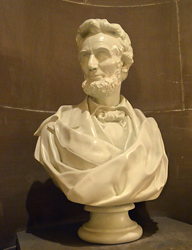
The Lincoln and Soldiers Monument stands in the southeast niche of the Statehouse  Rotunda where it was originally placed, although it was moved to other locations, and the monument and bust were displayed removed and stored for some time. Starting at the top of the 14-foot monument, there stands a bust of Lincoln, done by T.D. Jones in Springfield, Illinois, during the winter months of 1861 after Lincoln's election, but before his inauguration in March. It is one of five known to be in existence for which Lincoln sat. .
 
The surrender of the Confederate army at Vicksburg on July 4, 1863 fills the center tableau (shown below) of the monument.  On the left, General John S. Bowen, Colonel M. C. Montgomery and General John C. Pemberton, who is seen handing over a list of his troops to General Ulysses S. Grant. Standing next to Grant on the right, is General James B. McPherson and General William T. Sherman. All three of the Union generals were from Ohio. On each side there is an orderly holding the reins of a horse to honor all those on both sides who had served.


Just below this scene is a quote from Lincoln's second inaugural address, "Care for him who shall borne the battle and for his widow and his orphans." Use of the words appear to have been a compromise as Governor Hayes had written to his Uncle Sardis Birchard on February 3,1868 that not enough money had been collected to include the 'uprising of the people when Fort Sumter was taken.'


Personally, I think the words are a better choice for they cause us to pause and remember the more than 620,000 Americans, from the North and the South, who lost their lives in the Civil War, and especially the 35,475 who were from Ohio.

The Ohio Statehouse in Columbus offers free tours of the capitol building and of the grounds during the summer. Open seven days a week, I hope you will come and view the monument yourself and learn more about 'the people's house.'


Sunday, September 23, 2012

Retired Naval Commander Donates Civil War Escutcheon of General Manning Force


Ken Juul and General Manning Force's Civil War Escutcheon


This past week, during a visit to the Hayes Presidential Center, retired Naval Commander Ken Juul and his wife Vicki donated the Civil War escutcheon of Juul's great grandfather General Manning Force to the institution. Because of the lifelong friendship that existed between General Force and President Rutherford B. Hayes, Juul felt that the Hayes Presidential Center was an appropriate repository for the escutcheon and other family materials. President Hayes and Lucy named their eighth child and the only one born at Spiegel Grove for General Manning Force. 


Done in oil most likely by the J. P. Reynolds Company of Massachusetts in the 1880s, the escutcheon provides a visual record of his ancestor's Civil War service.  Force, who commanded the 20th Ohio Volunteer Infantry during the Civil War, received the escutcheon as a gift from his comrades. The escutcheon is on display in the Center's Library Reading Room.


General Manning F. Force


Manning Force was born Dec. 17, 1824 in Washington, D.C. to Peter and Hannah Force, the fourth of ten children. He attended Harvard University and Harvard Law School. Upon graduation in 1848, he moved to Cincinnati, Ohio, and entered the practice of law. Force joined the Literary Club of Cincinnati where he met fellow lawyer Rutherford B. Hayes with whom he would form a lifelong friendship


Prior to the Civil War, Manning Force served as a member of the Burnett Rifles.
On August 26, 1861, he was appointed major of the 20th Ohio Volunteer Infantry. The following month, he was promoted to lieutenant colonel. The first battle for the 20th O.V.I. was at Fort Donelson in February 1862. Shortly after the battle of Shiloh, Force was promoted to colonel and placed in command of the regiment. During the 1863 siege of Vicksburg, he served as acting commander of the 2nd Brigade of Mortimer Leggett’s Division, 17th Corps, and was then promoted to brigadier general.

In the summer of 1864, Leggett’s Division joined William T. Sherman’s drive on Atlanta. While leading his brigade in the defense of Bald Hill, Force was struck by a Minie ball. The ball struck him on the left side of his face and exited the upper right side of his skull. Believing the wound fatal, Force was sent home to die. Instead, he recovered and rejoined Sherman’s Army, taking part in the March to the Sea. For his actions at Atlanta, Force was promoted to major general and, in 1892, awarded the Congressional Medal of Honor. Following the Civil War, he was appointed military commander of the District of Mississippi, a position he held until January 1866 when he was mustered out.

Manning Force returned to his law practice in Cincinnati, Ohio. From 1866 to 1875 he served as judge of the Hamilton County Common Pleas Court. He married Frances Dabney Horton of Pomeroy, Ohio, on May 13, 1874. They had one son, Horton Caumont Force

In 1876, Manning Force was defeated in his bid for the U.S. House of Representatives. He later joined the faculty of the Cincinnati Law School and was also elected judge of the Superior Court of Cincinnati. Suffering from overwork, Force resigned his seat on the bench. He spent time with his good friend Rutherford B. Hayes at Spiegel Grove in Fremont, Ohio. After his stay in Fremont and a month long vacation in Europe, Force returned to Cincinnati. In 1888, he was appointed Commandant of the Ohio Soldiers’ and Sailors’ Home in Sandusky, Ohio, a position he held until his death May 8, 1899.
Force wrote papers and books on Native Americans and the Civil War and contributed to legal publications. His interest in music led to his affiliation with the Cincinnati Musical Festival Association. He was a member of numerous archaeological and historical societies.

Saturday, August 4, 2012

Civil War Battle of South Mountain Subject of Lecture by Brian Jordan August 19th at the Hayes Presidential Center


Brian Matthew Jordan

The Battle of South Mountain (Sept. 14, 1862) was the precursor to Antietam. It also was the conflict in which Rutherford B. Hayes suffered the most serious of his five Civil War wounds. Yet, most histories of the war devote little time and attention to South Mountain ... until now.

Brian Matthew Jordan, a cultural historian of the American Civil War, has released Unholy Sabbath: The Battle of South Mountain in History and Memory . The book relies on extensive research with primary sources to show that the Battle of South Mountain not only was a decisive Federal victory, but also a turning point in the campaign.

Jordan made use of the Manuscripts Collections at the Hayes Presidential Center in his research. He now returns to the Center to discuss his findings during a free lecture at 3 p.m. Sunday, August 19 in the Hayes Museum. A book signing follows the talk. Copies of Unholy Sabbath can be purchased in the Museum Store.


Unholy Sabbath: The Battle of South Mountain in History and Memory

In his third year of the history Ph.D. program at Yale University, Jordan is a native of Tallmadge, Ohio. He received a bachelor’s degree (summa cum laude, valedictorian) in history with a minor Civil War Era Studies from Gettysburg College in 2009. He is a frequent speaker at Civil War Round Tables nationwide, delivers tours for Gettysburg College’s Civil War Institute, and the Gilder Lehrman Institute of American History. He also conducts seminars for various Teaching American History programs. His published works have appeared in Civil War History and the Pennsylvania Magazine of History & Biography .

Monday, July 30, 2012

Army of the Ohio Completes Preservation Fundraising For the 23rd Ohio Battle Flag: Announces Adoption of the 25th Ohio Battle Flag


23rd Ohio Volunteer Infantry Battle Flag
with Members of the Army of the Ohio
Courtesy of Sgt. 1st Class Joshua Mann

Sgt. 1st Class Joshua Mann, Ohio National Guard Historian, recently sent me this news release. Thanks to the Army of the Ohio, the necessary funds to allow for the conservation of the 23rd Ohio Volunteer Infantry (OVI) battle flag from the American Civil War. In addition, the group has announced it will continue its preservation efforts by adopting the 25th OVI battle flag.

The group adopted the 23d OVI flag in January 2011 and has since raised $14,755 of the estimated $29,000 needed for the conservation of the nearly 150 year old silk regimental flag. The remaining funding came from a grant from the Army Historical Foundation, an anonymous donation to the Ohio Historical Society and from the general flag fund of the society, who operates the Save the Flags Campaign.

“One of the goals of the Army of the Ohio is to honor the memory of Ohio’s Civil War Soldiers,” says Col. Bob Minton, commander of the Army of the Ohio and Fostoria, Ohio resident. “The simple way to accomplish this is through accurate portrayals of them at reenactments, but to be able to preserve this distinctive symbol of the war is essential to telling the Soldiers story to future generations.”

The 23rd Ohio was organized at Camp Chase, Ohio on June 11, 1861 and served in the eastern theater, fighting at South Mountain, Antietam and Winchester. The members of this regiment gained distinction in military and civilian life. The first commander, William Rosecrans, became a noted general. The 23rd Ohio is also the only unit in the history of the Army to contain two future presidents: Rutherford B. Hayes and William S. McKinley.

The 25th Ohio was also organized at Camp Chase, Ohio on June 28, 1861 and served in the eastern theater. At the Battle of Gettysburg in July 1863 the regiment sustained a loss of 179 of the 220 officers and men it went into battle with. The 25th remained in service until April 1866 and had eighteen color bears killed or wounded, including eight at Gettysburg.

Minton said the groups fundraising efforts took them to numerous events across Ohio and New York selling T-shirts, mugs and selling raffle tickets for Civil War artwork. Additionally, members conducted preservation marches and sought donations from individuals and groups. The group will continue to sell these items to raise the estimated $29,000 required for the 25th OVI flag.

The 23rd Ohio flag will be taken to a conservator later this summer where it will be stabilized in order for the flag to be displayed. The Ohio Historical Society's flag collection is one of the largest in the country. It includes the Ohio Adjutant General’s collection of 553 flags, three quarters of which are from the Civil War. Since the inception of the Save the Flags campaign, 21 of the flags in the collection have been treated and housed in frames for display purposes.

The Army of the Ohio was organized in 1999 to combine the strength of American Civil War reenacting units from Ohio and surrounding states. Currently infantry, artillery and cavalry units from Ohio, New York and Pennsylvania comprise the group.

Sunday, April 29, 2012

Rutherford B. Hayes Exhibit on Display at The Ohio State University


President Rutherford B. Hayes

Legendary Ohio State University football coach Woody Hayes would not have had a place to work had it not been for a man who shared his surname.

Rutherford B. Hayes was governor of Ohio in 1870 when he urged the Ohio General Assembly to pass a bill creating a land-grant university under the Morrill Act of 1862. His persistence led to passage of the bill establishing the Ohio Agricultural and Mechanical College in Columbus - today known as The Ohio State University.

The Hayes Presidential Center and The Ohio State University's Rare Books & Manuscripts Library have partnered to create an exhibit Rutherford B. Hayes: Buckeye President. It is on display May 9 - August 26 in Thompson Library Room 165 at The Ohio State University (1858 Neil Avenue). In addition to exploring Rutherford B. Hayes’ connection to OSU, the exhibit tells the story of his life. Exhibit hours are 10 a.m.- 6 p.m. Monday - Friday and noon - 5 p.m. Saturday and Sunday.

Rutherford B. Hayes: Buckeye President includes artifacts from the Center’s and The Ohio State University's collections.

*Footnote: Rutherford B. Hayes and Woody Hayes are not related.

Thursday, December 31, 2009

William King Rogers and Duluth, Minnesota's Skyline Parkway

Columbus, Ohio native and ordained minister, William King Rogers was an early law partner of and later personal White House secretary to President Rutherford B. Hayes. Before the Civil War, Rogers moved to Minnesota where he was involved in the development of the cities of Hastings and Duluth. He also invested in railroads, a canal across Costa Rica and Panama, and mining interests in northern Mexico. Sadly, Rogers suffered financial losses in nearly all of his investments.

Despite his misfortunes, Rogers made a lasting contribution to the city of Duluth that exists to this day - the Skyline Parkway. As an investor in the Duluth Highland Improvement Company, Rogers realized that the development of his hilltop property depended on better access. As he surveyed the view of the city from the upper terrace, Rogers wrote that "no one can glance over it and doubt that one of the great cities of the world is here in the making...."

To that end, he advocated the construction of an incline railway to reach his land holdings. During a visit to Ohio in the summer of 1889, Rogers met with President Hayes at Spiegel Grove, explaining the importance of constructing the incline.


In his diary, Hayes indicated that he was fully aware that his dear friend Rogers was a poor businessman. Despite his concerns, Hayes agreed to invest in the project. Hayes believed that his share of the cost should have been one-tenth, but in reality, Hayes knew that he was paying one-sixth of the construction costs. To secure his investment, Hayes explained that his portion would only be forthcoming when the incline reached the Duluth property he himself owned. At right, is a 1904 image of the incline railway from the Library of Congress Prints and Photographs Division.


At left, is a map of Duluth given to President Hayes by Rogers. According to Mark Ryan in his article, "The History of Skyline Parkway," the incline intersected with the Old Beach Road, a path that followed a natural terrace left behind by glaciers.

In 1875, Rogers had looked out over the view from the terrace - the lake nearly 500 feet below. It was then that he conceived of a park system that would one day feature a citywide boulevard built across the hilltop, following the natural terrace. Such an improvement, he was certain, would attract more real estate investors.

As head of Duluth's park board, Rogers wrote to Hayes early in 1889, telling him that work on the parks and driveway had already begun. He believed that construction costs for four miles of the terrace boulevard would not exceed $5,000. "Nature has done the work" of creating a natural roadbed by grading, graveling, and draining. A wooden fence followed the boulevard's rim. Boulders were placed near the curves. Known as Rogers Boulevard or Terrace Parkway, the road was an immediate attraction for tourists and locals who enjoyed Sunday caravan rides and the spectacular view of Duluth and its harbor.

Due to ill health, Rogers resigned from the park board in 1891. He returned to Ohio, where he died in 1893. But others had already caught hold of his vision and would extend and complete the scenic byway. The total cost reached $312,000! Originally, the boulevard ran from from Chester Creek to Miller Creek, a distance of some 5 miles. Today, linked by bridges and parks, Skyline Parkway extends nearly 25 miles. Above, right is one of Bob Hendrickson's 2007 photos of Chester Park available on Google Earth. The breathtaking natural beauty that so captivated Rogers more than 100 years ago remains evident today.

Many of Rogers' Papers are located at the Hayes Presidential Center. His correspondence with President Hayes is part of the Rutherford B. Hayes Papers.
Bookmark and Share

Monday, January 19, 2009

Madame Marie Selika: First African American to Perform at the White House


Madame Marie Selika Williams


When President Teddy Roosevelt invited the Tuskegee educator Booker T. Washington to the White House in 1901, there was a storm of media protest. But years earlier, the first African Americans had been invited to the White House without incident. Introduced to President Rutherford B. and First Lady Lucy Webb Hayes by Frederick Douglass, soprano Madame Marie Selika, known as the "Queen of Staccato" became the first African American to perform at the White House. On the evening of November 13, 1878 Marie Selika and her husband, opera singer Sampson Williams, entertained the President and the First Lady and their guests in the Green Room. Her performance included Verdi's "Ernami, Involami," Thomas Moore's "The Last Rose of Summer." "Ave Maria," and Richard Mullard's "Staccato Polka." Williams then sang "Far Away" for the more than fifteen guests who had been invited by the Hayeses to join them that evening.

The following year, First Lady Lucy Webb Hayes accepted Madame Selika's invitation to attend her concert at St. Luke's Protestant Episcopal Church. (It would be another 17 years before another First Lady attended an African American church.) After separating from St. Mary's, a mission church, St. Luke's became the first independent African American church in Washington, D. C. Madame Selika's performance was in support of the construction of the new church built in 1880 on 15th Street NW.

St. Luke's Protestant Episcopal Church, Washington, D.C.

Born in Natchez, Mississippi in 1849, Marie moved with her family to Cincinnati, Ohio shortly after her birth. Through the patronage of a wealthy benefactor, she began studying music as a child. Selika eventually moved to San Francisco where she studied with Signora Bianchi. In 1876, Marie made her debut as a concert soprano. Following her White House performance, Selika toured the nation, performing for all-black audiences. During her career, she made two European tours that included command performances for Queen Victoria at St. James Hall.

A leading soprano, Selika nevertheless, did not reach her full potential because of racial prejudice. During the 1890s, she opened a music studio in Cleveland, Ohio. Following her husband's death in 1911, Selika retired from the stage. At the age of 67, she accepted a teaching position at the Martin-Smith School of Music in New York, one of the most important musical institutions for African Americans in the United States. Madame Marie Selika Williams died in New York in 1937.

Saturday, February 16, 2008

White House Easter Egg Roll


White House Easter Egg Roll
[Courtesy of the Library of Congress]
Slowly, silently, the White House gates opened. In dashed a group of small boys. Each carried a basket of brightly-colored Easter eggs. As they rushed across the freshly clipped grass of the South Lawn, their numbers multiplied. Out of nowhere, hordes of laughing, giggling children - some in dainty pinafores, others in tattered rags - flooded the White House lawn. Moments later, the grounds were alive with streams of color as thousands of Easter eggs rolled and bounced down the slopes. Behind them came hundreds of children, running, tumbling, screaming, and laughing all the way to the bottom. From inside the White House, President Rutherford B. Hayes and the First Lady watched with delight.

Washington's children always had claimed the grounds around the halls of government as their own on Easter Monday. Even before the Civil War, thousands of little ones gathered on the lawns of the U.S. Capitol to roll, race, toss, chase, and eat gaily-painted eggs. At noon government workers, nannies, and nurses came with picnic lunches to watch the fun. The afternoon was spent playing tag, croquet, skipping rope, racing, and floating eggshells. Only when the sun set did the celebration end.

But on Easter Monday in 1877, Congressmen were horrified to find the Capitol rotunda filled with screaming children, broken eggshells, and discarded sandwiches. Determined to return dignity to the hallowed halls, they signed a bill into law forbidding any such future events on the Capitol grounds. But even an act of Congress could not prevent the children of Washington from enjoying their East Egg Roll.

The following year, just before Easter, a boy bravely approached President Hayes and asked, "Are you going to let us roll eggs in your yard?" Unfamiliar with the event, Hayes answered, "I don't know, I'll have to see about that." When the White House staff explained the tradition, the President good-naturedly ordered the gates left unlocked on Easter Monday. Hidden from view, the Hayeses and their staff watched with amusement as children slipped through the gates to roll eggs on the South Lawn. The next year, the Easter Egg Roll became an official White House celebration and has remained so ever since.

Today the staff prepares 10,000 eggs for this unique event hosted by the First Lady, with each adding her personal touch to the 125-year-old tradition. Mrs. Nixon brought the Easter Bunny. Betty Ford introduced eggs decorated in the Ukrainian style. Rosalyn Carter presented souvenir eggs. Nancy Reagan autographed wooden eggs, and Hillary Clinton's featured the paw print of Socks the cat. More importantly, the White House Easter Egg Roll remains a fun-filled day especially for children - just as it did in President Hayes' time.

Monday, January 28, 2008

Colonel Everton J. Conger and Lincoln's Assassin


In the early morning hours of April 27, 1865, Colonel Everton J. Conger, a Secret Service agent, raced through the streets of Washington, D. C., heading for the War Department to report the capture and death of John Wilkes Booth. A relieved and grateful Secretary of War Edwin Stanton announced to a grieving nation that President Abraham Lincoln’s assassin was dead.

Everton J. Conger was the son of Rev. Enoch Conger, Presbyterian minister of Lyme Church. In 1856, Conger moved to Fremont, Ohio, where he established a dental practice. At the outbreak of the Civil War, the twenty-five-year-old Conger immediately enlisted in Company F of the 8th Ohio Volunteer Infantry. Intelligent, highly-organized, and a natural leader, Conger’s early military service impressed Rutherford B. Hayes when the two met in West Virginia. After returning to Fremont to marry Kate Boren, the postmaster’s daughter, Conger joined the Third West Virginia Cavalry.

By war’s end, Conger had suffered three severe wounds, but had risen to the rank of lieutenant colonel with the First District of Columbia Cavalry. No longer well enough for field command, Conger accepted detached duty as an agent serving secretly under the direct command of the War Department.

Stanton ordered Conger and a cavalry unit of 25 men to join the search for John Wilkes Booth. Tipped off by a former slave whom he had befriended, Conger discovered Booth at Garrett’s barn near Port Royal. Conger fired the barn to force Booth and his accomplice to surrender. He stated that Booth “knew that the end was near. Righting himself on his feet, he plunged for the door…” Against all orders, Sgt. Boston Corbett shot Booth through the neck. As Booth lay dying, Conger, carrying Booth’s weapons and notebook as evidence, raced for Washington where he reported Booth’s capture to Stanton.

Justly proud of their fellow townsman, the citizens of Fremont presented Col. Conger with an inscribed pair of silver-handled pistols. Congress wrangled over the division of the reward money. At the “eleventh hour,” Representative Rutherford B. Hayes put forth a compromise bill that Ohioan John Sherman rammed through the Senate. Hayes’ plan awarded Conger the largest share of the reward - $15,000. Hayes reasoned that it was Conger who had commanded the unit, developed the leads, and successfully orchestrated Booth’s capture.

Conger eventually moved to Carmi, Illinois where he practiced law. The home he built with the reward money still stands. The Illinois Historical Society erected a marker at the “Colonel Conger House” that recounts Conger’s unique place in history.


Everton J. Conger
Dillon, Montana

(Courtesy of Find A Grave)


In 1880, President Rutherford B.Hayes, once more, played a prominent role in the courageous colonel’s life. He appointed Conger the first associate judge of Montana Territory. Throughout the remainder of his life, Conger would relate the events of the capture of John Wilkes Booth for newspaper reporters and magazines editors across the nation.