Showing posts with label Cincinnati Ohio. Show all posts

Sunday, September 12, 2021

The Underground Railroad - Real and Imagined

Few subjects in America’s past are more steeped in myth than the Underground Railroad, according to Fergus Bordewich, author of Bound for Canaan. Lacking facts about the real history, tales of hidden tunnels, cryptic codes, songs, quilts and secret maps flourished. In reality, the Underground Railroad was a partnership between African Americans, both free and enslaved, and whites, first Quakers and later Christian reformers. Its existence was dependent on cooperation, trust, flexibility, and the Golden Rule.

Why is so little known? Bordewich writes that much of it was suppressed during Jim Crow years because it demonstrated the great cooperation between Blacks and whites, men and women who worked on equal footing.  Together they “created the first interracial mass movement for others’ human rights.”


                      Painting of Runaway Slaves on the Underground Railroad

Peter Pointz escape from slavery and who lived much of his life in Clyde, Ohio, bears testimony to these facts. Born into slavery in Bracken County, Kentucky in 1817 and “owned” by one Hugh Atwell.  He spent most of his young life at farm work and then as a hotel porter in Maysville. Peter was one of perhaps as many as 70,000 enslaved (Ohio’s Freedom Center puts the number at 100,000) who escaped via the Underground Railroad in the 60 years before the Civil War. Most were from Maryland, Virginia, and Kentucky, states that shared long borders with free states and where information about northern routes was readily available. According to Bordewich, few could escape from the Deep South where the way north was one long, dangerous route.


Cincinnati National Underground Railroad Freedom Center

Courtesy of Ohio History Connection


In 1848, so many slaves were escaping across the Ohio River that all were being watched closely by whites. After several attempts, Peter paid a Black man to take him across the Ohio River with co-worker Mary Gross and another. They arrived in Ripley and were taken on horseback to the home of a mulatto couple named Delaney who refused any payment. The Delaneys transported them at night on horseback to the Voorhees home where there were other runaway slaves. Peter wrote, “We all helped him strip his tobacco. That night he took 17 of us to the next place and so on traveling in the night on horses we went from place to place til we reached Delaware.”


Ohio Underground Railroad Routes

Courtesy of Federal Writers Project

On January 7, 1849, they departed for Mt. Gilead, where Peter and Mary remained for some months. That May the couple travelled by buggy to Mansfield and were put aboard the REAL railroad bound for Sandusky, Ohio.  At the docks, Peter found work on the “Sultana.” He later married Mary and settled in a home he had rented in Oberlin.


Peter Pointz

Courtesy of Harris-Elmore Library


Peter became fearful when the Fugitive Slave Law was passed in 1850. He and Mary fled to Windsor, Canada where they leased a farm until 1858.  All the while, Peter corresponded with his brother Samuel who assisted him in buying his freedom from the Atwells. He then returned to Kentucky to help a nephew escape to the north, but Peter found him to be a “worthless, shiftless fellow who did not know the value of freedom.” It was then that Peter traveled north and made his home in Clyde until his death in 1898.

In Bound for CanaanBordewich reminds us that slavery shows Americans at their worst, but the history of the Underground Railroad shows them at their bravest and best.”


A version of this article appeared in Lifestyles 2000.

Monday, October 16, 2017

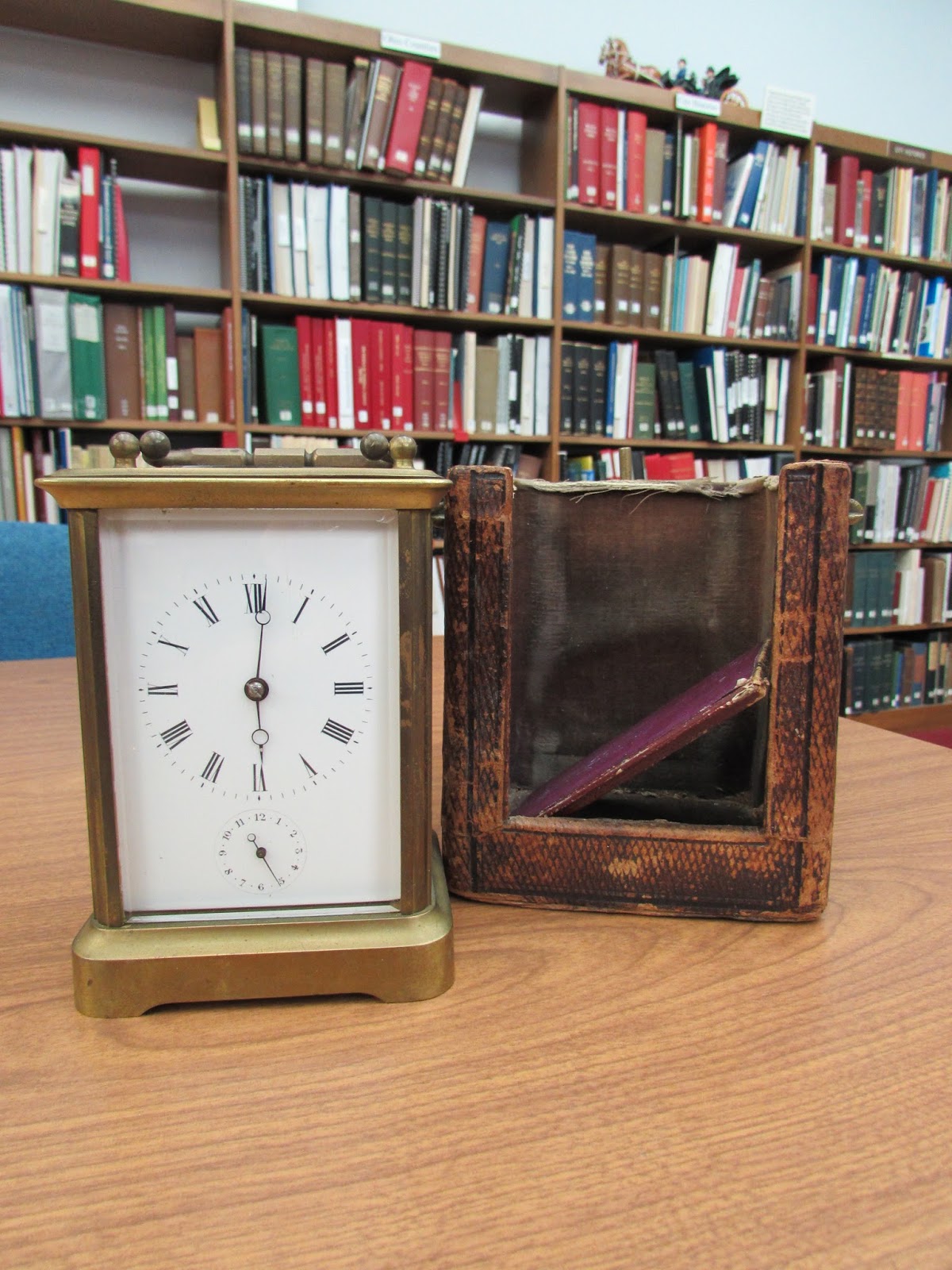
Ken and Vicki Juul Donate General Manning Force's Carriage Clock and Music Box

Vicki and Retired Naval Commander Ken Juul

In early October, retired Naval Commander Ken Juul and his wife Vicki visited the Hayes Library and Museums to make a special donation of items that had been carried by Ken's great grandfather General Manning Force during the Civil War.  Below are images of the French carriage clock with its leather case and the small music box. Both belonged to General Force.  We are deeply grateful to Ken and Vicki for their thoughtfulness and generosity.

In 2012, Ken and Vicki donated General Force's Civil War escutcheon. Because of the lifelong friendship that existed between General Force and President Rutherford B. Hayes, Juul felt that the Hayes Presidential Library and Museums was an appropriate repository for the escutcheon, the carriage clock, and music box. President Hayes and Lucy named their eighth child  and the only one born at Spiegel Grove for General Manning Force. 

French Carriage Clock and its Leather Case
Music Box owned by General Manning Force
General Manning Ferguson Force


Manning Force was born Dec. 17, 1824 in Washington, D.C. to Peter and Hannah Force, the fourth of ten children. He attended Harvard University and Harvard Law School. Upon graduation in 1848, he moved to Cincinnati, Ohio, and entered the practice of law. Force joined the Literary Club of Cincinnati where he met fellow lawyer Rutherford B. Hayes with whom he would form a lifelong friendship


Prior to the Civil War, Manning Force served as a member of the Burnett Rifles.
On August 26, 1861, he was appointed major of the 20th Ohio Volunteer Infantry. The following month, he was promoted to lieutenant colonel. The first battle for the 20th O.V.I. was at Fort Donelson in February 1862. Shortly after the battle of Shiloh, Force was promoted to colonel and placed in command of the regiment. During the 1863 siege of Vicksburg, he served as acting commander of the 2nd Brigade of Mortimer Leggett’s Division,17th Corps, and was then promoted to brigadier general. 

In the summer of 1864, Leggett’s Division joined William T. Sherman’s drive on Atlanta. While leading his brigade in the defense of Bald Hill, Force was struck by a Minie ball. The ball struck him on the left side of his face and exited the upper right side of his skull. Believing the wound fatal, Force was sent home to die. Instead, he recovered and rejoined Sherman’s Army, taking part in the March to the Sea. For his actions at Atlanta, Force was promoted to major general and, in 1892, awarded the Congressional Medal of Honor. Following the Civil War, he was appointed military commander of the District of Mississippi, a position he held until January 1866 when he was mustered out.

Manning Force returned to his law practice in Cincinnati, Ohio. From 1866 to 1875 he served as judge of the Hamilton County Common Pleas Court. He married Frances Dabney Horton of Pomeroy, Ohio, on May 13, 1874. They had one son, Horton Caumont Force

In 1876, Manning Force was defeated in his bid for the U.S. House of Representatives. He later joined the faculty of the Cincinnati Law School and was also elected judge of the Superior Court of Cincinnati. Suffering from overwork, Force resigned his seat on the bench. He spent time with his good friend Rutherford B. Hayes at Spiegel Grove in Fremont, Ohio. After his stay in Fremont and a month long vacation in Europe, Force returned to Cincinnati. In 1888, he was appointed Commandant of the Ohio Soldiers’ and Sailors’ Home in Sandusky, Ohio, a position he held until his death May 8, 1899.


Tuesday, June 13, 2017

Huntington Family Members Research Their Ancestor's Collection


Mr. and Mrs. William Huntington, Jr. of Maryland joined their cousin Sally Sparhawk of Colorado for a day's research of the papers of their  mutual ancestor Dwight Huntington, lawyer, artist, editor, and wildlife conservationist. Some of Dwight's correspondence, photographs, and watercolor landscapes are a part of the George Buckland Collection. (George Buckland, originally of Fremont, Ohio married Huntington's sister.) 

In 1898, the Cincinnati Sportsman’s Society published In Brush, Sedge, and Stubble: A Picture Book of the Shooting Fields and Feathered Game of North America. It was to be the first of many books Huntington would write and illustrate on wildlife conservation.


Huntington gave up the legal profession in 1900. Passionate about nature and wildlife conservation, he moved to New York and became editor of the Amateur Sportsman and the Game Breeder Magazine. .

Huntington wrote the nation’s first game breeding bill. With the assistance of Franklin D. Roosevelt, then head of New York’s Forest, Fish, and Game Commission, his bill became law in 1912. 


Sally and Bill were so pleased to learn that much of Dwight's material is preserved at the Hayes Presidential Library and Museums that they decided to donate two additional watercolors by Huntington and the galleys to In Brush, Sedge, and Stubble.  


Wednesday, September 2, 2009

Analyzing a Victorian Era Gown

Dating and identifying owners of 19th-century clothing can be difficult without documentation from individuals or descendants who know the history. When the Hayes Center received the George Buckland Collection from Jacksonville, Florida, a number of pieces of clothing were included in the donation. Among the items was an elegant silk dress. When it was made and for who remained a mystery until intern Alexandra Hutchings analyzed and researched its fabric and style. Below is Alex's analysis and description.

A one-piece elegant gold-colored dress features a fitted bodice and a train skirt, originally called a “mermaid’s tail,” a style that dates to approximately 1880. The bulk of the fabric used for this dress is silk. Hand-embroidered cream-colored silk flowers and leaves adorn the entire hem, skirt front, and bodice.

A matching gold velvet ribbon is sewn into the bottom of the bodice and wraps around to the back to form a bow with long ribbon tails. Cream-colored cording is used as lacing for the bodice front. Hand-sewn openings for the cording feature the same embroidery floss as the flowers and leaves. The sleeves puff slightly at the shoulder tapering down tightly at the wrist, ending with 1½” upturned cuffs.

Beneath the embroidered flowers of the skirt at the hem is ruching approximately 5½” in width. The lace placed on cream-colored silk on the front of the skirt gives the illusion of a complete under petticoat, but the lace in reality covers only the space visible to the eye. The same lace adorns the collar, cuffs, and shoulder areas.

There is a balayeuse or “dust ruffle” made of heavily pleated strips of fabric serving as a hem guard, with one ruffle in the front and three separate ruffles in the back under the “mermaid’s tail.” The dust ruffles are hand stitched loosely to a stiffer fabric perhaps for easy removal for washing.

Some of the manufactured items in this dress include: a belt secured on the inside back of the bodice to help with the weight of the garment. It includes a printed brand name, Cregmile Cincinnati. Quarter and half inch boning along with brass hook and eye closures were used in the bodice. Lace (different from the lace used on the bodice and front of skirt) found at the hem beneath the ruching of the skirt was also manufactured.

This gown has many qualities that fit the princess style dress dating from 1875 to 1881. The “mermaid’s tail” measures about 70” (evening gown length). The bustle, and the fitted and boned bodice are markers of the “princess style dress”.

The bulk of the dress was sewn by machine. However, the many finished edges were done by hand.

The overall appearance of this gown clearly emphasizes the hourglass shape.


A further search of the collection turned up two cabinet card images taken in Mora’s Studio at 707 Broadway in New York. One of the images was identified as “Elizabeth Huntington Rice, June 1881.” We later learned that Elizabeth Huntington married Brigadier General Edmund Rice, June 14, 1881 in Cincinnati, Ohio. We now know that the dress in our collection was Elizabeth Huntington’s wedding gown.