Showing posts with label Spiegel Grove. Show all posts

Monday, December 19, 2022

The Cannons That Came To Spiegel Grove

 For many years, I wondered what had become of the cannons that flanked the Spiegel Grove entrances featured in old postcards. Not long ago, Curator of Manuscripts Julie Mayle discovered when and why they disappeared. Her research appears in an article in the Hayes Presidential “Statesman,” The cannons were Rodman guns, named after their inventor Thomas Jackson Rodman.  At the time of the Civil War, they were the largest guns in the U.S. arsenal.

Preceding the White House gates, the cannon at the Harrison Gateway were the 15-inch style, while those at the McPherson-Thompson Gateway were 10-inch. Atop each gun was a 20-inch cannonball. Julie learned that it was Admiral Webb Hayes II, grandson of the president, who believed they should be donated to Sandusky County’s scrap drive in support of World War II.

Undated Spiegel Grove Post Card
                                                       

It took great effort to bring the 7-ton cannons down. The job was completed in November 1942 and the guns were transported by rail to a rolling mill in Mansfield. Eventually, more than $230 was raised and donated to the U.S.O.

Now my question was how did these giant Civil War cannons come to be at Spiegel Grove? There was little doubt that this was the work of Colonel Webb C. Hayes, Rutherford and Lucy’s second son and founder of the Hayes Presidential Library and Museums. The colonel acquired two for the Harrison Gateway in time for the dedication of the Harrison Trail.

But the two 10-inch Rodmans came later through the colonel’s contact with Major General Frederick Grant, the son of President Ulysses S. Grant. After a storied career in the military, General Grant became the Commander of the East, headquartered at Governor’s Island in New York. He wrote in 1911 that he considered the colonel’s desire to place the Civil War cannons at the McPherson-Thompson Gateway was a “worthy purpose.” No doubt he had known General James McPherson.  As a 10-year-old boy, he was with his father, General Ulysses S. Grant, during the Siege of Vicksburg. General McPherson had served on his father's staff.

General Frederick Grant ordered two Rodmans located at Fort Caswell in North Carolina be sent to Spiegel Grove. The Union forces had placed the guns there to defend Wilmington in early 1865 after the Confederates surrendered the fort. They arrived in Fremont, Ohio in November of 1911. According to a Fremnont “New-Messenger” article, it took a massive effort by the city engineer, superintendent of streets, and a number of men under direction of the colonel to erect the two cannons weighing 35,000 pounds. 

For more than 30 years, they marked the gateway honoring Civil War General James McPherson and Samuel Thompson who fought in both the War of 1812 and the War with Mexico.


Sunday, April 25, 2021

Grim: The Hayes Family's Favorite


From George Washington to Joe Biden, America’s presidents and their families have displayed great affection for their dogs. Perhaps none enjoyed this special bond more than the Hayes family. Their collection of canines included every size and shape. But the hands-down favorite was a beautiful brindle, mouse-colored greyhound named Grim, a gift from the DuPont family of Delaware. According to President Hayes, when the “good natured greyhound” arrived at Spiegel Grove, he “took all our hearts at once.”

 It was Grim’s special personality – his peculiarities – that endeared him to the family.  One day Lucy Hayes sang the Star Spangled Banner and “Grim lifted up his head and howled in a most pitiful manner.” And ever after when his mistress sang the national anthem, Grim began to howl. But if Hayes and the children were exceedingly fond of their “large, handsome” greyhound, it was Lucy whom Grim loved the best.  Hayes recalled, “How happy old Grim always was when she returned after an absence.” He was “lonely without her and unhappy.”

President Hayes and Lucy with Grim at Spiegel Grove
May 1887 

Lucy Keeler Photograph Collection

Had it not been for its many trees, Spiegel Grove would have suited Grim’s natural love for running to perfection. The sleek greyhound reached such speeds that “if a tree chanced to be in his way,” he would run headlong into it. Later, two pups fathered by Grim, Jove and Juno joined in these antics that so delighted the Hayes family. The three greyhounds raced around the grounds and if a door were open, they continued the chase inside. The family’s shepherd and little terrier were forever relegated to bringing up the rear.


                    Enlargement of Photo Showing Grim Beside Lucy

The president, believed that because of his size and appearance, Grim commanded respect from everyone who knew him. Wagons and carriages turned aside for him wherever he went. But Grim’s privileged status may have been his undoing. One spring day, while running on Lake Shore Railroad tracks, Grim encountered an oncoming train.  Instead of moving aside, he “stopped still.”  The engineer blew his whistle repeatedly, but Grim “did not stir.” Death was instantaneous. The president could only conclude that Grim fully expected “the train to turn out for him.”

 Hayes and Lucy were deeply affected by the loss of this much-loved pet. As soon as the frost was out of the ground. Hayes carried the remains of dear Grim to “cemetery point.”  He buried him there by his war horse Whitey.  Grim lies there still – only a few feet from the final resting place of the master and mistress to whom he had given so much joy.

Note: Taken in May 1887 by Lucy Keeler at Spiegel Grove with President Hayes and Lucy this photograph is the only known image of Grim. In the second picture, Photographic Curator Gil Gonzalez enlarged that portion  featuring Lucy with Grim by her side. 


Friday, January 19, 2018

Moving the Bodies of President Rutherford B. Hayes and First Lady Lucy Webb Hayes to Spiegel Grove

by
Meghan Wonderly
Annual Giving and Membership Coordinator
Rutherford B. Hayes Presidential Library and Museums

While his father’s Memorial was breaking new ground as the first presidential library, Webb Hayes, second son of President Rutherford B. Hayes was occupied with transporting his parents’ bodies to Spiegel Grove. This was far from a sudden decision on Webb’s part.  His earliest plans for the memorial included preparations for Lucy and Rutherford’s removal from Fremont, Ohio's Oakwood and re-internment at Spiegel Grove. Webb desired that his creation follow the model set by America’s first presidents—to have the president buried at his estate much like Jefferson at Monticello or Washington at Mount Vernon. By relocating his parents’ bodies to Spiegel Grove, Webb was bringing his Memorial full circle.  Visitors would not only be able to pay homage to Rutherford and Lucy’s lives through their belongings and life’s work, they would also be able to visit their final resting place.   Spiegel Grove was to be a site of pilgrimage for those devoted to and interested in Rutherford B. Hayes.  Webb sought to “conceal and make more private the Monument and Base in which the bodies” were to be placed, so that visitors to the tomb would be able to visit the grave site in relative solitude to pay their respects.[1] 
Before moving forward with the task, Webb secured his siblings’ approval. While much of his family was in agreement with him, Webb did face displeasure from some family members.  Rutherford Platt Hayes voiced strong dissent to the reburial in 1911. He argued that it went against his father’s wishes, writing, “Father selected the place and arranged everything himself and I know that it was his thought and wish that he and mother should remain there permanently.”[2] Presuming that the other Hayes siblings felt as he did, he sent his attorney to Fremont to prevent Webb from moving the bodies of their parents until all of the children were in agreement.[3] We have few details; however, it must have taken the siblings four years to resolve their issues regarding the reburial, because discussions of the removal did not resume until 1915.
Before moving forward with the task Webb secured further family approval. Some felt the same as Rutherford. His cousin Laura Platt Mitchell, who was Rutherford’s favorite niece, strongly opposed the plan.  Close friend and cousin, Mrs. L.C. Austin, had approved of the plan since 1911. Webb reached out to her once more for possible financial assistance. The relocation of the bodies, including the beautification of the knoll and the new monument, was estimated to cost $1,500. 

While updates on the progress of the memorial project were occasionally shared in newspapers across Ohio, this particular aspect of the project appealed to the public. Like modern times, the macabre and the dramatic attracted the media more than anything else. When the bodies of the former president and first lady were moved from their original burial site to Spiegel Grove, the nation paid attention. The notion of a son digging up his deceased parents and moving their bodies as he saw fit struck a chord of intrigue within the nation. The fact that the bodies were a first lady and president added to the sensational coverage. In January 1915, the Norwalk Reflector Herald of Norwalk, Ohio, shared that “there was talk today of disinterring the bodies of the late President Rutherford B. Hayes and his wife and their removal to a crypt in the memorial.” It took several months to finalize plans for the removal of the bodies, but when the event took place, newspapers across the country covered this story, including the Boston Evening Globe, the Waunakee Index of Wisconsin, the Hamburg Reporter of Iowa, and the Waco Morning News. 
Webb had planned to move his parents in late spring of 1915, but discovered on March 31st that he would be unable to disinter the remains between April 1st and October 1st to prevent further decomposition. With this knowledge, Webb sprang to action.  On that very day the former president and first lady were disinterred and placed in a vault of the Hayes Memorial building until the completion of their granite mausoleum.  Lucy Keeler recorded Webb’s retelling of the event in her diary:
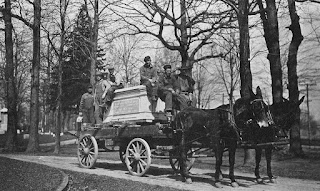
Webb & the workmen had been early to Oakwood; the caskets stood side by side in the crypt of the Memorial Building—covered with flags.  However Webb soon decided to move them to the adjoining vault; that was done—the flag draped with 2 handsome wreaths.  Then the vaults doors were closed; we went to the house for dinner.  Present; Webb; his wife; Birchard; his wife; Dr. and Mrs. Wright; myself; Miss Crocker the housekeeper, and the workman.  All done quietly, quickly and in Webb's masterly manner [sic].  He came to tell me—at the first opportunity—that he found the original casket almost intact in excellent condition (though he had prepared two new lead caskets in case of need.)  The old coffin (Mrs. Hayes--1889) sagged open at one end and out rolled—in his hands—his mother’s wedding ring!  He showed it to me—engraved with her name from RBH.  It seemed to me like a last message from Aunt Lucy to this devoted son of hers!  After dinner, I went over to the Memorial Bldg again.  Soon Birchard came running, asking me to bring my Kodak and go up Hayes Avenue and take a picture of the great stone Webb has brought from Barre Vt. Quarries (weighs 25 tons) 15 x 12 feet to cover the new grave on the knoll of Spiegel and serve as base to the monument now at Spiegel.  I took several views of it the people.[4]

Whether or not the former first lady’s wedding ring actually fell out of the coffin and into her son’s hand is debatable. He did not rebury the wedding ring with his mother.  Instead, Webb kept his mother’s wedding ring and it is currently on display in the museum


Moving the bodies when they did meant that their reburial had to wait until the monument portion of the tomb was finalized.  In a beautiful and impressive ceremony the bodies were removed from the Memorial building and re-interred at the knoll on April 3rd, where they remain to this day.  The new resting place was approved by the Hayes family, even those who had once opposed the project.  In September 1915 Lucy Keeler commented on Laura Platt Mitchell’s change of opinion on the matter, stating, “Laura is so pleased with the Knoll and Monument, though she had all along opposed Webb’s plan of moving his parent’s remains.”[5]  Rutherford also underwent a small change of heart. His wife Lucy Platt Hayes wrote to Mary Miller Hayes: “We are all glad to have the final move accomplished so simply and quietly.”[6]


While this decision to move the bodies of his parents may seem unusual or grotesque, it was not altogether uncommon at the time.   Webb had prior experiences with disinterring and moving bodies, on his own and with his father.  Upon Lucy’s death in 1889 Rutherford moved the body of their youngest child, so that he would be buried with Lucy. Manning Force Hayes had passed away in 1874.  In 1906 Webb worked in cooperation with the Western Reserve Historical Society, in which he was a Trustee, to secure Colonel George Croghan’s body.  Croghan was a local war hero, having defended Fort Stephenson during the War of 1812 in Fremont, Ohio.  Webb gained permission from Croghan’s family to move his body from Kentucky to Fremont. Once Croghan’s move was finished acquaintances offered congratulatory words to Webb on his accomplishment. One man said, “Accept my congratulations on your successful search for the “bones” of Col. Croghan.”[7]  Another stated that he received confirmation that Webb had “found and swiped George” with his congratulations. 
With the bodies of the former president and first lady safely resting at the knoll in Spiegel Grove, attentions turned back to the memorial.


[1] WCH to L.C. Austin, 1914, WCH Papers, Rutherford B. Hayes Presidential Library & Museums.
[2] Rutherford Platt Hayes [RPH] to L.C. Austin, 22 July 1911, RPH Papers, Rutherford B. Hayes Presidential Library & Museums.
[3] RPH to L.C. Austin, 5 July 1911, RPH Papers, Rutherford B. Hayes Presidential Library & Museums.
[4] LEK Diary, 31 March 1915, LEK Papers, Rutherford B. Hayes Presidential Library & Museums.
[5] LEK Diary, 9 September 1915, LEK Papers, Rutherford B. Hayes Presidential Library & Museums.
[6] Lucy Platt Hayes to MMH, 30 April 1915, RPH Papers, Rutherford B. Hayes Presidential Library & Museums.
[7] R.M. Kelley to WCH, 8 June 1906, WCH Papers, Rutherford B. Hayes Presidential Library & Museums.

Wednesday, December 6, 2017

The White House Gates

“Over five years ago President Harding requesting his successor in the United States Senate, Senator Willis of Ohio, to secure the passage of an act presenting the [White House] gates to the Spiegel Grove State Park, but which, through unaccountable bungling in the preparation of the original bill as well as the omission of the proposed beneficiary from the act, has recently come to naught.”
–Colonel Webb Cook Hayes to Edna M. Colman, April 27, 1927

The White House Gates
   by
Meghan Wonderly
Annual Giving and Membership Coordinator
Rutherford B. Hayes Presidential Library and Museums

Colonel Webb Cook Hayes, second son of President Hayes, founded the Hayes Presidential Library and Museums  in 1916. As construction began on the addition to the museum, Webb turned his sights towards the entrances to Spiegel Grove. He wanted every aspect of the site to be historically relevant. While the grounds themselves were historically important, the entrances to them were not. Webb sought something that would signal to visitors that they were entering a prestigious historical site.
Webb’s quest to find the perfect gates for Spiegel Grove began in 1920. Upon learning that the gates to the Soldiers Home in Washington D.C. were to be removed, Webb requested the gates from the governor of the Soldiers Home. The governor happened to be his former commander Lieutenant General S.B.M. Young. After his appeal to Young dragged on, Webb sought other possible gates.

When marching in the 1921 Armistice Day parade to honor the burial of the original Unknown Soldier, Webb took note of the iron gates in front of the future site of the Grant monument in the Botanical Gardens in Washington D.C. The gates were an attractive prospect. The Grant monument was too large to fit through the gates as they stood, so they would have to be removed for its installation and dedication. Upon broaching the subject of the Botanical Gardens’ gates with Colonel Clarence O. Sherrill, the commissioner of public buildings and grounds, Webb was informed that the gates on West Executive Avenue (between the White House and the State, War and Navy Building) would be a better proposition because the government desired their removal. At Sherrill’s suggestion, Webb at once called on President Warren G. Harding. Having been present at the 1920 dedication of the Soldiers’ Memorial Tablet at Spiegel Grove, Harding was personally familiar with the site. President Harding voluntarily offered to sign an Executive Order presenting the gates, if Colonel Sherrill brought it to him that day. Unfortunately, the commissioner was unavailable to meet with Webb before he returned to Ohio.  Nevertheless, Webb left Washington D.C. assured that President Harding’s approval had garnered him the gates at last. He later sent Sherrill a letter reminding him of the gates, and explained the historical significance and symbolism the gates would represent at Spiegel Grove.

However, the matter soon grew complicated. President Harding found that it required congressional approval and was out of his hands. As a staff correspondent for the Cincinnati Times-Star newspaper stated, “There the trouble started.” Harding wrote to Ohio Senator Frank B. Willis, “I told Colonel Hayes I would be glad to have the Museum (State Park) possess these gates and thought I could do so by Executive Order. I have learned that this is not possible, however, and that the donation must be made by act of Congress.” Therefore in 1922, Harding handed the matter to Willis. Through Willis’s initiative, a bill was created to remove the gates and send them to Spiegel Grove. The Senate and its Committee on Military Affairs approved the bill. 


The White House gates originally stood on West Executive Avenue between the White House and the State, War, and Navy building. The emblem that can be seen on the center set of gates features an anchor for the Navy department, guns for the War department, and an eagle for the State department

With this positive news, the Fremont area citizens began celebrating. A slightly overzealous Webb paid $2,500 to enlist Charles Mosser of Fremont, Ohio, to build massive split boulder gateways to hold the White House gates. Carl Rakemann, an artist friend of Webb’s, began designing the plaques for the dedication of the gates. The Green Springs [Ohio] Echo and the Fremont News both published articles congratulating Webb and Spiegel Grove on the accession of the gates. 

However, the bill had yet to pass through the House of Representatives. Ohio Congressman James T. Begg was put in charge of this task. He encountered resistance in presenting the bill, even though it had been approved by the Committee on Buildings & Grounds. At first representatives questioned if it had even been decided that the gates were to be removed. Begg read a letter from Colonel Sherrill (the Commissioner of Buildings & Grounds), stating that various government offices involved had attempted to remove the gates for several years due to the great congestion of traffic at that avenue. Sherrill explained that:
An effort was made to find someone who would pay something to the Government for the privilege of taking the gates away, but it was found that no one would pay for the privilege and on the contrary they expected us not only to give them the gates but to pay someone for taking them away. 

Sherrill’s explanation did little to sway the politicians.

Members of the House of Representatives argued that the gates provided the president much needed security even though they had generally been considered a hazard to safety. The failing came when Begg stated that the bill was “for the purpose of permitting the President to give away Government property.” He also stated that Harding was a “very good friend” of Webb C. Hayes. With these statements, the bill lost its momentum. 

Webb believed that the failure was Begg’s fault. He wrote to other representatives and senators asking for assistance. Most of those he wrote to assured him of Begg’s competence. The Speaker of the House Frederick H. Gillett told Webb that he was annoyed with Begg because of his attempts to use “unparliamentary methods.” Begg defended his efforts, citing Webb’s misunderstanding of congressional procedure. The bill was considered private, meaning that it could only be brought up on certain days for discussion. A private bill also had to pass unanimously. Throughout 1922 Begg struggled to get the bill on the calendar and to combat any objections.

The White House gates now sit at each entrance to Spiegel Grove. 

Two years passed with almost no mention of the gates. It took the Secretary of War’s intervention in 1924 to get the bill back on the calendar. In early 1925, the bill returned to the senate.  This time the chair of the Senate, along with other senators, were against Willis.  One senator even wanted the gates to go to New York instead of Ohio. A week later, a journalist for the Cincinnati Times-Star newspaper released an article about the conundrum titled: “Useless White House Gates Suddenly Become Important: Gift Made by Harding for Marker for President Hayes’s Grave Again Held up by Skeptical Congress.” The witty and sardonic author wrote that:
When Colonel Webb Hayes…came to Washington recently to carry away the White House gates, he ran into more opposition than he had expected.  He thought he was going to do the Government a favor, but he discovered that some members of the Government were not backward about calling it something else. 

The author continued, stating that “[Webb] offered to take the gates off the hands of the Government, or more specifically off their hinges, without cost to the Government.” The author then quipped, “When a bill was presented in Congress some of the legislators, who had, up until that time, never noticed the gates, asked some questions so as to learn where they were, and then decided that the Government might want these gates after all.”  

The next time the bill came up in the Senate and the House, the portion dictating where the gates were to be sent was removed. Even with the change, the Committee on Public Buildings & Grounds once again strongly recommended passing the bill. They stated that the gates “have long been a serious impediment to traffic and are a constant source of danger, both to vehicles and pedestrians.” Again, the House of Representatives did not heed the committee’s advice. Rather, they objected whenever the bill was brought up, stating that “it would be a waste of time to consider it further” and that “those are valuable gates and ought not to be torn down.” The Committee on Public Buildings & Grounds were again given the bill, which they again approved. They stressed that the gates had no material or intrinsic value, regardless of what the senators and congressmen believed. The committee also emphasized that if the gates were kept up “provision must be made for some expenditure on them for repairs.” 
Carl Rakemann, artist and friend of Webb Cook Hayes, included sketches of gatepost possibilities in a letter dated February 7, 1922.

In April of 1926 the Senate approved the bill.  However, Senator Wesley L. Jones from Washington interrupted the proceedings and said, “My attention was diverted for a moment, and I did not realize that…bill…had been passed.” He argued that the bill be reconsidered and put on the calendar again, since he did not agree with its passage. When the bill came up again for discussion, an argument ensued. Senator Royal S. Copeland from New York, who had previously wanted the gates to come to his state, argued with Jones about the gates’ removal:

It is not my bill, and I have only the interest in it that any other Senator would have, but I think those gates are a very great menace there in an automobile accident, and I would not want to have the Senate assume the responsibility for something that may be, after all, purely a matter of sentiment so far as the retention of the gates is concerned.

The discussion spiraled out of control. Other Senators jumped in to voice their opinions. It became so heated that they had to be called to order. The next time the bill was discussed, Jones recommended it be reviewed by a committee, since it was technically different than the one they had previously reviewed. This caused a debate amongst the Senators about which committee should review the bill, the District Committee or the Buildings & Grounds. It went to Buildings & Grounds for the fifth time.

            Finally, the Senate agreed on an amendment to the bill that would allow the gates’ removal but would not remove the piers to which they were attached. Congressman Richard Elliott from Indiana joined in the fray because he deemed the removal of gates but not the piers as “nothing short of idiocy” because the piers were just as much behind the traffic impediments as were the gates. This left the bill stuck between two politicians who wanted very different outcomes. Therefore, the House and Senate had to hold a conference to discuss the Senate’s proposed amendment to the bill. The conference was fruitless, ending with the two factions agreeing to disagree. 

            Elliott ended his determined efforts to remove the piers and urged the House to agree with the amendments. So on March 3, 1927, an act was passed that would authorize the removal of the gates from West Executive Avenue as long as the piers were left undisturbed. After five or so years of effort, the bill that had been approved simply permitted the gates’ removal but did not secure them for Spiegel Grove. The Fremont Daily News reported, “Congress has passed an act which merely states that the gates shall be removed, but doesn’t specify to what place.” Webb saw this as “rather stupid bill” that was badly handled by the Ohio representatives. Aware of Webb’s frustration, Willis explained to the colonel that he thought it was best to take what they could get and accept this small victory. 

            Congressman Begg explained that the gates now had to go out to bid for removal and possession, but that the Chairman of the General Supply Committee was going to try his best to ensure the gates went to Ohio. The General Supply Committee was chaired by Colonel Ulysses S. Grant III, grandson of the former president and son of Webb’s comrade Frederick Grant.  Aware of connections between Grant and himself, Webb wrote to him asking for assistance in securing the gates. Grant replied that there was no legal way for him to give the gates to Spiegel Grove. The committee was forced to invite bids for the gates, since they had to be sold as junk.  Difficulties arose as “Washington people have all at once gotten the idea that these gates are exceedingly important to Washington.” Webb’s bid for the gates unfortunately fell $1,050 below the highest offer. Willis wrote Webb that there was some insistence that the gates be erected at one of the Washington parks. F.A. Roman, a local attorney, made the winning bid.  Newspapers rumored that the Fine Arts Commission was behind his bid, as they desired the gates to remain in Washington D.C. In April of 1927 the Fremont Daily News released an article stating that Webb had lost the bid for the gates. The paper bemoaned the loss, stating:
The six year request of Colonel Webb C. Hayes of Fremont for the possession of the ancient White House gates at the Pennsylvania avenue entrance to West Executive Avenue apparently ended in failure Monday when bids were opened by the treasury and his offer was found to be considerably below another submitted.

However, the bid had to be approved by certain treasury heads before the gates could be given away.

            In 1928, Begg went to bat for Webb again, this time to ensure the gates be presented to the Ohio Archaeological and Historical Society so they could hang at Spiegel Grove. The Committee on Public Buildings and Grounds reviewed the bill. They suggested an amendment, removing the preamble of the bill which simply explained the historical nature of Spiegel Grove. The House passed the bill. The Senate also passed the bill after its Committee on Public Buildings and Grounds amended it to ensure the federal government would incur no expense for the gates’ removal. At last, on April 11, 1928, the bill passed and was approved by President Coolidge, securing the gates’ donation to the OHC for historical entrances to Spiegel Grove. The Anchor Fence Company removed the gates from the White House and shipped them to Fremont in mid May 1928. 
After the entrance to the museum moved from Jefferson Street, these gates were moved from the Memorial Gateway to the Croghan Gateway.


            Webb wanted to christen the gates at the annual Memorial Day festivities at Spiegel Grove, but the gates’ poor condition required some maintenance before they could be erected.  The Fremont Steam Boiler Company, operated by the Nickel brothers, worked with the Fremont Foundry to repair the gates. Therefore the celebration of the gates’ installation was postponed until August 2, to coincide with the 115th anniversary of the Battle of Fort Stephenson. Webb coordinated the event to include the dedication of the nurses’ home at the Fremont Memorial Hospital and the christening of a 
tree in honor of Theodore Burton, a trustee of the Rutherford B. and Lucy Webb Hayes Foundation.

After eight years of persistence, the gates were finally brought home to Spiegel Grove. They were laid out exactly how Webb had imagined in 1922, with four of the White House gates installed in four gateways, and the fifth divided to make two single pedestrian gates. The gates have remained in that configuration ever since.


A Son's Dream: Colonel Webb C. Hayes and the Founding of the Nation's First Presidential Library by Meghan Wonderly

To learn more about Colonel Webb C. Hayes and the founding of the Rutherford B. Hayes Presidential Library and Museums, you can purchase a copy of Meghan's book online or in the Museum Store

Tuesday, June 16, 2015

Admiral Chester Nimitz Honored at Spiegel Grove


Before and after his presidency, Rutherford B. Hayes took great pride in the trees at his Spiegel Grove estate. Hayes began naming trees for distinguished visitors. The custom continued long after his death.
The photograph above features Admiral Chester and Mrs. Nimitz; Admiral Webb C. and Martha Baker Hayes; and then director of the Hayes Presidential Center Watt Marchman. 
Admiral and Mrs. Nimitz were the guests of Admiral and Mrs. Hayes at Spiegel Grove on September 21, 1950.

The occasion was Admiral Nimitz's dedicatory address at the celebration of the opening of the Toledo, Ohio Union Depot. Also included were Mr. Gus Metzman, President of the New York Central Railroad, and his wife. Behind Admiral Nimitz is the large oak tree named in his honor. It still stands 65 years later. You can see it just across the pathway from President Hayes' tomb.

Admiral Nimitz served as a fleet admiral of the United States Navy. He played a major role during WWII in the Pacific theater where he served as Commander in Chief U. S. Pacific Fleet (CinCPac) for U. S. Naval forces and as Commander in Chief, Pacific Ocean Areas (CinCPOA) for Allied air, land, and sea forces. He was the last surviving officer who served in the rank of fleet admiral. He died in 1966.


Saturday, August 20, 2011

United States Mint Launches Rutherford B. Hayes Presidential $1 Coin

On August 18th, residents of Fremont, Ohio and the surrounding area celebrated the release of the new Presidential $1 Coin honoring Rutherford B. Hayes, 19th President of the United States. “The Presidential $1 Coin series connects us to the wellspring of our nation’s government and the many stories that unite us,” said Marc Landry, Acting Associate Director of Manufacturing of the United States Mint. “One of those is captured here at Spiegel Grove, the beautiful home where President Rutherford B. Hayes retired from elected office but remained a dedicated public servant, helping veterans, improving prisons and fighting for universal education.


Over 400 people joined Hayes Presidential Center Director Tom Culbertson, Sandusky County commissioners Terry Thatcher and Dan Polter, Fremont Mayor Terry Overmyer, U. S. Representative Bob Latta, and Ohio State Representative Rex Damschroder for the official coin launch.

Free dollar coins were available to children 18 and under who attended the ceremony on the front lawn of the Hayes home, while Fremont-based Croghan Colonial Bank was on site to exchange dollar bills for the new Hayes coins for everyone else. The bank had nearly sold out of the 12,000 coins it brought to Thursday's event, although the Hayes coins will be available at the bank's main branch.

Sunday, February 7, 2010

Lucy Webb Hayes and Her Four-Footed and Feathered Friends

The nearby photo of Lucy Webb Hayes, wearing the President’s hat while feeding pigeons on a cold, snowy morning, is one of the last ever taken of the former first lady. It has always been one of my favorites. This candid image would be considered common place in today’s casual world, but in the 19th century, such unassuming poses of women, particularly former first ladies, were much less common. Perhaps its appeal is that it represents a true reflection of who Lucy Webb Hayes was and how she lived her life.

Compassionate, cheerful, gracious, and possessed of a quiet confidence, Lucy showered kindness on family, friends, children, the sick, and the helpless. The same was true for animals - be they domestic or wild. It was always her way.

Upon Lucy’s arrival in Washington, society columnists commented on what changes she surely would make in her hair style, her dress, and her demeanor. But the First Lady remained unchanged - outwardly and inwardly. It wasn’t long before such questions were forgotten. Rather, Lucy’s warmth and kindness to all around her became the recurring topic in DC newspaper columns.

Gifts for Lucy poured in – a mockingbird, a Siamese cat, a turkey, a cow, and other feathered and four-footed creatures. They all found their place in the White House family. When Lucy learned that an owl had become trapped inside the unfinished Washington Monument, she asked that construction stop until it could be freed.

When the Hayeses returned to Ohio, their White House pets came with them. Their homecoming at Spiegel Grove brought more gifts of dogs, chickens, turkeys, and cats. Lucy welcomed and loved them all.

In his letters and diary, President Hayes often mentioned how children, servants, and animals responded to Lucy. He wrote, “All seemed to know her, and loved to be near her. The dogs would climb on her, the Jerseys would rush to her, the pigeons came at her call….How happy she was to see their glad welcome of her. I must preserve the pictures that show these things.”


Lucy's Jersey Cows at Spiegel Grove

Everyone was aware of Lucy’s love for animals and the affection they returned. Some weeks after her death, a Fremont teamster came up to President Hayes after Sunday services. He said, “There was a notable thing at [Lucy’s] funeral. I noticed it and many others [did]. The jerseys – her Jerseys – all came up as near to the funeral procession as they could get and stood in a row looking at it – standing still like soldiers in ranks until the funeral had all passed.”

Wednesday, April 2, 2008

The Dillon House: A Legacy of Gracious Hospitality


72nd Ohio Volunteer Infantry Reunion at the Dillon House
(date unknown)

(Captain Jonathan Harrington Collection)

Among the fine Victorian homes that grace the streets of Fremont, Ohio is the Dillon House on Buckland Avenue. The Towered Second Empire design was the creation of local architect John C. Johnson. While Johnson was best known throughout the Midwest for his public buildings, he also received commissions to design private homes. It was Charles and Ann Buckland Dillon who asked Johnson to provide them with plans for a structure that at once expressed both warmth and elegance - one in which their growing family would enjoy the comforts of home and yet where friends could experience their gracious hospitality.

Ann Buckland, the daughter of prominent attorney and Civil War General Ralph P. Buckland married Charles Dillon in 1868. Dillon, part owner of a hardware business, was a druggist who founded what is today Grund Drug in Fremont.

The site chosen by the Dillons was one of several lots owned by Ann's father. It lay across from the Hayes Home situated on the grounds of Spiegel Grove. In the fall of 1873, then former Governor Rutherford B. Hayes wrote his sons that "Mr. Dillon was putting down the foundaton of his fine large brick house opposite to Spiegel Grove."


While the Dillons hoped to complete their house early the following year, construction took longer than expected. It wasn't until the fall of 1875 that the Dillons finally moved to their new home. Even then, the house wasn't finished. Despite delays, the Dillons achieved their goal. The elaborate pediments adorning the windows and detnal molding and cornices accentuating the roofline embellished the structure's understated elegance. Black walnut double doors brought from Michigan by Mr. Dillon created an impressive entranceway. Butternut woodwork filled the home's foyer, cozy alcoves, and stately rooms with a warmth that nearly glowed.

Perhaps no event reflected the Dillons' refined entertainment more than the wedding of their eldest daughter Mary to Irvin Fangboner. More than a hundred guests celebrated the couple's marriage at a "white and green" event held during the holiday season of 1898. The home was a profusion of white roses, carnations, and chrysanthemums. A bower of greens graced the downstairs parlor along with palms, ferns, and holly. At the top of the stairway, Mr. Dillon installed a beautiful leaded glass window for the occasion. Carrying white roses, Mary descended the stairs to the front hall and entered the parlor where the couple said their vows beneath the bower.


Charles and Ann Dillon on the front steps of the Dillon House with their children Ralph and Charlotte
(date unknown)


After the death of General Buckland, Ann and her younger brother George hosted reunions for their father's Civil War comrades of the 72nd Ohio Volunteer Infantry. The Dillon home nearly overflowed with veterans and their families. Food, drink, and song were the order of the day. Women chatted and children played games on the lawn while the old soldiers gathered on the porches to remember long ago days of hard fighting.

Members of the Dillon family called 1329 Buckland Avenue "home" until 1960, when Charlotte Dillon Ickes, the youngest of Charles and Ann's daughters passed away. Purchased by the Hayes Presidential Center two years later, the Dillon House remains a gracious setting for spedcial occasions, echoing the warmth and hospitality of its former owners.

The ambience that the Dillons once enjoyed can stll be experienced at a Dillon House Tea or through rental for private events or business functions.