Showing posts with label Admiral Webb C. Hayes. Show all posts

Tuesday, June 16, 2015

Admiral Chester Nimitz Honored at Spiegel Grove


Before and after his presidency, Rutherford B. Hayes took great pride in the trees at his Spiegel Grove estate. Hayes began naming trees for distinguished visitors. The custom continued long after his death.
The photograph above features Admiral Chester and Mrs. Nimitz; Admiral Webb C. and Martha Baker Hayes; and then director of the Hayes Presidential Center Watt Marchman. 
Admiral and Mrs. Nimitz were the guests of Admiral and Mrs. Hayes at Spiegel Grove on September 21, 1950.

The occasion was Admiral Nimitz's dedicatory address at the celebration of the opening of the Toledo, Ohio Union Depot. Also included were Mr. Gus Metzman, President of the New York Central Railroad, and his wife. Behind Admiral Nimitz is the large oak tree named in his honor. It still stands 65 years later. You can see it just across the pathway from President Hayes' tomb.

Admiral Nimitz served as a fleet admiral of the United States Navy. He played a major role during WWII in the Pacific theater where he served as Commander in Chief U. S. Pacific Fleet (CinCPac) for U. S. Naval forces and as Commander in Chief, Pacific Ocean Areas (CinCPOA) for Allied air, land, and sea forces. He was the last surviving officer who served in the rank of fleet admiral. He died in 1966.


Sunday, February 15, 2015

Mouse Island and the Hayes Family

View of Mouse Island by Platt Studios
Charles E. Frohman Collection


Cabins ca. 1912

“There is something romantic in that idea of having an island all to one’s self. Ex-President Hayes felt it years ago when his children were young, for he bought a mile or so off the [Catawba] Peninsula, a small island ” …. so wrote Henry Howe in his history of Ohio. Howe further described the island as "a very small affair, so small one might someday take a fancy to pick it up, slip it in his vest pocket as he would his watch and walk off with it.”

In 1874, then Governor Hayes purchased Lake Erie’s Mouse Island jointly with Fremont attorney Ralph Buckland and Dr. L. Q. Rawson. The private island, sometimes called Hat Island in early records, was acquired from Ira Dutcher of Catawba.

Hayes believed it would be a great spot for his family to camp, boat, swim, and especially fish (Lucy’s favorite past time). When Hayes returned to Ohio during his presidency, the family spent time on the island. In 1879, Hayes purchased Dr. Rawson’s portion of the island. And at the turn of the century, the Bucklands exchanged their portion of Mouse for land Hayes and the Bucklands owned jointly in Omaha, Nebraska.

Through the years, Hayes had numerous opportunities to sell the island, but his children and their friends continued to enjoy time spent each summer on the heavily wooded island. President Hayes’ son Birchard and his children Webb, Scott, and Walter, built two cabins, a boat house, dock, ice house, tennis court, and a hand ferry to shore. They also supplied the island with water.

The brothers worked each summer to repair damage brought on by the previous winter’s storms. But time and weather continued to take a toll on the island’s structures. With Scott’s move to Los Angeles and Admiral Webb Hayes away much of the time, there were fewer opportunities for the Hayes grandchildren to visit the island. Even though time spent at Mouse became rare, it was not until 1966 that they finally decided it was time to part with the “emerald isle” the family had enjoyed for more than 90 years!  

Native Stone Chimney 1912

Fireplace 1912

Titled "Hayes Construction Company"
Birchard Hayes and Sons Scott and Walter
on their Newly Built Dock

Dalton Hayes and Elizabeth Boarding Their Boat the "Owl"


Mr and Mrs. Birchard Hayes at the Cabin

The Dock 

Friday, February 14, 2014

U.S.S. West Point During World War II

U.S.S. West Point
Originally built as the U.S.S. America, this ship was the largest merchant vessel built at the time of World War II. She was converted to a transport vessel, carrying U. S. soldiers to both the Pacific and the European theaters of the war. During WWII, she traveled more than 350.000 miles, more than 14 times around the world, transporting soldiers, the wounded, prisoners of war, and auxillary wartime personnel. Despite her mammoth size, 723 feet overall and 93 feet at the beam, the West Point was as graceful as a clipper ship. She traveled without escort around the world, even though her size made her a prime target of the enemy, particularly the wolf packs. that prowled the North Atlantic. 

Officers of the U.S.S. West Point
Her captain was Webb C. Hayes II (seated second from the right)

During one of his return trips across the North Atlantic during the winter of 1944/1945, Admiral Hayes guided her through a raging storm in which waves swelled to 50 feet. The West Point pitched and rolled. One wave struck the forward gun platform, 50 feet above the water line. The waves demolished the gun platform, crushing a gunner on lookout. Steel ladders were crumpled into shapeless debris and gun shields were ripped to shreds. Only her size and the sea worthiness of her construction allowed her to escape with only the loss of one sailor and minor damage. 


G.Is aboard the U.S.S. West Point

U.S.S. West Point transporting U.S. soldiers home from Europe after V.E. Day. The vessel had a crew of more than 800. She could carry as many as 7.,700 passengers


U.S.S. West Point
July 11, 1945
New York Harbor
Tugs nose the U.S.S. West Point  into her slip in the New York Harbor. Thousands of soldiers stand on  the top deck as they await a hero's  welcome home

U.S. S. West Point arriving in New York Harbor
July 11, 1945

These photographs are part of the Admiral Webb C. Hayes Collection at the Hayes Presidential Center

Friday, December 7, 2012

Admiral Webb C. Hayes II, Commander of the USS Tracy

Webb C. Hayes II, born in 1890, was the third son of Birchard Hayes, who was the eldest son of President Rutherford B. Hayes. Webb II graduated from the United States Naval Academy in 1911.


Admiral Webb C. Hayes II
Admiral Webb C. Hayes II Collection

He was commissioned lieutenant in 1912, and lieutenant commander in 1917. During World War I, he served as the executive officer on the destroyer U.S.S. Tracy and as destroyer officer in the Queenstown Flotilla. From 1918 until 1927, he commanded the United States ships: Champlin, Wood, Moody, and Sinclair.


In 1927, Admiral Hayes was given command of the destroyer USS Tracy. She and two other destroyers were assigned to the Atlantic as part of the Scouting Force of the Mediterranean Fleet. Her duties were to “show the flag” at ports of call. Steaming from Newport, she visited Queenstown, Northern Ireland before touching at ports in Scotland, England, Belgium, France, Portugal, Spain, Algeria, Tunisia, and Italy. Departing Gibraltar in January 1928, she operated in the Atlantic for another month before being transferred to the Battle Fleet.


Admiral Webb C. Hayes II and the officers of the U.S.S. Tracy
1927
Admiral Webb C. Hayes II Collection

In 1919, he married Martha Baker, daughter of Arthur Baker of Toledo, Ohio. They were the parents of three sons: Webb Cook (born 1920), Arthur Baker (born 1924), and Scott Birchard. (born 1926)


Martha Baker Hayes in Europe with her sons Webb (left), Arthur (middle), and Scott (right)
1927
Admiral Webb C. Hayes II Collection

Webb took the opportunity to have his wife and three sons, ages 7, 3, and 1 join him in Europe. Martha Baker Hayes and family left New York on the tenth of June  with their three sons and 14 trunks! Martha and the boys stayed in hotels, rented rooms, and chateaus, moving from port to port and country to country during the admiral’s tour of duty in the United Kingdom, Europe, and the Mediterranean. Their home movies, a part of the exhibit at the Hayes Presidential Center Tales of Travel from the President's Attic, feature the family and some of the highlights of their time in Europe and the Mediterranean.


Personal Possessions of Admiral Webb C. Hayes II & Martha Baker Hayes
as part of


Wednesday, August 17, 2011

Toledo Antique & Classic Boat Show: August 27 and 28, 2011


On August 27th and 28th, Toledo, Ohio's annual Antique and Classic Boat Show takes place at Toledo's Maritime Center at 1701 Front Street on the banks of the Maumee. It's a treat! You'll see some of those great vintage  boats from the 1920s to the 1960s that were so much a part of summer recreation on the Great Lakes. 

This year, the focus will be on the DART BOAT. From 1928 to 1932, Admiral Webb C. Hayes II, grandson of President Rutherford B. Hayes, headed a group of investors who built the famed Dart (first built at Indian Lake Boat Company in Lima, Ohio.) The Dart was offered in four models – an 18 ½-foot; 22 ½-foot; 26-foot and 30-foot, ranging in price from $1,500 to $5,000. There were three-cockpit, split-cockpit, open and sedan models to choose from. The queen of the fleet was the 30-foot Gold Dart with its 125 horsepower Chrysler Imperial engine. You can read more about the Dart on our earlier post by clicking on this link. You will also enjoy the displays of books, postcards, and artifacts of the Great Lakes as well food, music, and antique autos! It's a great way to spend the weekend!


Tuesday, December 30, 2008

The Dart Boat: A Revered Classic


Restored Dart Boats
(Courtesy of Ramsey Brothers Restoration)


On August 23rd the Toledo Antique and Classic Boat Society held its annual show at International Park. Featured are antique and classic wooden boats built from the 1920s to the 1960s. Many have been lovingly and painstakingly restored to their former glory by skilled craftsmen. One of the truly revered classics is the Dart. Manufactured by the hundreds and sold around the world, the inboard mahogany runabouts were known for their speed, durability, and seaworthiness.

The Dart was originally built by Lima’s Indian Lake Boat Company. In 1928, a group of businessmen, headed by Admiral Webb C. Hayes, grandson of President Hayes, purchased the rights to build the Dart. Located on Summit St. in Toledo, the company eventually employed nearly 100 craftsmen led by the Dart’s original designer Hocky Holler.

The Dart’s closely spaced frames were constructed of clear white ash. Its hull was strengthened with steam bent white oak. The beautifully balanced Dart also featured a laminated double bottom with a layer of canvas duck between its inner and outer mahogany bottoms. Its deep “V” shape and planing hull were perfect for cutting through the choppy waters of Lake Erie at high speed. Every boat featured the racy chrome Dart “arrow” logo that came to symbolize speed and quality among boaters worldwide. “More speed per horsepower” became the company’s motto. The Dart was a favorite of “bootleggers” who were “hauling the mail” across Lake Erie during the days of Prohibition. Even fully loaded (75 cases of liquor), the Dart could speed across the lake at night, outrunning any and every Coast Guard vessel.

Burdened with the construction of a new plant on Haynes Street, Hayes and his partners had limited time for marketing. But the Dart’s reputation for speed needed little promotion. She gained international attention in 1929 when a 26-foot Silver Dart runabout raced along the River Ouse against England’s fastest train, the famous “Flying Scotsman.” The sleek and sophisticated Dart runabout won hands down. Photographs of the event soon hit boating magazines. Sales skyrocketed. Orders came in from as far away as Jerusalem, where a Dart runabout became the first speedboat to cruise the waters of the Dead Sea.


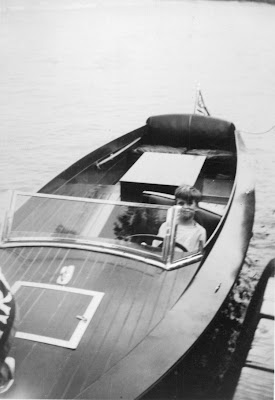
One of Admiral Webb C. Hayes' sons off Lake Erie's Mouse Island in a Dart Boat, ca. 1929
(Hayes Family Album)

To fill their back orders and meet growing demand, Hayes and his partners planned a 24-hour work schedule that would allow the company to manufacture three boats per day. The company offered four models – an 18 ½-foot; 22 ½-foot; 26-foot and 30-foot, ranging in price from $1,500 to $5,000. There were three-cockpit, split-cockpit, open and sedan models to choose from. The queen of the fleet was the 30-foot Gold Dart with its 125 horsepower Chrysler Imperial engine.

But just as rapidly as sales soared, they quickly nosedived. The Great Depression devastated the company. Hayes tried to forestall liquidation, but by late1933 the Dart Boat Company faded into history. Today, it is estimated that only 30 to 40 of the sleek, graceful Dart runabouts survive.

Play the video and watch Admiral Webb C. Hayes and Hayes Family members in a Dart Boat on the Maumee River at Toledo, Ohio and on Lake Erie at Put-in-Bay and Middle Bass Island. The video is a segment of a film made by the family of Admiral Webb C. Hayes. The film is part of the Hayes Family Collection at the Rutherford B. Hayes Presidential Center


This article first appeared in Lifestyles2000.