Sunday, December 18, 2022

For the Love of Maps

 Recently I lost a map of the state of Ohio that I purchased several years ago. It was expensive, printed on fine paper, and beautiful. It was one of my favorites because like others I own, it connected me to places that brought back fond memories. I have a drawer full of maps that I picked up over the years – mostly as a child at gas stations where they were always free. Some show streets, counties, towns, rivers, the Great Lakes, and most of all - places I could only imagine visiting.

Today, maps, like the one I bought in Ohio are scarce and few are free. Why? Because nearly everyone uses GPS. We no longer need a map to find our way. The lady tells us just how to get there, but she doesn’t help us visualize where we are in relation to our surroundings.

At no time in our history was this more important than in the Civil War. It was the Union forces who were in desperate need of accurate maps as they plunged blindly into the southern states to fight the Confederacy (who had the advantage of knowing every stream, road, and pass).

As armies have done for centuries, both Union and Confederate, they lived largely off the land. Therefore, it was essential for the Union to have detailed maps that identified crops, orchards, fording sites, parallel roads, woods, and landmarks. Without this knowledge, Union armies, made up of thousands of men and horses, could be stalled in an area without sufficient water and resources. Within days they would be starving.

I had the good fortune to see some of the Civil War maps at the Hayes Presidential Library and Museums. One in particular (shown nearby), made in 1863 for General William S. Rosecrans details the area around Cleveland, Tennessee, some 30 miles from Chattanooga. Using an existing map, engineer William E. Merrill traveled the area, adding critical details, including swampy areas, “good farming country” “broken country,” springs. creeks, woods, mills, bridges and even residents’ names. These maps were printed on cloth and could be washed, dried and stuffed into saddlebags.


Cleveland, Tennessee, 1863, by William E. Merrill
Hayes Presidential Library and Museums

Another map, boring to the eye, was actually vital to General William T. Sherman. It shows Cobb County Georgia divided into numbered lots, 6/10th of a mile on each side originally surveyed in 1840. From this map, Sherman was able to tell his army commander General James McPherson that his headquarters was located in a house “not far from the northwest corner of lot #273”.


Cobb County Georgia
Developed from the Land Office Map, 1864
Hayes Presidential Library and Museums

In contrast, General Robert E. Lee’s Army of Northern Virginia marched into Gettysburg’s unfamiliar and unfriendly territory. As General James Longstreet described it, Lee was like a man walking “over strange ground with his eyes shut.” This was the situation Union armies faced throughout the war.

While no longer as important as they once were, maps still remain interesting documents that connect us to the wider world. They are also like time capsules that bring back memories of trips taken and roads traveled. 

Much of what I learned of Civil War maps and those who made them came from discussions with Earl McElfresh during his visit to the Hayes Presidential Library and Museums when he was seeking unique Civil War maps in repositories around the country. It was he who explained to me the significance of these maps to Union commanders. 

McElfresh published many of these maps in a book titled Maps and Mapmakers of the Civil War. Some were exquisitely drawn while others were quick pencil sketches. Many are not only beautiful, but colorful. His work appears on the Internet Archive where Mr. McElfresh provides an explanation of each maps importance. McElfresh Map Company reproduces significant maps of the Civil War. You can also view maps of WWII, the Underground Railroad, Little Big Horn Battlefield, and even Antarctica in  his online gallery. To learn about the process of creating maps, see Mr. McElfresh's Blog.


Saturday, December 17, 2022

The Inspiration for Mickey!

 One of America’s most iconic images is that of Mickey Mouse, the beloved cartoon character that became the Disney mascot. For generations, Mickey and his adventures have symbolized fun, childhood, laughter, happiness, and joy. The inspiration for Mickey began with Clifton Meek born in Fremont in 1888. Clifton was the son of George and Harriet (Mourer) Meek. At the age of 17, Clifton was working for the Wheeling and Lake Erie Railroad as a telegrapher. Hoping for a better career, Meek attended Cleveland School of Art. He soon found work as a cartoonist for the Scripps-McRae Syndicate in San Francisco.


Johnny Mouse by Clifton Meek

Johnny Gruelle, Meek’s friend and creator of “Raggedy Ann"  books, convinced Meek to join him in Norwalk, Connecticut. Meek and his family headed east, settling in nearby Silvermine. It was here that Meek created the 4-panel strip titled “The Adventures of Johnny Mouse” as a pantomime comic. Johnny Mouse eventually  wore pants, shoes, sported large ears, and took part in all sorts of antics. Meek’s “Johnny Mouse” was syndicated from 1913 to 1915. He also created “George Grindstone” and “Nobody” for the “New York Evening Journal” and the “New York World.” By the 1920s, Meek had become a freelance artist producing “funny animal” comics that appeared in “Puck,” “Judge,” and “Life” magazines.


Raggedy Ann by Johnny Gruelle

Meek grew tired of cartoons and knew it was time for a change. He wrote, “I felt like I was in a factory. I began to see George Grindstone in my dreams.” Clifton bought a forge and began a successful career creating ironwork that he sold throughout the region, becoming part of the Silvermine Artists Guild.


Walt Disney's Mickey Mouse


In 1944, Meek got the surprise of his life when he read a Walt Disney interview. Walt told that between the ages of five and ten, he had lived on a Missouri farm where he learned what farm animals looked like…  “It was those early childhood days that the first faint glimmering of mouse fascination dawned on Disney.” Then Walt Disney is quoted as saying “there was a man named Clifton Meek who used to draw cute little mice and I grew up with those drawings…. They were different from ours, but they had cute ears.”


Clifton was delighted to learn that he had ignited the spark of inspiration for Mickey. After writing Disney a note of thanks, Meek received an autograph picture signed in appreciation. In a 1950s interview, Ub Iwerks, a partner of Disney in the early days, also confirmed that Meek’s mouse cartoons were their inspiration. The animated short film “Steamboat Willie,” drawn exclusively by Iwerks, debuted in 1928. Mickey Mouse became an instant hit. And, as they say, “the rest is history!”

Ironically, Clifton Meek’s granddaughter came to Ohio to attend Heidelberg University and made Tiffin her home where she lives today.


Friday, April 8, 2022

Ulysses S. Grant: A Look Back


This year the Hayes Presidential Library and Museumsat Spiegel Grove will  celebrate the 200th birthday of the 19th president who was born in Delaware, Ohio on October 4, 1822. Celebrations will soon be underway for another Ohio president, also born 200 years ago. Ulysses S. Grant was born on the 27th of this month near the Ohio River at Point Pleasant. The son of a tanner and later a West Point graduate and a veteran of the War with Mexico, Grant suffered innumerable failures and setbacks in his personal life.


                                        General Ulysses S. Grant

But with quiet confidence and enduring love for his wife Julia, Grant in 7 years rose from a lowly clerk in his father’s store to commander of all the Union armies and President of the United States.

As president, Grant advanced the Reconstruction agenda, battled the KKK, and signed the Civil Rights Act of 1875. There were mistakes and scandals. Yet, he became the most well-known and popular American of his time. When Grant left office after two terms, future President James Garfield wrote, “No American has carried greater fame out of the White House than this silent man who leaves today.”

While a great general, Ulysses S. Grant was a poor businessman. Swindled by his son’s brokerage partner, Grant found himself destitute.  A short time later, his doctors gave him the sad diagnosis of throat cancer. With a death sentence before him, Grant could only think of providing a way out of poverty for his beloved Julia.

Mark Twain offered an advance of $25,000 for publication of each of 2 volumes of his military memoirs, but Grant refused believing that Twain would lose money. They settled on a profit sharing deal. Even though he was in a race against time, Grant proved to be a gifted writer. Through excruciating pain, fits of coughing and at times, unable to eat or speak, he continued to write. Finally, on July 19th, 1885, Grant penned his final words. Four days later, the man who had saved the Union breathed his last. More than one million people, both Union and Confederate, attended his funeral in New York City.


Grant Writing his "Personal Memoirs"


Grant’s “Personal Memoirs” became America’s first blockbuster. As he had hoped, Julia lived on in comfort, receiving $450,000 from Twain’s firm. To this day, his work has never been out of print. Every president since, has consulted Grant’s memoirs when writing their own.


                                      Tomb of Ulysses S. Grant


As one historian wrote, “In the generations after his death in 1885, Grant’s reputation as a general and president spiraled downward until the current generation of biographers and historians has persuasively resurrected it.” Another wrote, “…how fortunate the nation was that Grant went into the world – to save the Union, to lead it and, on his deathbed, to write one of the finest memoirs in all of American letters.” Pick up one of these recent biographies or better yet, read his “Personal Memoirs.” They do not disappoint.


                  Personal Memoirs of Ulysses S. Grant, First Edition


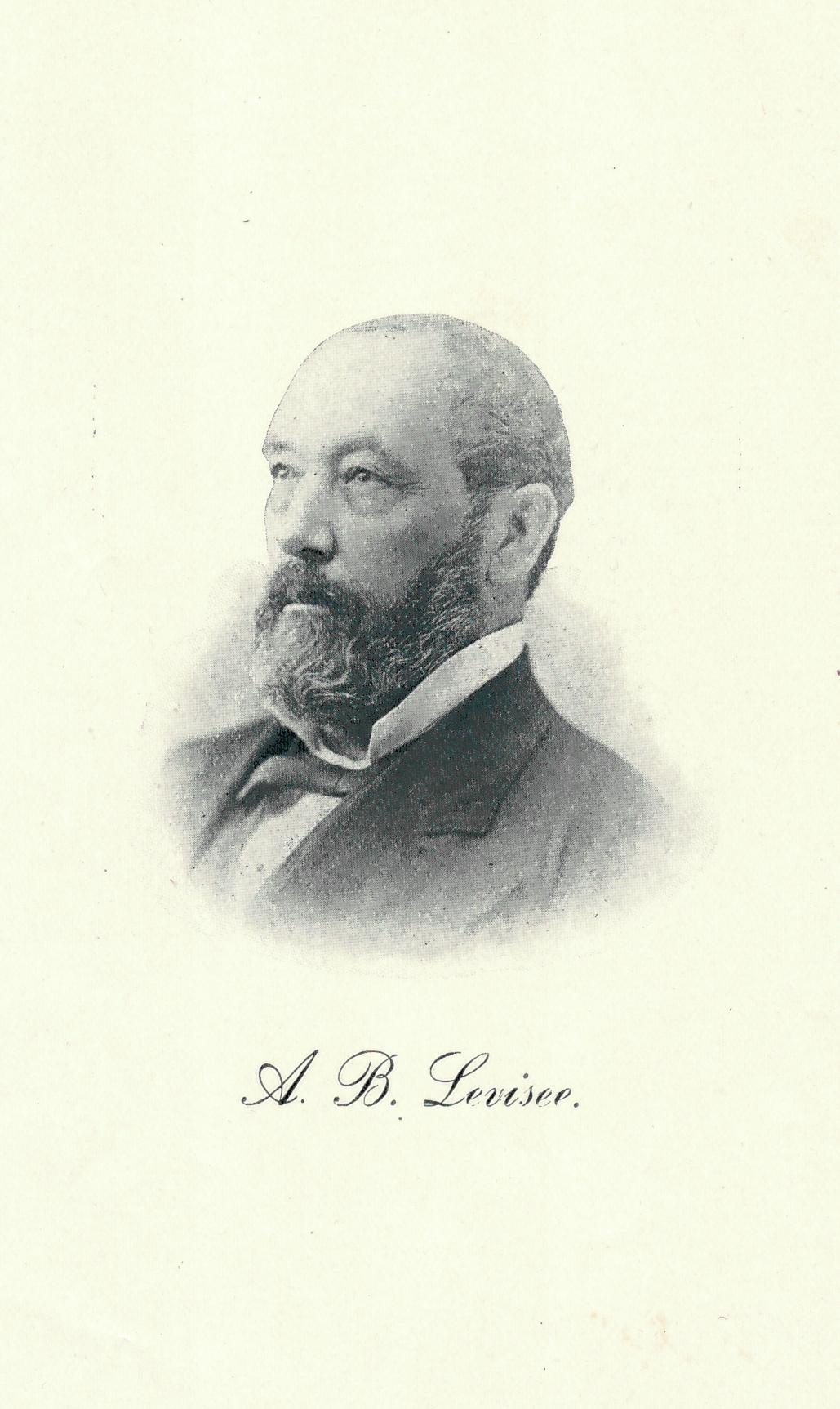
Life and Times of Judge Aaron Levisee


Few Sandusky County pioneers led a more eventful life than Aaron Levisee. Born in Livingston County, New York in 1821, Levisee moved to Sandusky County at the age of 10. Bright, energetic, and the youngest of 11 children, Levisee was forced to find his own way in the world. He eventually attended the University of Michigan which led directly to teaching positions in Louisiana and then Alabama. Hungering for more education, Levisee came north once more to study law in New York before returning to Talladega where he became head of the Female Collegiate Institute of Talladega.


Judge Aaron Levisee

The following year, he married Persia Willis who had grown up at “Thornhill,” a 2600-acre cotton plantation nearby. After their marriage, the couple moved to Shreveport where Aaron opened a law practice and presented his bride with their new home, also called “Thornhill.” The couple had only one son, Leonidas.


                             Thornhill Plantation, Talladega, Alabama

Aaron continued to practice law in Shreveport and was elected judge of his district. Although respected by those who knew him, Judge Levisee lost support when he took a stand against the South’s secession movement. Despite his unpopularity he remained in the South throughout the war, eventually serving the Confederacy as an attache to the Inspector General. After Persia’s death in 1862, “Thornhill” served as a Confederate military hospital.


                          Thornhill Shreveport, Louisiana

During the Reconstruction era, he was elected successively as a judge and state legislator from the district that includes Shreveport. Levisee presided over the trial of Ku Klux Klan members who murdered an African American for casting a vote for Ulysses S. Grant in the 1868 presidential election. He assumed his duties as a legislator in 1874 at the height of an armed conflict between Republican supporters and the White League over control of the state legislature.

He served as one of six Louisiana presidential electors during the controversial Hayes/Tilden election. Levisee refused a bribe to cast his vote for Democrat Tilden. But on the appointed December day when the presidential electors were to cast their votes at New Orleans, Levisee and another elector were snowed in at the Red River. It was not until more than a year later, when the Democratic Congress was continuing its investigation of the disputed election that he learned his signature had been forged and then sent on to Washington!

Having lost a second wife during the Civil War and another shortly after marriage, Levisee moved with his son to the Pacific Northwest and then the Dakota Territory. It was here that he again opened a law practice. He also performed a massive work by preparing and publishing an annotated edition of the legal codes adopted by the state of South Dakota. In 1893, Judge Levisee’s life came full circle. He returned to Sandusky County,where he lived out his final years, dying in 1907. The diary, detailing the eventful life of Judge Levisee can be found at the Library of Congress. The original “Thornhill” plantation and the Shreveport estate named “Thornhill,” built for his first wife Persia, still survive.


The Courageous Laura Haviland

 After reading my article about the Underground Railroad published in Lifestyles 2000, my friend told me about her great aunt, Laura Haviland. In fact, she shared her first edition of Laura’s autobiography, “A Woman’s Life Work.” (You can find a full transcription of the book online.) Laura was born in Canada in 1808 to American Quaker parents, Daniel and Sene Smith. At the age of 16, she married Charles Haviland. Shortly after, they moved with other Quakers to Lenawee County, Michigan.

Quakers had always condemned slavery, but initially did not work actively for abolition. Restless, determined, and driven to action, Laura Haviland took up the more active role of Wesleyan Methodists to fight slavery. With Elizabeth Chandler, Laura formed the Logan FemaleAnti-Slavery Society, the first abolitionist organization in Michigan.  The Havilands began hiding fugitive slaves. Their home became the first Underground Railroad station in Michigan.


                        Laura Haviland Statue in Adrian, Michigan 
                  

Laura also founded the Raisin Institute, the first racially integrated school in Michigan. The Havilands brought several teachers from Ohio’s Oberlin College who helped them make it one of the best schools in the territory.

In 1845, the family was struck by erysipelas. Laura became desperately ill. Upon her recovery she learned that her husband, sister, parents, and young baby had died. Despite these tragedies, Laura remained as determined as ever to carry on her battle against slavery.

She made trips into the Deep South to aid escaped slaves. In an effort to bring the children of a fugitive slave couple to freedom in Michigan, she traveled to the tavern of slave owner John Chester of Washington County, Tennessee. Chester held Laura, her son, and another at gunpoint, threatening to kill them. They managed to escape only to be chased by slave catchers. For the next 15 years, Chester and his son harassed Laura Haviland in court, with slave catchers, and with threats of violence. After the Fugitive Slave Act, she began escorting runaway slaves to Canada. In 1851, she helped found the Refugee Home Society in Windsor, Ontario, a settlement with a church, school, and 25 acres for each family. 

When the Civil War broke out, Haviland traveled throughout the South, distributing supplies, caring for the wounded, and working for better hospital conditions as far the Gulf of Mexico. At war’s end General O. O. Howard appointed Haviland Inspector of Hospitals for the Freedmen’s Bureau. Haviland traveled to Virginia, Tennessee, Kansas, and Washington, D.C. teaching, lecturing, and volunteering as a nurse.

The Raisin Institute went through many changes, becoming the Haviland Home, an orphanage for African American children. Eventually, the home was purchased by the state and became known as the Michigan Orphan Asylum.

Even in her later years Laura Haviland continued to work tirelessly to help freed slaves. Using her own money, Laura bought 240 acres in Kansas where African Americans escaping the violence of the KKK could farm, raise their children, and attend school. Both Haviland, Kansas and Haviland, Ohio were named in her honor. The image nearby is that of a statue of Laura Haviland in Adrian, Michigan.


Friday, January 7, 2022

Independent Order of the Odd Fellows, Elmore Lodge No. 462

As a child while waiting with my dad for the light to change on the Elmore, Ohio town hill, I often wondered what those very large plaster letters I O O F meant on the corner building of the main street. Little did I know that it represented the Elmore chapter of the Independent Order of the Odd Fellows, a fraternal organization that began in the U. S in a Baltimore tavern in 1819 with the formation of Washington Lodge No. 1


                         Symbols of the Independent Order of the Odd Fellows

It became the first fraternity to include both men and women when it adopted the “Beautiful Rebekah Degree” in 1851. It was sometimes called the “Triple Links Fraternity” because of its motto “Friendship, Love, Truth.” During the 19th century, it became the largest fraternal organization in the nation – larger than the Freemasonry. By 1889, every state had lodges. It was especially popular among skilled workers and laborers. Yet, Presidents Grant, Rutherford B. Hayes, McKinley, Harding, and FDR were members as well as several Supreme Court justices.

The IOOF was devastated by the Civil War. Chapters did not begin to reorganize until some years later. Elmore was designated as Lodge No. 462 when it organized in May of 1870 with some 32 charter members. John Jenny being its first brother. Like all lodges, it promoted charity, the development of character, and relief of sickness and suffering among the brotherhood. Elmore Lodge members took seriously the command “to visit the sick, relieve the distressed, bury the dead, and educate the orphan.”

Members accomplished this work through weekly Friday evening meetings held at 7 p.m. in the hall from October through February and Fridays at 8 p.m. beginning in June. New members were initiated, dues paid, ceremonies performed and degrees conferred. From their dues, members paid those who reported as “sick” one dollar each week. As the years went by, the amount was raised to $3 per week. But by-laws required that a member must be sick enough to remain at home. Funeral costs were also covered. Widows received some compensation from the organization as well. Yet, the Ohio lodges even found enough funds to build and support a home in Springfield, Ohio, for indigent members and their families.


Lindsey Lodge Members 


Some moved away, transferring their membership. Others were dropped for lack of payment of dues, but all members, if they chose, were easily reinstated. In 1915, the Lindsey Lodge began meeting in the Elmore IOOF Hall, paying rent of 40 dollars semi- annually and covering janitorial services. On April 8, 1921, the two lodges consolidated adding some 2 dozen brothers to the rolls. During the Great Depression, membership declined across the country when fees could no longer be afforded. When social reforms of Roosevelt’s New Deal began to take effect, there was less need for the work of the IOOF. And, lodges took on a greater social role for members. Cards, dart ball, singing, and picnics were enjoyed by the brotherhood. More than 300 members had at one time or another been part of Lodge No. 462 by the outbreak of WWII. Today there are 155 lodges in Ohio with more than 4,000 members and 187 Rebekah lodges with 8,000 members.


                                            Lindsey Lodge Members


 The Elmore records were recently discovered and donated to the Harris-Elmore Public Library. 

Tuesday, November 30, 2021

Frederick Douglass and the Fight for Freedom


Some weeks after President Rutherford B. Hayes left office, he received a letter marked “personal”. It began, “I express to you and to Mrs. Hayes my lively sense of the uniform kindness and consideration shown me from first to last during your Presidency of the Republic. You gave me at the beginning a higher place under the Government than was ever given to my race before. Neither time nor events will make me forgetful of your justice and magnanimity…. No man will be allowed to speak disparagingly of your administration in my presence without reproof.  With grateful recollections.” - signed Frederick Douglass. 


Frederick Douglass Letter to President Hayes

Hayes Presidential Library and Museums

Learning that he was soon to be inaugurated as President of the United States, Hayes consulted with Douglass and told him his views regarding his Southern Policy. Douglass approved. Hayes recorded in his diary that Douglass “had given him many useful hints regarding the subject.”

On March 17, 1877, in executive session, Hayes put forth Douglass’ name as United States Marshal of the District of Columbia. Senators overwhelmingly confirmed Hayes’ choice. It was to be the first of several federal appointments, including Recorder of Deeds for D.C.; and Minister Resident and Consul General to Haiti.


Frederick Douglass


Born into slavery in 1818 in Maryland and given the name Frederick Augustus Washington Bailey, Douglass knew little of his mother and never learned the identity of his father. At the age of 8, his slave owner hired him out as a body servant in Baltimore where Douglass taught himself to read. Some 7 years later, the slave owner brought him back to the Eastern Shore to work in the fields. Douglass rebelled and physically fought back. He was returned to Baltimore where, disguised as a sailor, he hopped a train using money borrowed from a free black woman named Anna Murray, who later became his wife. It was then that they chose the surname of “Douglass.”  Settling in Massachusetts, Douglass worked as an agent for the Massachusetts Anti-Slavery Society, where his fame grew as he spoke out against slavery throughout the North and Midwest.  Fearing that he would be captured, Douglass fled to the United Kingdom where abolitionists purchased his freedom.  


     North Star           


Once free, he returned to America and allied himself with abolitionist William Lloyd Garrison, helped people on the Underground Railroad, published the “North Star.” Two of his sons fought in the famed 54th Massachusetts. Following the war, Douglass, now widely known and highly respected, pressed for equal citizenship and voting rights.  He later held positions at Howard University and became president of the Freedman’s Bank.

Along with his duties as Marshal, Douglass brought many of his friends and associates to meet the Hayeses. Among them were soprano Madame Selika and Josiah Henson (believed to be the inspiration for Uncle Tom in “Uncle Tom’s Cabin.”) He attended Diplomatic Corps receptions and state occasions. All the while he traveled and lectured on racial equality and women’s rights. (And on several occasions, he spoke at Fremont, Ohio's Birchard Hall.)


Rev. Josiah Henson

Courtesy of Smithsonian

Learning of Lucy’s death in 1889, Douglass sent a letter to Hayes, expressing his heartfelt condolences. His home, Cedar Hill in Anacostia, is today a National Historic Site. It was here that Douglass died at age 77, after a life time spent in the fight for freedom and equal rights for all.


Frederick Douglass Home, Cedar Hill, Anacostia

Courtesy National Historic Sites