Guest Post by
David
Boling, Ohio Statehouse Tour Guide
In early January,1872 Rutherford B. Hayes was completing his
term as Ohio's governor. He wrote in his diary a list of what he believed were his most important
acts of legislation and accomplishments since coming into office in 1868. Nestled
between the passage of the Fifteenth Amendment to the Constitution of the United
States and creation of an ''Asylum for the Inebriate" in Mansfield, he lists item number 12, The Lincoln Memorial - T. D. Jones (See Diary
entry, January 9, 1872)
What memorial to Lincoln? Where is it? Does it still exist?
What role did Governor Hayes have in its creation? Perhaps most important why was this so
important to Governor Hayes?
I am a tour guide at the Ohio Statehouse. On our daily tours of the Ohio
Statehouse, one of our stops in the Rotunda is a large marble tableau (pictured
below) that honors Abraham Lincoln and the soldiers who fought at the battle of
Vicksburg in the summer of 1863.

Standing 14 feet tall, from floor
to the top of the bust of Abraham Lincoln, the Lincoln and Soldiers Monument stands in the same spot as it did
when it was dedicated on the evening of January 19, 1871. The dedication itself
was quite the event, Here is how it was described in the Cincinnati Enquirer the
next day.
'An immense
crowd attended the unveiling, music by the Quintet Choir of First Presbyterian
Church was magnificent. Governor Hayes presided. Mr. Galloway, representing the
Association spoke first, followed by General William H. Enochs of the House and General
Durbin Ward of the Senate. When Mr. Jones unveiled the monument, the crowd gave
unequivocal demonstrations of applause.'
'
Governor Hayes presided. As chairman
of the Ohio Monument Association, the contracting agent for the memorial. As governor and as a veteran he would have been within his rights to give his own
speech, but as Hayes writes the next day in his diary, he chose 'a meritorious
thing'.
January 20, 1871, -- I did an unusual, and, I think, a meritorious, thing last night, Tom Jones' memorial to Lincoln and the Ohio Soldiers was to be inaugurated in the rotunda of the Capitol. I presided, I had a fairish little opening speech, which with my good lungs I could make go off well. But there were three speakers to give addresses. I knew that the little, pretty, pet things to be said were not numerous, and that my speech would more or less interfere with the success of theirs. I accordingly swallowed my speech and introduced the various actors without an extra word. Who has beaten this?
The Speech I Didn't Make
Fellow Citizens: -- We have assembled this evening to witness the inauguration, the unveiling of the Memorial -- the work of an Ohio sculptor, Thomas D. Jones, of Cincinnati -- placed here in the rotunda of the State House, to remain, we trust, as long as the building itself shall stand in honor of the brave sons of Ohio who in more than a thousand conflicts on land and water poured out their lives for Liberty and Union; and in honor also of him who "strove for the fight as God gave him to see the right," and who "with charity for all and malice towards none," "Ascended Fame's ladder so high from the round at the top he stepped in the sky.
The Lincoln
and Soldiers Monument stands in the southeast niche of the Statehouse Rotunda where it
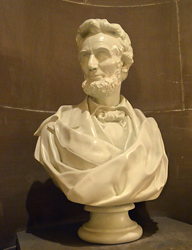
was originally placed, although it was moved to other locations, and the monument and bust were displayed removed and stored for some time. Starting at the top of the 14-foot monument, there stands a bust of
Lincoln, done by T.D. Jones in Springfield, Illinois, during the winter months
of 1861 after Lincoln's election, but before his inauguration in March. It is one of five known to be in existence for which Lincoln sat. .
The surrender of the Confederate army at Vicksburg on July 4,
1863 fills the center tableau (shown below) of the monument. On the left, General John S. Bowen, Colonel M. C. Montgomery
and General John C. Pemberton, who is seen handing over a list of his troops to General Ulysses S. Grant. Standing next to Grant on the right, is General James B. McPherson and General William T. Sherman. All three of the Union generals were from Ohio. On each side there is
an orderly holding the reins of a horse to honor all those on both sides who
had served.

Just below this scene is a quote from Lincoln's second
inaugural address, "Care for him who shall borne the battle and for his
widow and his orphans." Use of the words appear to have been a compromise
as Governor Hayes had written to his Uncle Sardis Birchard on February 3,1868 that not
enough money had been collected to include the 'uprising of the people when
Fort Sumter was taken.'
Personally, I think the words are a better choice for
they cause us to pause and remember the more than 620,000 Americans, from the
North and the South, who lost their lives in the Civil War, and especially the
35,475 who were from Ohio.
The Ohio Statehouse in Columbus offers free tours of the
capitol building and of the grounds during the summer. Open seven days a week, I
hope you will come and view the monument yourself and learn more about 'the people's
house.'


 Everton J. Conger