Thursday, January 24, 2013

Sandusky's "Crystal Blue, Clear as Glass Ice"


Local Ice Dealers Loading Blocks Directly from the Ice Fields
Ernst Niebergall ca. 1911/1912
Charles E. Frohman Collection
Sandusky, Ohio, was the largest ice producer west of New York City during the latter half of the 19th century. Noted for its solid, "crystal blue, clear as glass" ice, the city became known as the "Ice Capital of the Great Lakes." Icemen eagerly watched the waters of Lake Erie until they froze to a depth of 8 to 16 inches. For as long as "good ice makin' weather" held, Sanduskians endured ten-hour days of harsh winds and frigid temperatures for a daily wage of $2.

In the picture above, taken during the winter of 1911 or 1912, many local dealers from Sandusky and neighboring towns filled their orders by loading their delivery wagons directly from the ice fields.

Sanduskians harvested 400,000 tons of ice each winter. The greater portion of the harvest was stored in some fifty sheds that dotted Lake Erie's shoreline. Sandusky provided most of Ohio's cities with ice, including 90 percent of the ice consumed by the city of Cleveland. According to the local paper, Sandusky's "crystal quality put the murky, sewer-tainted" Cleveland ice to shame. Most of the ice was shipped across the lake as needed from a string of icehouses located on Put-In-Bay's Peach Point.

Corporal Elton Mackin: World War I Marine

Corporal Elton Mackin
WWI Marine, 1918
Born in 1898 in Lewiston, New York, Elton Mackin enlisted in the United States Marine Corps in 1917. After training at Parris Island, South Carolina, Mackin was sent to Europe, where he served as a battalion runner for the 67th Company 1st Battalion, 5th Marine Regiment, United States Army Regulars. This highly decorated Marine fought in every Marine Brigade battle from Belleau Wood to the crossing of the Meuse on the eve of the Armistice. Mackin was awarded the United States Army Distinguished Service Cross, the Navy Cross, and two Army Silver Star citations. He was honorably discharged from the United States Marine Corps in May 1919.

Mackin moved to Norwalk, Ohio in 1935. He began writing a memoir of his WWI experience. Excerpts from his manuscript, "Flashes and Fragments," appeared in Leatherneck Magazine. Essays that appeared later in the American Heritage magazine caught the eye of Marine Corps historian George B. Clark. Believing that Mackin's memoir provided a unique viewpoint of the war - "an enlisted man's viewpoint" and that of a "young man who suffered." Clark sought out the Mackin family. Although Private Mackin had passed away in 1974, his son, Wallace Mackin, shared the memoir and the taped oral interviews. The oral account assisted Clark in developing annotations for the manuscript that was eventually published in 1993 as Suddenly We Didn't Want To Die: Memoirs of a World War I Marine. 

Elton Mackin’s oral interview was conducted by the late Carl D. Klopfenstein, Professor of History at Heidelberg College. The interview was conducted at Mackin’s home at 116 Milan Avenue, Norwalk, Ohio on June 29, 1973. Following the interview, a rough draft transcription was produced. Using the draft and the audiotapes that are part of the Elton Mackin Collection at the Hayes Presidential Center, the digitized transcription was created. It is available by following this link.  Due to the poor quality of the audiotapes,  errors exist.

A Game of Hockey on Sandusky Bay

Playing Hockey on Sandusky Bay
Ernst Niebergall ca. 1913
Charles E. Frohman Collection

Generations of Sanduskians have enjoyed the bay - summer and winter. This image produced from one of the late Ernst Niebergall's glass plate negatives shows Sanduskians of all ages skating and enjoying a game of hockey on the frozen bay.


Monday, December 24, 2012

Richard "Dick" Stotz: Marine Corps Combat Photographer at Iwo Jima


Richard Stotz with Roscoe, the Regimental Mascot


In Richard Stotz's last years, he gave a scrapbook of photographs to his nephew. They were taken during Stotz's time as combat photographer with the 28th Marine Corps during World War II. The photographs were taken by him and his fellow comrades during training at Camp Pendleton, in Hawaii, at the Battle of Iwo Jima, and during the occupation of Tokyo.

You can see a gallery of some of his photos on the Hayes Presidential Center website

We "pinned" some of Richard Stotz's photographs on Historypin, where you can see a slideshow .

In October, the Stotz Photographs were highlighted as the featured collection of the week on the Historypin blog.

Richard “Dick” H. Stotz was born on 18 March 1922 in Fremont, Ohio to Edward and Neva (Heinman) Stotz. Upon graduating from Fremont Ross High School in 1940, he owned and operated Abdoo Photography with his brother, Donald Stotz. On 14 December 1942 Dick enlisted in the United States Marine Corps and reported to boot camp at Camp Pendleton in San Diego, California.

After graduating from boot camp he was assigned to the base photograph section as a photographer, completing numerous aerial and reconnaissance training missions. In 1944 Dick was reassigned to the 5th Marine Division, 28th Regiment intelligence platoon as a motion and still photographer. Each division had 12 to 30 still photographers and cinematographers. Stotz and the other combat photographers were sent to 20th Century Fox Studios in Hollywood, California for additional training on still photography. After completing this training he rejoined his platoon, along with fellow photographer L.R. Burmeister and combat correspondents William Vessey and W. Keyes Beech.


Marines Carrying Their Wounded Comrade

In September 1944, the 28th Regiment left Camp Pendleton and sailed to the Hawaiian Islands for Camp Tarawa to join the 26th and 27th Regiments. Intense training, field maneuvers and mock landings took place until January 1945. While aboard the USS Dickens the regiments received a top secret operation called “Workman Island”, later to be known as Iwo Jima. On 19 February 1945the 28th Regiment arrived at the island of Iwo Jima and was part of the second assault wave to advance ashore, followed by three additional waves of troops.

Stotz’s primary duty was to capture the battle in photographs as it was taking place. The job of a combat photographer was made more dangerous because they were never heavily armed, usually carrying only a single weapon and their camera equipment. Photographs taken during a combat assault, like Iwo Jima, were rarely developed in the field. The photographers film was sent out by plane or naval ship to an alternate location to be developed. Most likely, photographers never saw the actual photographs. These photographs were be used for training purposes and to identify any mistakes that may have occurred.


Medic Treating Wounded Marine

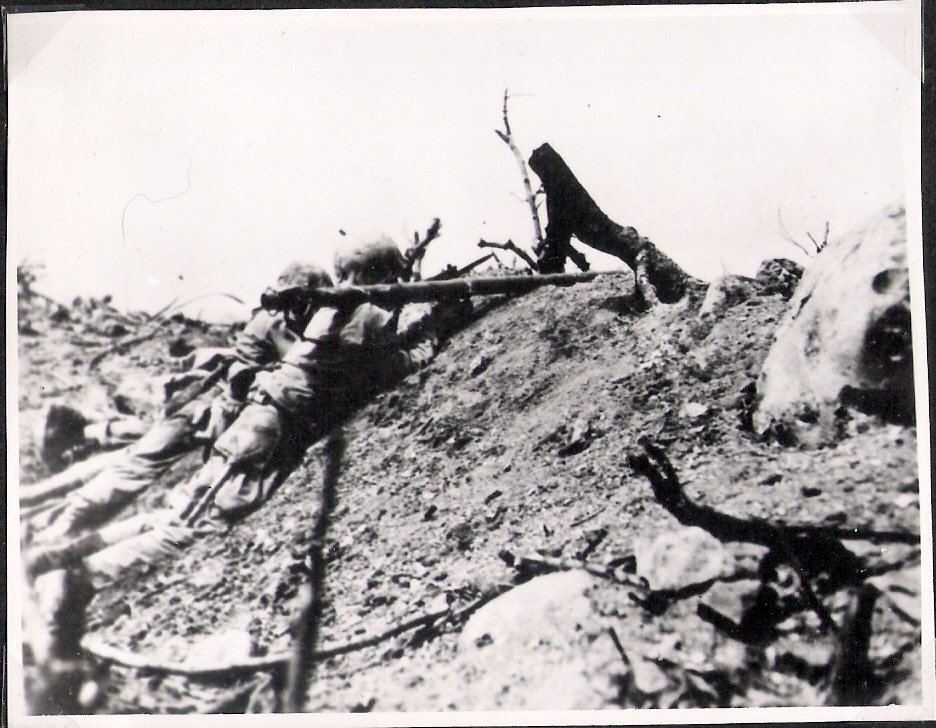
Once on shore the Marines were immediately met with a heavy assault from the Japanese that included artillery and machine gunfire. Both the United States and Japan experienced heavy casualties during the initial invasion. Intelligence correspondent, Sgt. Bill Vessey, was killed on 20 February 1945, the second day of the battle. Sgt. L.R. Burmeister was wounded several days later. On 22 February 1945 the Marines gained control of Mount Suribachi and proceeded to take possession of both airfields on the island. Stotz was acquainted with fellow photographer, Joe Rosenthal, who took the iconic photograph of the flag raising atop Mt. Suribachi. The assault lasted 36 days, with the United States taking control of the island on 26 March 1945. The seizure of Iwo Jima allowed for sea and air blockades, andthe ability to conduct intensive air bombardment to destroy Japan’s air and naval capabilities. Although Iwo Jima was a key victory for the United States, the battle resulted in over 26,000 American casualties. Twenty-seven Medals of Honor were awarded to Marines and sailors, more than were awarded for any other single operation during the war.

To read more about the Marines on Iwo Jima, follow this link to Iwo  Jima: A Retrospective


Marines Dug In

Friday, December 7, 2012

Admiral Webb C. Hayes II, Commander of the USS Tracy

Webb C. Hayes II, born in 1890, was the third son of Birchard Hayes, who was the eldest son of President Rutherford B. Hayes. Webb II graduated from the United States Naval Academy in 1911.


Admiral Webb C. Hayes II
Admiral Webb C. Hayes II Collection

He was commissioned lieutenant in 1912, and lieutenant commander in 1917. During World War I, he served as the executive officer on the destroyer U.S.S. Tracy and as destroyer officer in the Queenstown Flotilla. From 1918 until 1927, he commanded the United States ships: Champlin, Wood, Moody, and Sinclair.


In 1927, Admiral Hayes was given command of the destroyer USS Tracy. She and two other destroyers were assigned to the Atlantic as part of the Scouting Force of the Mediterranean Fleet. Her duties were to “show the flag” at ports of call. Steaming from Newport, she visited Queenstown, Northern Ireland before touching at ports in Scotland, England, Belgium, France, Portugal, Spain, Algeria, Tunisia, and Italy. Departing Gibraltar in January 1928, she operated in the Atlantic for another month before being transferred to the Battle Fleet.


Admiral Webb C. Hayes II and the officers of the U.S.S. Tracy
1927
Admiral Webb C. Hayes II Collection

In 1919, he married Martha Baker, daughter of Arthur Baker of Toledo, Ohio. They were the parents of three sons: Webb Cook (born 1920), Arthur Baker (born 1924), and Scott Birchard. (born 1926)


Martha Baker Hayes in Europe with her sons Webb (left), Arthur (middle), and Scott (right)
1927
Admiral Webb C. Hayes II Collection

Webb took the opportunity to have his wife and three sons, ages 7, 3, and 1 join him in Europe. Martha Baker Hayes and family left New York on the tenth of June  with their three sons and 14 trunks! Martha and the boys stayed in hotels, rented rooms, and chateaus, moving from port to port and country to country during the admiral’s tour of duty in the United Kingdom, Europe, and the Mediterranean. Their home movies, a part of the exhibit at the Hayes Presidential Center Tales of Travel from the President's Attic, feature the family and some of the highlights of their time in Europe and the Mediterranean.


Personal Possessions of Admiral Webb C. Hayes II & Martha Baker Hayes
as part of


Wednesday, December 5, 2012

Fremont Ross Track Star Meets the Best of the Best


Pete Erchenbrecher
                                                           
From its earliest days, Fremont Ross High School has had a proud history of exceptional athletes. One of those was Ross track star Leland “Pete” Erchenbrecher Throughout his high school years, he nearly had done it all – the broad jump, high jump, hurdles, the 100-yard dash, and the 220. No doubt, it was a thrilling moment for the young athlete when he was named the 1938 Buckeye League Champion.

But perhaps the highlight of the celebrated track star’s career came on a warm Friday evening in July 1938. It was the night Jesse Owens, one of the greatest Olympians of all time, came to town. His stunning achievement of four gold medals at the 1936 Olympics held in Berlin’s Nazi Germany had brought him international fame. But like other Olympians of his day, Owens never benefited from product endorsements and advertising contracts enjoyed by today’s medal winners. To support his family, Owens accepted speaking engagements worked with Cleveland’s underprivileged youth, and on occasion took part in exhibitions.


Jesse Owens 1936 Olympics

That night more than 1500 excited spectators jammed Anderson Field to watch their star athletes compete against the best in the world. Sponsored by Tony Syzmanowski, owner of Tony’s Bakery, the event was organized by Fremont Ross’ track coach Whitey Althoff. Two other track standouts took part – Jim Spangler and Cy Reardon of Findlay College.

Although out of training for more than two years, Owens gave Erchenbrecher and Reardon a 5-yard handicap in the 100-yard dash. Owens flashed home two yards ahead of Erchenbrecher and four yards ahead of Reardon. Spangler then bested the Olympian by a yard over the same distance, but Owens ran over four hurdles while Spangler pounded down the straightaway. Next came the broad jump. Using a crude pit, Owens’ jump measured 24 feet 9 inches. Erchenbrecher turned in a stellar performance with a leap of 20 feet 7 inches.

Jesse Owens later moved to Chicago, where he continued his work with youth, established the Jesse Owens Foundation, and traveled throughout the world. In 1976, President Gerald Ford presented Owens with the Medal of Freedom, the highest honor awarded an American civilian.

With war clouds looming, Pete Erchenbrecher soon joined his brothers, serving in the U. S. Army during World War II. He eventually settled in Shelby, Ohio where he married, raised three sons, worked as a purchasing agent, and established the Erchenbrecher Shoe Store. While Pete Erchenbrecher led a full life, that moment on a hot July night at Anderson Field, competing with the best of the best most certainly lived long in his memory!

A version of this post appeared in Lifestyles2000.

George Gascoyne: Island Contractor


George Gascoyne surrounded by his wife Mary, relatives, and his Dog "Watch"

Dr. Thomas Langlois Collection


Like many others, George Gascoyne came to South Bass Island perhaps never intending to stay. George had grown up in New Providence, New Jersey, the son of a farmer who had emigrated from England.  At the age of 18, he enlisted in the 26th New Jersey Infantry, experiencing the horrors of the Civil War at Fredericksburg, Chancellorsville, and Maryes Heights. After the war, the 25-year-old Gascoyne accepted contracts to build the Beebe House and the first Put-in-Bay House. When the job was done, Gascoyne stayed on, making the island his home for the remainder of his long life.

An ambitious, creative individual, he served for a time as a Put-in-Bay councilman, island postmaster and the village’s first fire chief and funeral director. He owned and operated a livery service as well as a vineyard behind Perry’s Cave. He performed in island theatricals and enjoyed his whiskey and his gamecocks.   

But it was truly his skill and talent as a building contractor that set him apart. Gascoyne built the U.S. Fish Hatchery, the Oak Point House, and the Town Hall, one of the few brick buildings then on the island. Around 1875, dock master and storekeeper Clinton Idlor hired Gascoyne to build his new home. Featuring Italianate architecture, the Idlor House was considered one of the island’s finest homes. Perhaps Gascoyne’s masterpiece was the home he built in 1875 for railroad magnate James Monroe.  Designed by a Toledo architect, “Inselruhe” (meaning “island rest” in German) features a broad verandah, a corner tower, and long narrow windows. Decorative moldings, brackets, and woodwork adorn the interior. Even the outbuildings were ornate The architectural style was sometimes known as “Steamboat Gothic.” Today the home is listed on the National Register of Historic Places.

Gascoyne’s own home, located near St. Paul’s Parish House, was simple and featured none of the elegance of the summer homes he designed for others.  The nearby picture shows Gascoyne sitting on the steps of that home beside his wife Mary, their relatives, and his dog “Watch.” When he died at the age of 93, as the oldest man in Ottawa County and the last surviving Civil War veteran, no one could say that the enterprising George Gascoyne had not lived life to the fullest!
A version of this post appeared in Lifestyles2000.