Monday, January 5, 2009

All of Life Was a Stage for Margaret Stahl


As the curtain came down, Margaret Stahl savored the applause one last time. It would be the final performance of her professional career. Her thrilling, one-woman dramatic portrayals had captivated America’s small town audiences for nearly three decades.

Born shortly after the Civil War on a farm near Fremont, Ohio, Margaret discovered her love of acting on a Cleveland stage. Following training at a Boston dramatic school, she found her niche on the Chautauqua Circuit, an organization that brought both entertainment and enlightenment to millions of rural Americans.


Founded in 1874 in western New York at Lake Chautauqua, the Chautauqua Circuit offered cultural and religious programs that brought renewal of the mind, body, and spirit. It was an instant success. Tents sprang up across the United States. For many small town Americans, the advent of summer meant the arrival of the “big brown Chautauqua tent.” Beneath the canvas, families and communities gathered to enjoy plays, operas, symphonies and lectures on health, travel, and politics. President Teddy Roosevelt called Chautauqua “the most American thing in America.”

Margaret was a perfect fit for the Chautauqua Circuit. Bright, charming, and talented, she thrilled crowds with gripping performances. Her talent was matched only by her hard work. Whether using simple props or elaborate costumes for roles such as “Madame Butterfly” (see photo), Margaret brought life and a vivid reality to each of her characters. Critics praised her artistry, voice, and ability to perform each part from memory. Propelled to the top of her profession, Margaret became a headliner and in constant demand at Chautauqua assemblies, campuses, and local theaters across the nation.

But times changed. radio and the automobile ended the isolation that many American families felt. With the onset of the Great Depression, attendance at Chautauquas began to wane. In 1930, Margaret retired and returned to Fremont where she lived out the remainder of her life.

Margaret Stahl was grateful for her years in the limelight, her financial success, and memories of a life lived to the fullest. She had lived her dream and, as she told one reporter, “I have no regrets.”

Thursday, January 1, 2009

Indentured Children in 19th Century Ohio


Indentured Servant and Apprenticeship Record of
Green Creek Twp., Sandusky County, Ohio

Read abstracts from this township record

The term “indentured servitude” brings to mind a horrifying vision of a ragged, frightened child toiling his or her young life away for a hated tyrant – much like Cinderella in the children’s story. Today’s world, filled with the assistance of public and private agencies, makes it difficult to imagine a time when young children were “bound out’ until they reached adulthood. For families who settled in the wilds of Northwest Ohio’s Black Swamp, the death, illness, or injury of a parent could threaten the very survival of their children. As harsh at it seems, many parents had no choice but to place their children with those who were more financially secure.

During the 19th century, under Ohio law, the care of “destitute” children and orphans became the responsibility of township trustees. Intervening into the privacy of family matters was done with the greatest reluctance. But when relatives or neighbors could not help, trustees had little choice but to find families willing to care for another child.

Officials drew up contracts that legally bound caretakers to provide food, clothing, medicine, and some education for the child. In return, the parent or guardian committed the child to a stated number of years of labor. Beneath the cold, legal language of such documents, a parent’s heart-wrenching agony can sometimes be felt. When John Forester apprenticed his four-year-old Willie in 1866, he requested that his son “be treated as a member of the family.” The standard education was not enough for Forester either: he demanded that his son receive a “complete thorough education in the common sciences.” When Leah Shilts arranged an apprenticeship for her son, she asked trustees to spell out the exact number of months of schooling he would receive each year.

Not every parent felt as John Forester or Leah Shilts about parting with their children. The mother of Mariah and William Pembleton refused to care for her five and six-year-old – even after township trustees provided assistance. Trustees were forced to find them new homes. It must have given officials a sense of satisfaction when they placed the Pembleton children in the homes of two of the township’s most prominent families.

With no formal system for monitoring care, helpless children were indeed at the mercy of their masters. Yet, the record shows that officials remained concerned for them. The same trustees who bound out eleven-year-old William Spence later cancelled the contract and placed the orphan in the county home.

For others, indentured servitude not only saved their lives, but also provided them with loving families who trained and educated them. Boys like William Herald learned the skills of harness making – skills that served him well throughout his life.

After the Civil War, the system collapsed under the weight of so many fatherless and homeless children. Institutions established and managed by charities and churches became home to thousands of Ohio’s orphaned children.

Remembering Andersonville


Gustavus Gessner

72nd Ohio Volunteer Infantry


For those who knew him, Gustavus Gessner was a successful, dedicated physician, pharmacist, and businessman. But beneath Gessner’s calm, capable exterior lay haunting memories of suffering and death.

Two decades earlier, Gessner, then 16 years old, was among the first to answer Lincoln’s call for volunteers. So outstanding was his military conduct that soldiers of the 72nd Ohio chose him as color bearer. His daring escape at Shiloh, after being seriously wounded, convinced many that he was the bravest man in the regiment.

Soldiering changed for Gessner when, in the spring of 1864, the 72nd received orders to join General Samuel Sturgis’ expedition against Rebel troops led by Nathan Bedford Forrest. After a grueling forced march in stifling heat, the 72nd met the enemy at Brice’s Crossroads. Just as the Union was gaining the upper hand, orders came to withdraw. Although shocked and confused, the 72nd did its duty, covering the retreat of the troops and the cavalry who acted as Sturgis’ personal bodyguard. When ammunition gave out, the men of the 72nd ran for their lives as the Rebel cavalrymen chased them down. Only a third reached safety some 90 miles from the battlefield. The rest - including Gessner - were destined for Andersonville.


Ohio Monument at Andersonville by the Hughes Granite Company
Clyde, Sandusky County, Ohio

(Photo courtesy of Dr. Wallace Eberhard, 2008)


Gessner survived the starvation and torture of Andersonville, but he was witness to countless murders and the suffering of dozens of comrades. He blamed only one man – “the shameless drunken coward” - General Samuel Sturgis. When the war ended, Gessner went on with his life, but he could not forget. “Always,” he wrote, “there was a world of bitter memories filled with scenes of the horror and death of Andersonville - days of torture and nights of agony."


Andersonville
(Photo courtesy of Dr. Wallace Eberhard, 2008)

When Gessner learned in 1882 that Sturgis was appointed head of the National Soldiers’ Home in Washington, D.C., he was outraged. How could the man responsible for the imprisonment, suffering, and death of brave soldiers be allowed to oversee their care in their final days? It was a cruel irony, and Gessner was having none of it.

He launched a massive letter-writing campaign and published editorials in newspapers throughout the Midwest. He contacted former prisoners of war from Ohio, Minnesota, Wisconsin, Iowa, Illinois, Indiana, and Michigan, telling them that “we owe it to our dead comrades to expose Sturgis’ cowardice.” Hundreds of letters poured in from veterans, recounting Sturgis’ incompetence and their own sufferings. Gessner’s former comrade and business partner U. S. Congressman Dr. John B. Rice printed their letters and presented them to the House Committee on Military Affairs.

Sturgis was embarrassed and humiliated by the scathing testimony of veterans who had suffered because of the disastrous battle at Brice’s Crossroads. Seeking help from his superiors, Sturgis fought back, defending his actions and leveling sharp criticism at Gessner. A regular Army officer, Sturgis was too powerful and politically well connected for Gessner and his comrades. He kept his position, but remained forever tainted by the words of those who had suffered and survived - and would never forget.

Tuesday, December 30, 2008

The Dart Boat: A Revered Classic


Restored Dart Boats
(Courtesy of Ramsey Brothers Restoration)


On August 23rd the Toledo Antique and Classic Boat Society held its annual show at International Park. Featured are antique and classic wooden boats built from the 1920s to the 1960s. Many have been lovingly and painstakingly restored to their former glory by skilled craftsmen. One of the truly revered classics is the Dart. Manufactured by the hundreds and sold around the world, the inboard mahogany runabouts were known for their speed, durability, and seaworthiness.

The Dart was originally built by Lima’s Indian Lake Boat Company. In 1928, a group of businessmen, headed by Admiral Webb C. Hayes, grandson of President Hayes, purchased the rights to build the Dart. Located on Summit St. in Toledo, the company eventually employed nearly 100 craftsmen led by the Dart’s original designer Hocky Holler.

The Dart’s closely spaced frames were constructed of clear white ash. Its hull was strengthened with steam bent white oak. The beautifully balanced Dart also featured a laminated double bottom with a layer of canvas duck between its inner and outer mahogany bottoms. Its deep “V” shape and planing hull were perfect for cutting through the choppy waters of Lake Erie at high speed. Every boat featured the racy chrome Dart “arrow” logo that came to symbolize speed and quality among boaters worldwide. “More speed per horsepower” became the company’s motto. The Dart was a favorite of “bootleggers” who were “hauling the mail” across Lake Erie during the days of Prohibition. Even fully loaded (75 cases of liquor), the Dart could speed across the lake at night, outrunning any and every Coast Guard vessel.

Burdened with the construction of a new plant on Haynes Street, Hayes and his partners had limited time for marketing. But the Dart’s reputation for speed needed little promotion. She gained international attention in 1929 when a 26-foot Silver Dart runabout raced along the River Ouse against England’s fastest train, the famous “Flying Scotsman.” The sleek and sophisticated Dart runabout won hands down. Photographs of the event soon hit boating magazines. Sales skyrocketed. Orders came in from as far away as Jerusalem, where a Dart runabout became the first speedboat to cruise the waters of the Dead Sea.


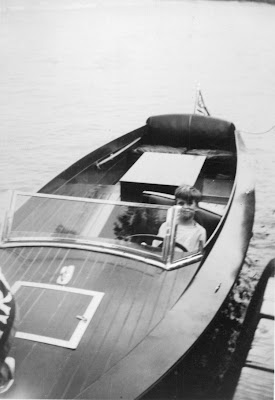
One of Admiral Webb C. Hayes' sons off Lake Erie's Mouse Island in a Dart Boat, ca. 1929
(Hayes Family Album)

To fill their back orders and meet growing demand, Hayes and his partners planned a 24-hour work schedule that would allow the company to manufacture three boats per day. The company offered four models – an 18 ½-foot; 22 ½-foot; 26-foot and 30-foot, ranging in price from $1,500 to $5,000. There were three-cockpit, split-cockpit, open and sedan models to choose from. The queen of the fleet was the 30-foot Gold Dart with its 125 horsepower Chrysler Imperial engine.

But just as rapidly as sales soared, they quickly nosedived. The Great Depression devastated the company. Hayes tried to forestall liquidation, but by late1933 the Dart Boat Company faded into history. Today, it is estimated that only 30 to 40 of the sleek, graceful Dart runabouts survive.

Play the video and watch Admiral Webb C. Hayes and Hayes Family members in a Dart Boat on the Maumee River at Toledo, Ohio and on Lake Erie at Put-in-Bay and Middle Bass Island. The video is a segment of a film made by the family of Admiral Webb C. Hayes. The film is part of the Hayes Family Collection at the Rutherford B. Hayes Presidential Center


This article first appeared in Lifestyles2000.

Monday, December 22, 2008

The "S. O. S." or Charles B. Stilwell's Self Opening Sack

“Would you like paper or plastic?” We’ve all been asked that question many times (although much less frequently of late). For more than a hundred years, our choice for hauling groceries was the durable, inexpensive brown paper bag. Once we’d unloaded our purchases, we found all sorts of second and third uses for that square-bottomed sack. From trash to lunches, schoolbooks, or clothes for an overnight stay, the versatile brown paper bag did it all – and we never gave it much thought. But one man did - Charles B. Stilwell, the son of one of Sandusky County’s most prominent pioneer physicians.

Born in 1845, Stilwell grew up in Fremont. At the age of 17, he defied his parents’ wishes and went off to fight for the Union in the Civil War. At war’s end, he studied mechanical engineering, eventually settling in Watertown, New York where he worked for a paper manufacturer. It was in Watertown that Stilwell began thinking about improvements to the conventional paper bag – an odd-shaped tubular affair that had to be pasted together by hand. Its V-shaped bottom made it inconvenient for packing; clerks found it difficult to stack and store.

In 1883, Stilwell was awarded a patent for his invention – a machine that produced a square, flat-bottomed paper bag with pleated sides. He dubbed it the “S.O.S.” or Self-Opening Sack. It quickly became a favorite of grocers, who discovered that with a flick of the wrist, the “S.O.S.” popped open and stood alone on the counter while they packed in more items than they ever thought possible. Collapsible, the “S.O.S.” could be stacked and conveniently stored. Customers liked it too. One man thought it was the “greatest invention of all time!”

The following year, Stilwell moved to Philadelphia where he married and raised a family. Working for the Union Paper Bag Machine Company, he continued to improve his invention, while securing patents for another machine, one that printed on oil cloth, and a map for charting the course of the stars.

Charles Stilwell’s “S.O.S.” revolutionized the paper bag industry, but it really came into its own in the 1930s when freezers, refrigerators, supermarkets, and cars emerged as part of the American lifestyle. It was then that families began shopping and transporting in a single trip, enough food for an entire week. The “S.O.S.” became a staple of the industry and proved indispensable to shoppers, who found a million and one uses for the brown paper bag once they’d unloaded the groceries.

Stilwell’s invention did not bring him wealth, but it did provide him with a comfortable lifestyle – one that allowed him to travel to England and indulge his passion for William Shakespeare. He died in Wayne, Pennsylvania in 1919. In accordance with his wishes, his ashes were interred at Oakwood Cemetery in his boyhood home of Fremont.

Nettie Cronise Lutes: Ohio’s First Woman Lawyer


On that spring morning in 1873, Nettie Cronise appeared poised and confident as she stood before three judges of the Ohio Common Pleas Court. Beneath the calm exterior was a nervous, apprehensive young woman. The judges’ decision would shape not only her future, but also that of hundreds of other Ohio women in the years ahead. Despite her fears, Nettie was ready to present her qualifications for admission to the Ohio Bar Association.

With her she carried recommendations from four of Seneca County’s most prominent attorneys. They had offered to present the application on her behalf. Her colleagues knew that most judges opposed the idea of women lawyers. Indeed, at the very moment Ohio legislators were launching a successful campaign against all women seeking the right to vote.

While grateful to her colleagues for their offer, Nettie chose to confront the challenge personally. To her great joy and relief, the panel granted her a license. Nettie Cronise became the first woman in Ohio to practice law! Six months later, her younger sister Florence would follow in her footsteps.

Born in Republic, Ohio, in 1843, Nettie was the daughter of Dr. Jacob and Katharine Staub. While she was still a child, her parents divorced. Nettie and Florence moved with their mother to the home of their grandfather Judge Henry Cronise. Nettie attended school in Tiffin and studied at Heidelberg College and the State Normal School in Bloomington, Illinois. Nettie taught for a short time in Illinois, but returned to Tiffin to read law at the firm of Warren P. Noble.

After Florence’s admission to the bar, the Cronise sisters opened their own practice in Tiffin. A year later, Nettie married fellow attorney Nelson Lutes. When Nelson began to lose his hearing, Nettie dissolved her partnership with her sister and joined her husband’s firm. Through extraordinary teamwork, they developed a thriving corporate law practice in federal and district courts throughout Ohio, Indiana, and Michigan.

Nelson’s deafness demanded the couple have an especially thorough knowledge of their briefs, the evidence, and their opponent’s trial strategy. In the courtroom, Nettie silently repeated testimony to Nelson, enabling him to deliver opening and closing arguments and examine witnesses. Their skill and preparation made them a formidable team. Few courtroom observers ever realized that Nelson was totally deaf. The “Lutes Combination,” as they were known in legal circles, continued their highly successful practice until Nelson’s death in 1900.

Nettie Cronise Lutes’ remarkable accomplishments have not been forgotten. In recognition of her groundbreaking efforts, the women of the Ohio Bar Association present an award each year in her honor. The Nettie Cronise Lutes Award is presented to a woman lawyer who has “improved the legal profession through her own high level of professionalism and a commitment to opening doors for girls and women.”

E. W. Scripps: Hermit of the Seas


The Detroit
Built by the Matthews Boat Company


Beginning as a copy boy at the “Detroit News,” E. W. Scripps rose to prominence as one of America’s great newspaper publishers. He founded the Scripps-Howard news syndicate, and established the United Press International, better known today as the UPI. The multi-talented publisher was also the founder and engine designer of the Scripps Marine Motor Company. Scripps served as the commodore of the Detroit Yacht Club and built “Miramar,” his enormous retirement home near San Diego.

Despite his successes, Scripps remained an eccentric, reclusive individual, who was most comfortable sailing the world aboard his yachts, the “Kenah” and the “Ohio.” He often referred to himself as the “hermit of the seas.” In 1912, Scripps found a way to thrill readers of his dozens of newspapers and promote his gasoline marine engine while spending time on the high seas.

Scripps would demonstrate the reliability of his company’s marine engine by using it to power the smallest boat to ever cross the Atlantic Ocean. He contacted the Matthews Boat Company of Port Clinton to design a vessel capable of such a voyage. Known around the world for quality construction, Scott Matthews took on the challenge. “The Rudder” magazine called the finished product a “trans-Atlantic liner,” but others called it an “oversized lifeboat.” Indeed, the 35-foot vessel was a double-ender that was heavily built - much like a lifeboat. Scripps christened her the “Detroit.” She was driven by one of his company’s 16-horsepower, two-cylinder model engines that could move the boat at 5 to 6 knots.

Five stainless steel fuel tanks, holding 1,000 gallons of gasoline, were fastened under the deck midship. Another 1,275 gallons was stored on deck. (No doubt the necessity of a smoking ban posed a problem for Scripps, who was known to smoke up to fifty cigars a day.) The “Detroit” also carried engine oil, 200 gallons of water, food for ninety days, and sails and a mast in case of engine failure..

Captained by Thomas F. Day, editor of “The Rudder,” she began her voyage from Detroit on July 12th. Scripps and two others rounded out the crew. The boat passed through Lake Erie, the Erie Canal, the Hudson River and Long Island Sound. On July 16th, the “Detroit” set out on her 4,000-mile transatlantic journey from New Rochelle, New York. Other than engine inspections that took place every few days and a single incident of water in the fuel, the engine ran continuously. Twenty-one days later the “Detroit” arrived in Cobh, Ireland – the smallest boat with a gasoline-powered engine to cross the Atlantic. After a few weeks rest and re-fitting, Scripps decided to head to Europe. From there, the “Detroit” journeyed to St. Petersburg, Russia, making port on Sept. 13th.

Scripps lived another 14 years after the “Detroit’s” transatlantic voyage. Much of that time was spent roaming the world aboard his yachts. He died off the coast of Liberia in 1926 at the age of 72. He was buried at sea.