Thursday, January 28, 2021

Emma Foote's Days at the Hayes White House


Emma Foote Glenn
Rutherford B. Hayes Presidential Library and Museums


During the Hayes Administration, it was not customary to hire a staff to assist the First Lady.  Without grown daughters, Lucy Hayes invited nieces, cousins, and daughters of friends to stay at the White House to help with social events and secretarial duties. One of these was Miss Emma Foote of Cincinnati, Ohio.  Lucy had known Emma since her husband's years as Ohio's governor.  

Emma was the daughter of Jane Foote who had come from New York to Champaign County and then to Cincinnati.  A widow, Jane and her daughter Emma lived in the Carlisle House owned by her brother-in-law George Carlisle, a wealthy Cincinnati banker. Hayes had also rented rooms for the family at the Carlisle in 1872.

When Hayes became president, Lucy immediately asked Emma to join them in Washington.  Of course, Emma was thrilled. Her letters to the Carlisles give a glimpse of life at the Hayes White House.  She not only assisted Lucy for more than a year, but also traveled with the Hayes family, attended social events and state dinners, including that given for the Grand Dukes Alexis and Constantine of Russia.  
(Emma's letter to her cousin about this event has been transcribed below.}

She and Winnie Monroe attended the theater accompanied by General William T. Sherman. She enjoyed elegant luncheons given but Kate Chase Sprague. Emma shopped in New York for Lucy, delivered flowers to disabled veterans, wrote letters, and accompanied the First Lady to charity events.  Emma traveled with the Hayes family to New York and throughout New England. She was pleased when Lucy gave her a "special room" at the Soldiers' Home where the Hayes family stayed during the hot summer months.  

Although not wealthy, Emma received an excellent education. She was deeply interested in politics and appreciative of the opportunity to know some of the nation's most prominent men and women.  Her nearly year-long stay led many to believe she was part of the Hayes family.

But, indeed, Emma was not a relative. In the spring of 1878, Webb, President Hayes' second son and secretary to his father, proposed to Emma. However, Emma was not interested.  It was then that she knew it was time to leave. 

She joined her cousin Florence Murdoch in New Jersey.  Later, she met Colonel George Glenn.  In the winter of 1880, Lucy and the President attended her wedding at the Carlisle House. From then on, Emma led a vastly different life. As an officer's wife, it was a harsh existence at forts on the western frontier and in Arizona.  Always cheerful and blessed with a buoyant personality,  Emma viewed her experience as a great adventure. When Colonel Glenn died of malaria contracted in Cuba during the Spanish American War, Emma returned to Cincinnati where she lived out the final days of a full and exciting life.


Emma Foote Glenn
Rutherford B. Hayes Presidential Library and Museums

Executive Mansion,   Washington                                                                  
                        Saturday April 21, 1877

My dear Florence,

I will send this letter to Orange [New Jersey] first so I will not have to write the same thing twice.  Thursday was the grand dinner. It was raining dreadfully, but everyone attended. Promptly at quarter of seven we all went down stairs to see the handsome table, then to the blue room. In a few moments members of the Cabinet and wives arrived.  Lady and Sir Edward Thornton, then the Grand Duke and party. he was dressed in a plain evening dress.  It was a little stiff before we went out to dinner.  Soon dinner was announced.  Right off the grand Marine band commenced to play the Russian March.  Stringed instruments, fifty of them, played all through the dinner.  They were so far off the music was not deafening.  Mrs. Hayes looked like a Queen as she sat between the Grand Duke and Constantine.  I went out with Gen. Schurz, Sec. of the Interior.  Sec. of War on my right.  The grandest sight I ever expect to see as I looked up and down the table.  It was not till after dinner that we were presented to his Royal Highness.  I had quite a long talk with him. I was not at all nervous or excited at dinner.

Nothing can ever compare with my feelings like the first dinner I took in the White House.  Then I was a bundle of nerves, could not eat much less speak, the other eve.  I send you a paper.  I can't believe I had shaken hands with his Royal Highness.  He is very sensible, not at all airy to use such an expression.  We were all sorry to have them say good night.    /signed/ Emma [Foote]


Colonel George Evan Glenn

Rutherford B. Hayes Presidential Library and Museums


Thursday, January 14, 2021

A Reflection of Family Love: The Diary of Belinda Elliot McLellan


Belinda Elliot McLellan

           Rutherford B. Hayes Library & Museums

Far from home, Mary McLellan Fitch, once again, opened her mother's diary, given to her some years before her mother's death in 1873.  Mary and her husband the Reverend George Fitch had left Fremont, Ohio, to travel to Shanghai, China, as missionaries only a year after their marriage.  Mary's mother, Belinda Elliot McLellan, a first cousin of President Hayes, had nearly destroyed the diary she had kept for 20 years, believing it to be of little value. Instead, she gave the diary to Mary, who found, again and again, comfort in her mother's poems, prose, and prayers.  

Belinda Eliot had married Robert Bolton McLellan in Vermont. She recorded in her diary how the couple had come to Fremont, Ohio. Belinda and her husband, then suffering from depression and physically unwell, had accepted the invitation of her half brother, John R. Pease, to begin a new life in Ohio.  She recorded in 1852 on that "first Thanksgiving in Ohio, we have now been here nearly five months,  all the time living with brother John's family, who has made us very welcome and happy here. Still we have had the feeling of strangers in a strange land! But Fremont now begins to seem like home in many respects."


John R. Pease

Rutherford B. Hayes Library & Museums

Deeply religious and continuously concerned for the Christian upbringing of her daughters, Belinda depended on  Fremont's Presbyterian Church and its minister Reverend Bushnell to deepen her faith.  But is was John Pease, who helped his much-loved younger half-sister adapt to life in Ohio.  


First Presbyterian Church, Fremont, Ohio

Courtesy of First Presbyterian Church


He advised her husband in business prospects, gave Belinda a piano, money, presents, a lot and two others for her daughters. His daily visits to the McLellan home on his way downtown to his hardware store brought much good cheer and laughter to the household. 


John R. Pease, Oakwood Cemetery, Fremont, Ohio
Courtesy Find a Grave

On January 3rd, 1860, Belinda was at John's bedside when he died after severe suffering from tuberculosis.  She described in detail how much she loved him.  His help had even made it possible for her daughters to attend the Lake Erie Female Seminary in Painesville, Ohio.  And, they did not disappoint. Mary and her sister Jennie graduated at the head of their class.  They went on to serve as teachers.  Later Mary and Jennie married the Fitch brothers.  

Mary McLellan Fitch
Died in Shanghai, China 1918
Courtesy of Find a Grave

When Belinda died, President Hayes wrote in his diary that his cousin "was possessed of talents of a high order, excellent education, and a temper and disposition almost perfect.  In the small circle of her intimate friends she was dearly loved.  A poet of some excellence and a superior prose writer - she was religious - her piety a reality"  Mary, in a notation in Belinda's diary, paid to her mother the highest of tributes, "May Christ make me like her insomuch as she was like Him."  Today, Belinda's diary is part of the Hayes Manuscript Collection.
 

Friday, January 8, 2021

The Fisk Jubilee Singers


Courtesy Harper's Weekly

On May 23rd 1882, President Rutherford B. Hayes wrote in his diary that the Fisk Jubilee Singers had stayed at Spiegel Grove for two days, following their "successful concert." Hayes was not the first president for whom the Jubilee Singers had performed. Touring the world for more than a decade, the group had sung for other presidents as well as for queens, ministers, prisoners, patients, and for thousands of concert goers.  

They were students at Nashville's Fisk University  The American Missionary Association founded the school in 1866 on the grounds of an old hospital used by Union troops during the Civil War.  The goal was to educate former slaves and other young African Americans..  Five years later, Fisk was functioning but teetering on the edge of bankruptcy. Its treasurer and music director George White scraped together what funds he could to take some of his best singers on tour for a fundraising effort for Fisk.  

The American Missionary Association was opposed.  Concerned about its reputation, the AMA viewed the singers as Fisk's ambassadors for its educational mission.  Eventually, the organization relented, but demanded that performances, demeanor, and dress must be impeccable.  This was not lost on President Hayes years later who wrote that "Miss [Mattie] Lawrence ladylike and intelligent and even more so Miss [Ella] Sheppard."

On October 6, 1871, White took his singers to Cincinnati, then Columbus, and on to Oberlin, following the old path of the Underground Railroad.  The acapella ensemble, some of them teens and all but two born into slavery, had shared their "slave songs" with White.  Soprano, arranger, and Fisk's first black instructor Ella Sheppard wrote, "At first the slave songs were never sung in public, they were sacred to our parents." White deeply valued their songs and asked his singers to teach him the songs of their parents.  He called the group the Jubilee Singers, referring to the Old Testament's Jewish year of Jubilee.

As they toured New York and New England's churches and concert halls, their largely white audiences grew to appreciate the sacred songs that the group first performed only as encores. After touring for eight months, the Jubilee Singers returned to Fisk, having raised $40,000.

The following year, the Singers continued to hold performances in the U.S. and then spent nearly a year touring England. In 1875, the Jubilee Singers embarked on a three-year European tour.  But non-stop travel, discrimination, poor accommodations, exhaustion, illness, grueling practices, and discord took its toll among the members.

Forced to re-organize in 1879, the Jubilee Singers set out once again under the direction of White and singer Frederick Loudin. During the 1880s, they performed in Australia, Asia, New Zealand, and throughout the American West. The Singers raised $150,000 for Fisk University and its Jubilee Hall. 

The Jubilee Singers have continued to sing to this day, receiving awards and accolades from around the world.  In 2008, President George-W-Bush presented the Singers with the National Medal of the Arts. They are recognized for preserving the musical tradition known today as Negro Spirituals. You can listen to their songs at fiskjubileesingers.org. 


Wednesday, May 27, 2020

Jim Thorpe: America's Greatest Athlete of the First Half of the 20th Century


Jim Thorpe (center)  Clarence Childs (right)
Indiana University 1913/1914 season
James B. Childs Family Collection
Rutherford B. Hayes Presidential Library and Museums

 Jim Thorpe was born May 28, 1888 near Prague in Indian Territory (present day Oklahoma). He was the great great grandson of Chief Black Hawk.  In 1950, sports writers and broadcasters voted him the greatest football player and the greatest American athlete of the first half of the 20th century. 

He attended Haskell Institute in Lawrence, Kansas and the Carlisle Indian Industrial School in Pennsylvania. Carlisle, was founded during the Hayes administration as the first off -reservation school for Native Americans. 

In 1911, he was voted first-string All American.  Thorpe played football, baseball, basketball, and trained for the 1912 Olympics in track. Thorpe won the gold medal for both the decathlon and the pentathlon at the Stockholm Olympics. (He was later stripped of these medals when it was revealed he had played  semi-professional baseball in 1909. They were not re-instated until after his death)  

Clarence Childs (left) Jim Thorpe (second left)
Indiana University 1913/1914
James B. Childs Collection
Rutherford B. Hayes Presidential Library and Museums


While training for the Olympics, Thorpe met Clarence Childs of Fremont, Ohio. Childs, a superb athlete in his own right, won the bronze medal in the hammer throw, missing the silver by less than an inch. After touring the U. S. and Europe with the Olympic team, Childs returned to Fremont and married Zella Sherard. He coached at Wooster College and then Indiana University. His assistant at Indiana was his Olympic team mate, the legendary Jim Thorpe. 

According to the Library of Congress, Thorpe played baseball and football professionally from 1913 to 1929. He was the first president of the new American Professional Football Association that later became the NFL.  He played football professionally until the age of forty-one. For two of those years he coached and played for the Oorang Indians, an all Native American franchise of LaRue, Ohio.

***************

Note:  To learn more about the extraordinary life of soldier, athlete,  Clarence Childs, read his diary or follow this link to the collection held by the Rutherford B. Hayes Presidential Library and Museums or read about him on Paper Trail


Monday, May 18, 2020

William Feaga of the 72nd Ohio at the Running of the Vicksburg Batteries

Union Soldiers at Vicksburg by Kurtz and Allison

On April 16, 1863, a joint army/naval operation was commanded by General Ulysses S. Grant and Admiral David Porter.  Porter succeeded in making the daring run of eleven vessels: steamers, rams, and gunboats passed the Rebel batteries at Vicksburg, giving Grant the naval power to bring his troops across the Mississippi River which he accomplished on April 29th.  

William Feaga, 72nd Ohio Volunteer Infantry
Jacob S. Holtz Collection, Hayes Presidential Libraryand Museums

Few Union soldiers ever forgot the sights and sounds of that daring run of Union vessels past the Vicksburg batteries on that night. The next day William Feaga of the 72nd Ohio Volunteer Infantry wrote the following home to his family in Seneca County, Ohio

Jake had ought to been here last night we had a lively time of it from half past 11 until half past one some of our boats ran passed Vicksburg there was 5 Gun boats, 3 rams one Tug and 3 transports started they went through safe but one Transport got burned the Henry Clay and th Forest Queen was damaged some. One shot went in a porthole of one of the Gun boats and killed one man and wounded two more this is the total of our loss I believe as near as I can find out after the boats got through they drove the rebels out of Warrenton a place below Vicksburg oposite the mouth of the Canal you se on this piece of map I send you now this Dr. Caul brought up for he was down there all night they have been firing all day and while I write we can hear heavy guns one of our boys just came from down there so close that he could se the rebels fire on our gun boats today of all the thunder and lightning I ever heard in my life it would not equal last night so we could se the flash of the gun then hear the report. Which was so terable that the Earth appeard all in a quiver it is only about 6 miles straight through to Vicksburg.

To read more of William Feaga's war correspondence and other letters in the Holtz collection, follow this link.

Panoramic View of Vicksburg and Map of Canal, Fortification, and Vicinity, 1863
Courtesy of the Library of Congress
Note: The Above Map is from the Library of Congress Map Division and can be viewed in a larger format by following this link


In his memoirs, General Grant described the event: The enemy were evidently expecting our fleet, for they were ready to light up the river by means of bonfires on the east side and by firing houses on the point of land opposite the city on the Louisiana side. The sight was magnificent, but terrible. I witnessed it from the deck of a river transport, run out into the middle of the river and as low down as it was prudent to go. My mind was much relieved when I learned that no one on the transports had been killed, and but few, if any, wounded.  

To read the Personal Memoirs of U. S. Grant, follow this link


Sunday, May 10, 2020

"Real Photos" Tell the Real Story


Everyone collects something. Down through the decades, millions have collected those fascinating images of America printed in a 3 x 5 format - known to all of us as picture postcards.  It began in 1901 when the U. S. Post Office allowed companies to print pictures on small postcard stock. A caption was sometimes written on the negative which was often glass. They could be mailed for a penny. 


An Ernst Niebergall real photo postcard of the ferry Welcome tied up at Lake Erie's Kelleys Island
Lake Erie's Yesterdays features more than a thousand of his photographs 


Originally the sender could add only his or her address.  But in 1907, all that changed.  Space was created on the back so people could write a short message.  What began as a mere fad became an absolute craze. At the height of the golden age of postcards, Americans were sending nearly a billion a year!  

Why, one asks, did these little pictures become such a mania?  For the first time, average Americans could see how the other half lived. They could see views of cities they never would visit, mountains they never would climb, bridges they would never cross, and technology they never would use. 


Bridge over Ohio River at Marietta, Ohio
Library of Congress

To satisfy what seemed to be an insatiable appetite for "view" cards, companies hired armies of anonymous photographers. They fanned out across the country, snapping black and white photos of anything and everything. From trains, planes, churches, bridges, courthouses, businesses to families, farms, houses, dogs, horses, disasters, - nothing was too insignificant, too strange, or too plain.


Cityscape of Findlay, Ohio
Library of Congress

Walker Evans, renowned photographer, photojournalist, and avid postcard collector, once said, "The picture postcard is a folk document - these honest and direct little pictures." And, how right he was! When we look at them today we see factories belching smoke with proud workers standing front and center; clogged streets, fires, and disasters. They were simple, straightforward, and often ugly. 

On the way to the Fire
Library of Congress

But  as Evans declared, there is no doubt that this is exactly what our towns, cities, homes, streets, buildings, and families looked like during the early years of the 20th century. It was an expression of their world - and they were proud of it.


Perhaps most interesting are the one-of-a-kind pictures created by amateur and professional photographers. In 1903, Eastman Kodak invented a simple, affordable pocket camera and photographic printing paper which made it possible for nearly anyone to develop photographs. There was also a Kodak postcard camera. Film could be sent away and printed on special postcard paper.  Even today in the 21st century, these "real photo" postcards are rare and in demand by collectors and publishers of the ever-popular "then and now" books. 


Eastman Kodak Postcard Camera

Those long ago pictures of tree lined streets, county courthouses, and ballparks fascinate even those who claim to have little or no interest in history. The photo postcards of schoolchildren posing before their one-room schoolhouses often evoke a poignant charm -.their brave little faces, earnest expressions, slicked-down hair, an occasional tie, a worn dress, and sometimes bare feet. 

Graytown School, Ottawa County, Ohio 
Private Collection


Note: More than a thousand images by Sandusky, Ohio photographer
Ernst Niebergall appear on Lake Erie's Yesterdays. He sold many of his images as postcards at Cedar Point and around Erie and Ottawa Counties. 


In 2018, the Firelands Postcard Club produced the award-winning book of Nierbergall's postcard images titled "Sandusky's Photographer: The Real Photo Postcards of Ernst Niebergall."

Sunday, May 3, 2020

The Lorain-Sandusky Tornado of 1924: Ohio's Deadliest

Sandusky Standpipe Crushed by Tornado
Courtesy of Sandusky Library


On a warm Saturday afternoon in late June 1924, a light rain began falling. Blue-black clouds gathered over Lake Erie's Sandusky Bay. The winds, coming from the southeast, suddenly swung to the northwest and increased rapidly to gale force. Sandusky's 23,000 residents had no idea that within minutes they would be engulfed by Ohio's deadliest tornado.  

Sandusky Yacht Club. ca. 1910
Following the tornado, no part of the yacht club was ever found
Rutherford B . Hayes Library and Museums


Located on the eastern edge of what has come to be known as "tornado alley," Ohio experiences an average 16 tornadoes each year. While tornadoes can occur in any month and at any time of the day or night, the peak season runs from April through July, with the bulk of twisters hitting between 2 P.M. and 10 P.M.


Tornado Alley
Tornadochaser.com

By this definition, the tornado that touched down at the northern edge of Sandusky on the afternoon of June 28, 1924 fit the classic mold. While it was neither the largest nor the strongest tornado to hit Ohio, it was the deadliest. What set this one apart from the others? It was the twister's destructive path through populated areas.
                                                             
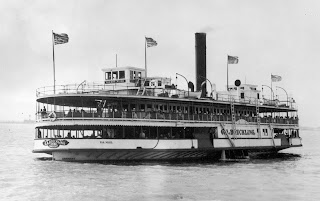
Boeckling
Lake Erie's Yesterdays
At the Cedar Point dock, 1,200 passengers aboard the "Boeckling" looked on in horror as the twister tore apart the waterfront.
                                                

                                                Cedar Point
            Lake Erie's Yesterdays 

 Nine city blocks bounded by Adams Street, Market Streets, and Washington Park were damaged. By the time the tornado headed out into Lake Erie, it had killed eight Sanduskians and destroyed more than 100 homes and 25 businesses in the city. 


Tornado's Path
Courtesy of Cleveland Memory
                                               
The deadly funnel then came down at Cedar Point. Shortly after 5 P.M., it roared ashore at Lorain's Lakeview Park ripping a three-mile path of death and destruction through the city's downtown.  The grim tally in Lorain was 72 people killed, 500 homes destroyed, and another 1,000 damaged. Fifteen bodies were found among the wreckage of the State Theater and another eight were discovered in the collapsed Bath House.  Cars were blown into Lake Erie and nearly every downtown business sustained damage.  The freighter "Henry Ford II," under construction at the American Shipbuilding yards, broke its moorings and rammed a bridge on the Black River pushing it four feet off its foundation. 

The National Guard, Salvation Army, Red Cross, and search and rescue teams made up of ordinary citizens worked through the night to locate the missing and injured. Doctors and nurses came from Clevcland, Ohio to treat the injured. But it would be weeks and weeks before life in the two cities returned to anything that resembled a normal existence. 

No one knows the exact number of human lives lost that deadly day in 1924, but 85 has become the accepted figure. The so-called "Lorain-Sandusky Tornado" ranks 22nd on the nation's list of the 25 deadliest tornadoes. It remains the only Ohio tornado to make that infamous list.  

Less than a year later, the Midwest would experience the nation's deadliest twister.  The "Tri-State Tornado" took the lives of 695 people along a 220-mile track through Missouri, Indiana, and Illinois.  Since then education, better forecasting, communication and construction techniques all have helped lessen the deadly impact of a tornado. However, tornadoes continue to be nature's deadliest phenomenon.

____________________________________________

Note: See the excellent  "Sandusky History" blog for more details and photos.