Monday, February 18, 2013

War of 1812 on the Ohio Frontier

Visitors examine portraits of some of the key players in the War of 1812.On June 18, 1812, President James Madison declared war on Great Britain over the forced service of Americans in the British Royal Navy, trade restrictions, and increasing British influence among Native Americans. The year 2013 marks the bicentennial of the major events of the war on the ‘Ohio Frontier’ - a region bordering Lake Erie that included areas of Ohio, Michigan, and Canada. A 1:64-scale model of the brig 'Niagara' is on display.During the War of 1812, the Ohio Frontier played a pivotal role as the Army of the Northwest struggled against Great Britain for control of the Great Lakes. Through the holdings of the Hayes Presidential Center and the Lou Schultz Collection, the War of 1812 on the Ohio Frontier explores America’s early defeats and its eventual victories at Fort Meigs, Fort Stephenson, on Lake Erie, and at the Thames – successes that inspired a sense of pride throughout the young nation. This exhibit is made possible through sponsorship from the Sidney Frohman Foundation .

Tuesday, February 12, 2013

Carl Ohlemacher and the 14th U. S. Infantry


Private Carl Ohlemacher (top row left)  
14th U. S. Infantry, Companies D and F
1899 - 1902
Mr. and Mrs. John Ohlemacher, Huron, Ohio, donated this print of Private Carl Ohlemacher and Companies F and D of the 14th U. S. Infantry, known as the Golden Dragons. Born in Sandusky, Ohio, Ohlemacher worked as a cooper. At the age of 18, he enlisted in the 14th U. S. Infantry for three years service. Later that same year, the 14th sailed for the Philippines, where they fought in the Philippine Insurrection. Ohlemacher particpated in the battles of Paramagne and Zapote.

In August of the following year, the 14th was deployed to China to put down the Boxer Rebellion. The unit was part of the United States' 2500-man force under the command of Major General Adna Chaffee, who had arrived only weeks earlier.

The China Relief Expedition was made up of a coalition of 19.000 American, Russian, Italian, French, Japanese, British, German, and Austrian soldiers. Their mission was to rescue United States citizens and foreign nationals held during the 
Boxer Rebellion. They moved toward Peking, fighting in the battles of Pie-tsang and Yang Tsun, where Ohlemacher's 14th served as the spearhead for the eventual victory. At Peking, the 14th scaled the Tartar Wall and placed the first foreign flag ever to fly over the wall. Their efforts made it possible for British regiments to reach and relieve the legation compound. In gratitude, the Chinese presented the 14th with a large amount of silver bullion.

Courtesy of U. S. Army Art Collection

Excerpt from Major General Adna Chaffee's report.....

I withdrew the troops from the legation and camped just outside near the Tartar wall for the night. My casualties during the day were 8 enlisted men wounded in the Fourteenth Infantry, 1 enlisted man wounded of Battery F, Fifth Artillery, and 1 officer and 2 enlisted men wounded of the marines.
Upon entering the legations the appearance of the people and their surroundings, buildings, walls, streets, alleys, entrances, etc., showed every evidence of a confining siege. Barricades were built everywhere and of every sort of material, native brick being largely used for their construction, topped with sandbags made from every conceivable sort of cloth, from sheets and pillowcases to dress materials and brocaded curtains.

Many of the legations were in ruins, and the English, Russian, and American, though standing and occupied, were filled with bullet holes from small arms, and often having larger apertures made by shell.
 

The children presented a pitiable sight, white and wan for lack of proper food, but the adults, as a rule, seemed cheerful and little the worse for their trying experience, except from anxiety and constant care. They were living on short rations, a portion of which consisted of a very small piece of horse or mule meat daily. The Christian Chinese were being fed upon whatever could be secured, and were often reduced to killing dogs for meat. All the surroundings indicated that the people had been closely besieged, confined to a small area without any comforts, no conveniences, and barely existing from day to day in hope of succor.
 
Ohlemacher was discharged at Fort Snelling, Minnesota in March 1902, the expiration of his term of service. He returned to Sandusky, where he married Mary Hengel and attended St. Mary's Church. The father of five children, Ohlemacher worked at the Farrel-Cheek Foundry. He passed away in Sandusky December 1935.


Friday, February 8, 2013

Punting, But Not Football

Vernon Zenser punting a hunter and his son at Magee Marsh, Benton Twp. Ottawa County, Ohio, ca. 1944
Courtesy of Sandra L. Zenser


Until much of Lake Erie's marshlands became federal and state property, local residents earned an income by transporting private hunt club members through the marshes. Thanks to lifelong Ottawa County resident Sandra L. Zenser for sharing the following story and picture of her father punting a hunter and his son at Magee Marsh.

Punting means something different than kicking a football through a set of goal posts. Punting dates back to England from about the mid to late 1800s when it referred to punting or poling of punt boats used for fowling and angling on England’s many shallow streams. In the marshes bordering Lake Erie, punt boats similar to those in England, were used to transport hunters down the shallow channels or cuts of the local marshes which were also called punting.

Local wooden punt boats had flat bottoms that drew only a few inches even when loaded. These punt boats were pointed at both the bow (front) and the stern (rear). Surprisingly, these boats were very stable and suitable for both passengers and cargo. They were steered manually by what was called a punter.

A punter was similar to a gondolier, a Venetian boatman who guides a gondola with an oar; except punters pole in much shallower water while standing stationary at the rear (stern) of the punt boat. Typically the pole or punt paddle had a cross piece at the top of a 8-10 foot long pole, used for setting the paddle end directly into the waterway’s bed to propel the boat forward.

Punt boats were used at local private hunt clubs, where at least one club member would be assigned to a boat usually with a guest or possibly another club member along with their shotguns and gear. In addition, the boat would be loaded with bulky decoys used to lure in flocks of ducks and sometimes a retriever dog or two. With all this, the punt boat was often quite weighted down with barely a few inches of free board above the water.

A much larger gas boat towed a string of punt boats down the marsh’s main channel before sunrise, sometimes breaking ice as they putted along. At appropriate intervals, each punt boat would be unhooked from the towline at which time the punter took over manually punting (poling) to the designated hunting area. The hunting area consisted of some open water where the decoys would be placed in front of a camouflaged blind that also had a shielded area alongside to conceal the punt boat. At the end of a day’s hunt, the punter manually poled the boat and its occupants back to the main club house, sometimes this was a great distance and in frigid temperatures.

Vernon Zenser (pictured) of Oak Harbor was a punter in the mid 1940s into the 1950s. He worked for several private hunt clubs until they became government owned as part of the Ottawa National Wildlife Refuge and the state’s Magee Marsh. As a punter, he remembers having to be at work at 6 a.m., which was well before sunrise and receiving fifty dollars a day no matter how many hours worked. Often the member’s guest would tip the punter ten or twenty dollars extra which was always appreciated.


Thursday, January 24, 2013

Sandusky's "Crystal Blue, Clear as Glass Ice"


Local Ice Dealers Loading Blocks Directly from the Ice Fields
Ernst Niebergall ca. 1911/1912
Charles E. Frohman Collection
Sandusky, Ohio, was the largest ice producer west of New York City during the latter half of the 19th century. Noted for its solid, "crystal blue, clear as glass" ice, the city became known as the "Ice Capital of the Great Lakes." Icemen eagerly watched the waters of Lake Erie until they froze to a depth of 8 to 16 inches. For as long as "good ice makin' weather" held, Sanduskians endured ten-hour days of harsh winds and frigid temperatures for a daily wage of $2.

In the picture above, taken during the winter of 1911 or 1912, many local dealers from Sandusky and neighboring towns filled their orders by loading their delivery wagons directly from the ice fields.

Sanduskians harvested 400,000 tons of ice each winter. The greater portion of the harvest was stored in some fifty sheds that dotted Lake Erie's shoreline. Sandusky provided most of Ohio's cities with ice, including 90 percent of the ice consumed by the city of Cleveland. According to the local paper, Sandusky's "crystal quality put the murky, sewer-tainted" Cleveland ice to shame. Most of the ice was shipped across the lake as needed from a string of icehouses located on Put-In-Bay's Peach Point.

Corporal Elton Mackin: World War I Marine

Corporal Elton Mackin
WWI Marine, 1918
Born in 1898 in Lewiston, New York, Elton Mackin enlisted in the United States Marine Corps in 1917. After training at Parris Island, South Carolina, Mackin was sent to Europe, where he served as a battalion runner for the 67th Company 1st Battalion, 5th Marine Regiment, United States Army Regulars. This highly decorated Marine fought in every Marine Brigade battle from Belleau Wood to the crossing of the Meuse on the eve of the Armistice. Mackin was awarded the United States Army Distinguished Service Cross, the Navy Cross, and two Army Silver Star citations. He was honorably discharged from the United States Marine Corps in May 1919.

Mackin moved to Norwalk, Ohio in 1935. He began writing a memoir of his WWI experience. Excerpts from his manuscript, "Flashes and Fragments," appeared in Leatherneck Magazine. Essays that appeared later in the American Heritage magazine caught the eye of Marine Corps historian George B. Clark. Believing that Mackin's memoir provided a unique viewpoint of the war - "an enlisted man's viewpoint" and that of a "young man who suffered." Clark sought out the Mackin family. Although Private Mackin had passed away in 1974, his son, Wallace Mackin, shared the memoir and the taped oral interviews. The oral account assisted Clark in developing annotations for the manuscript that was eventually published in 1993 as Suddenly We Didn't Want To Die: Memoirs of a World War I Marine. 

Elton Mackin’s oral interview was conducted by the late Carl D. Klopfenstein, Professor of History at Heidelberg College. The interview was conducted at Mackin’s home at 116 Milan Avenue, Norwalk, Ohio on June 29, 1973. Following the interview, a rough draft transcription was produced. Using the draft and the audiotapes that are part of the Elton Mackin Collection at the Hayes Presidential Center, the digitized transcription was created. It is available by following this link.  Due to the poor quality of the audiotapes,  errors exist.

A Game of Hockey on Sandusky Bay

Playing Hockey on Sandusky Bay
Ernst Niebergall ca. 1913
Charles E. Frohman Collection

Generations of Sanduskians have enjoyed the bay - summer and winter. This image produced from one of the late Ernst Niebergall's glass plate negatives shows Sanduskians of all ages skating and enjoying a game of hockey on the frozen bay.


Monday, December 24, 2012

Richard "Dick" Stotz: Marine Corps Combat Photographer at Iwo Jima


Richard Stotz with Roscoe, the Regimental Mascot


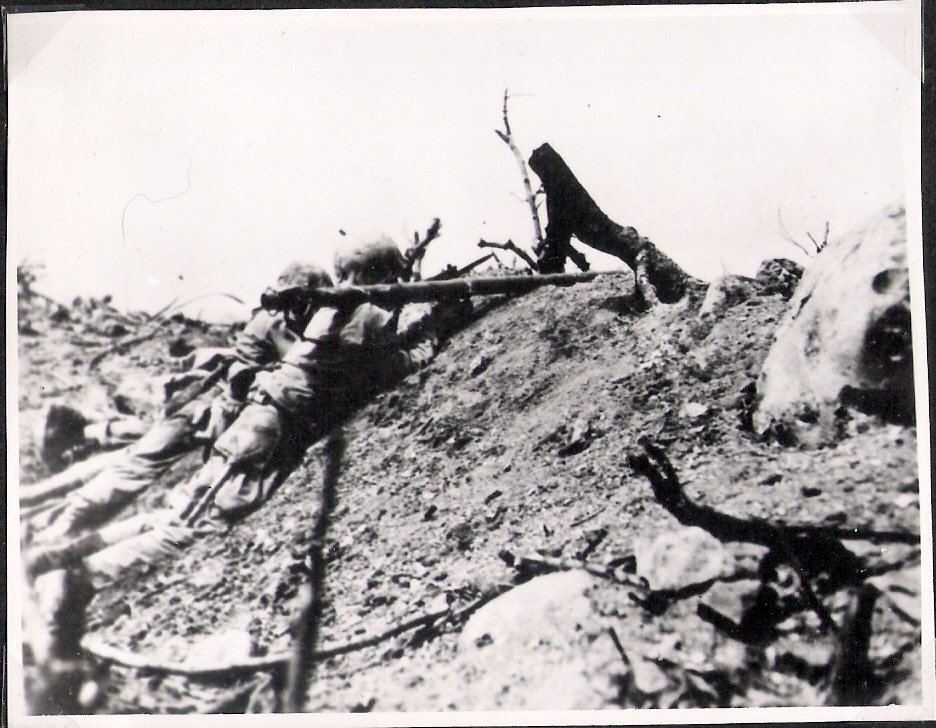
In Richard Stotz's last years, he gave a scrapbook of photographs to his nephew. They were taken during Stotz's time as combat photographer with the 28th Marine Corps during World War II. The photographs were taken by him and his fellow comrades during training at Camp Pendleton, in Hawaii, at the Battle of Iwo Jima, and during the occupation of Tokyo.

You can see a gallery of some of his photos on the Hayes Presidential Center website

We "pinned" some of Richard Stotz's photographs on Historypin, where you can see a slideshow .

In October, the Stotz Photographs were highlighted as the featured collection of the week on the Historypin blog.

Richard “Dick” H. Stotz was born on 18 March 1922 in Fremont, Ohio to Edward and Neva (Heinman) Stotz. Upon graduating from Fremont Ross High School in 1940, he owned and operated Abdoo Photography with his brother, Donald Stotz. On 14 December 1942 Dick enlisted in the United States Marine Corps and reported to boot camp at Camp Pendleton in San Diego, California.

After graduating from boot camp he was assigned to the base photograph section as a photographer, completing numerous aerial and reconnaissance training missions. In 1944 Dick was reassigned to the 5th Marine Division, 28th Regiment intelligence platoon as a motion and still photographer. Each division had 12 to 30 still photographers and cinematographers. Stotz and the other combat photographers were sent to 20th Century Fox Studios in Hollywood, California for additional training on still photography. After completing this training he rejoined his platoon, along with fellow photographer L.R. Burmeister and combat correspondents William Vessey and W. Keyes Beech.


Marines Carrying Their Wounded Comrade

In September 1944, the 28th Regiment left Camp Pendleton and sailed to the Hawaiian Islands for Camp Tarawa to join the 26th and 27th Regiments. Intense training, field maneuvers and mock landings took place until January 1945. While aboard the USS Dickens the regiments received a top secret operation called “Workman Island”, later to be known as Iwo Jima. On 19 February 1945the 28th Regiment arrived at the island of Iwo Jima and was part of the second assault wave to advance ashore, followed by three additional waves of troops.

Stotz’s primary duty was to capture the battle in photographs as it was taking place. The job of a combat photographer was made more dangerous because they were never heavily armed, usually carrying only a single weapon and their camera equipment. Photographs taken during a combat assault, like Iwo Jima, were rarely developed in the field. The photographers film was sent out by plane or naval ship to an alternate location to be developed. Most likely, photographers never saw the actual photographs. These photographs were be used for training purposes and to identify any mistakes that may have occurred.


Medic Treating Wounded Marine

Once on shore the Marines were immediately met with a heavy assault from the Japanese that included artillery and machine gunfire. Both the United States and Japan experienced heavy casualties during the initial invasion. Intelligence correspondent, Sgt. Bill Vessey, was killed on 20 February 1945, the second day of the battle. Sgt. L.R. Burmeister was wounded several days later. On 22 February 1945 the Marines gained control of Mount Suribachi and proceeded to take possession of both airfields on the island. Stotz was acquainted with fellow photographer, Joe Rosenthal, who took the iconic photograph of the flag raising atop Mt. Suribachi. The assault lasted 36 days, with the United States taking control of the island on 26 March 1945. The seizure of Iwo Jima allowed for sea and air blockades, andthe ability to conduct intensive air bombardment to destroy Japan’s air and naval capabilities. Although Iwo Jima was a key victory for the United States, the battle resulted in over 26,000 American casualties. Twenty-seven Medals of Honor were awarded to Marines and sailors, more than were awarded for any other single operation during the war.

To read more about the Marines on Iwo Jima, follow this link to Iwo  Jima: A Retrospective


Marines Dug In